
Buyer Guide
Can a Portable Power Station Run an Inflatable Race Arch? A Buyer’s Runtime Checklist
A portable power station may run an inflatable race arch only if its output, starting capability and usable energy suit the exact blower and all connected equipment. Battery capacity alone does not establish compatibility or runtime. Obtain the equipment data, have the event’s competent electrical lead review the configuration, and complete a supervised full-window test before relying on it.
By InflatCraft Product Team • Last updated
Why race directors ask about battery-powered arches
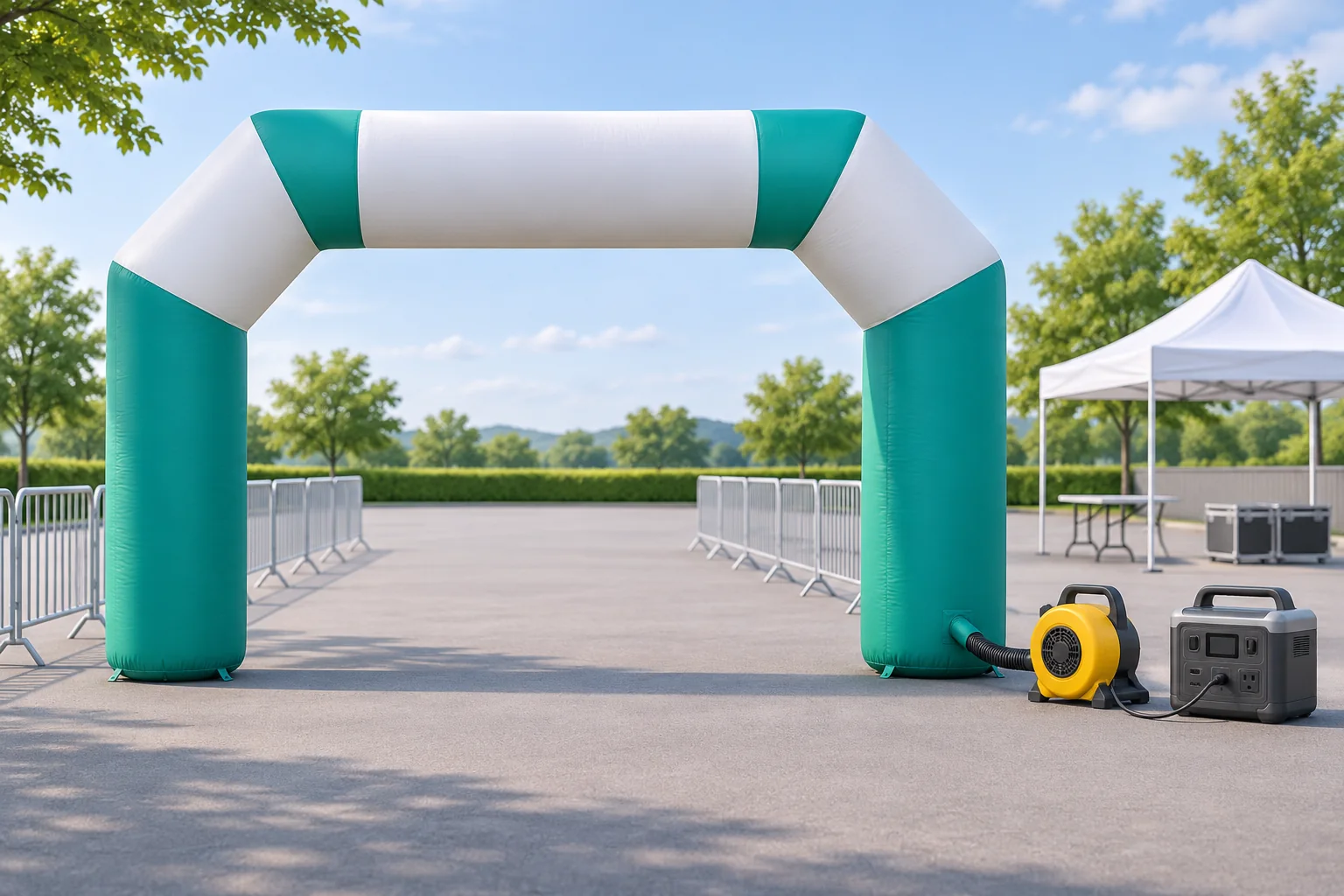
An off-grid start line can be far from a reliable outlet. A quiet supply also looks attractive beside a timing desk or commentary position. But the buying question is not simply whether a portable station can make a blower turn on. It is whether the approved equipment can keep the arch operating for the complete event window, with a practical reserve and a safe shutdown arrangement.
A July 2026 Agee Race Timing users discussion about battery packs asks about portable power lasting at least five hours and includes discussion of arch and timing loads. Race Directors HQ’s Going Solar interview also discusses event power planning. These are useful professional questions, not controlled tests of InflatCraft equipment or a reason to copy another organiser’s battery model.
This checklist focuses on stored-energy planning. Use the separate race arch site-approval guide for location, route clearance, timing integration and operational responsibilities. A battery does not remove anchoring, weather or venue requirements.
First identify continuous-air or sealed-air construction
A blower-supported arch needs the specified air system operating while the arch is in use. A portable battery is therefore an ongoing supply, not merely an inflation tool. Ask the arch supplier to identify the intended blower, operating arrangement and response to interrupted power.
A sealed-air product is a different configuration and may not need a continuously running blower. It can still have separate lighting or other electrical loads and requires its own pressure checks and operating instructions. Do not assume a quoted race arch is sealed because it is described as portable or easy to install.
The Showdown Displays arch instructions illustrate one manufacturer’s continuous-blower arrangement. They are model-specific instructions, not electrical ratings or approval for an InflatCraft configuration. Ask for the documents matching the arch you intend to buy.
Build an equipment schedule before comparing power stations
Record the exact blower model, rated supply voltage and frequency, input information, starting requirements and manufacturer instructions. Ask the power-station supplier to confirm compatibility with that motor load, including any waveform, surge-duration or operating restrictions. A shared plug shape is not a compatibility assessment.
| Equipment or condition | What the buyer should obtain | Who should confirm it |
|---|---|---|
| Arch and blower | Air-system type, exact model, supply requirements, running and starting information | Arch/blower supplier |
| Portable supply | Continuous output, starting capability, usable-energy evidence and relevant limits | Power-station supplier |
| Lighting and accessories | Actual input requirements and operating schedule | Equipment supplier |
| Timing, laptops and audio | Which devices need power and whether they share the supply | Timing contractor and event technical lead |
| Outdoor arrangement | Environmental suitability, cable routing and applicable protective measures | Competent electrical lead and venue |
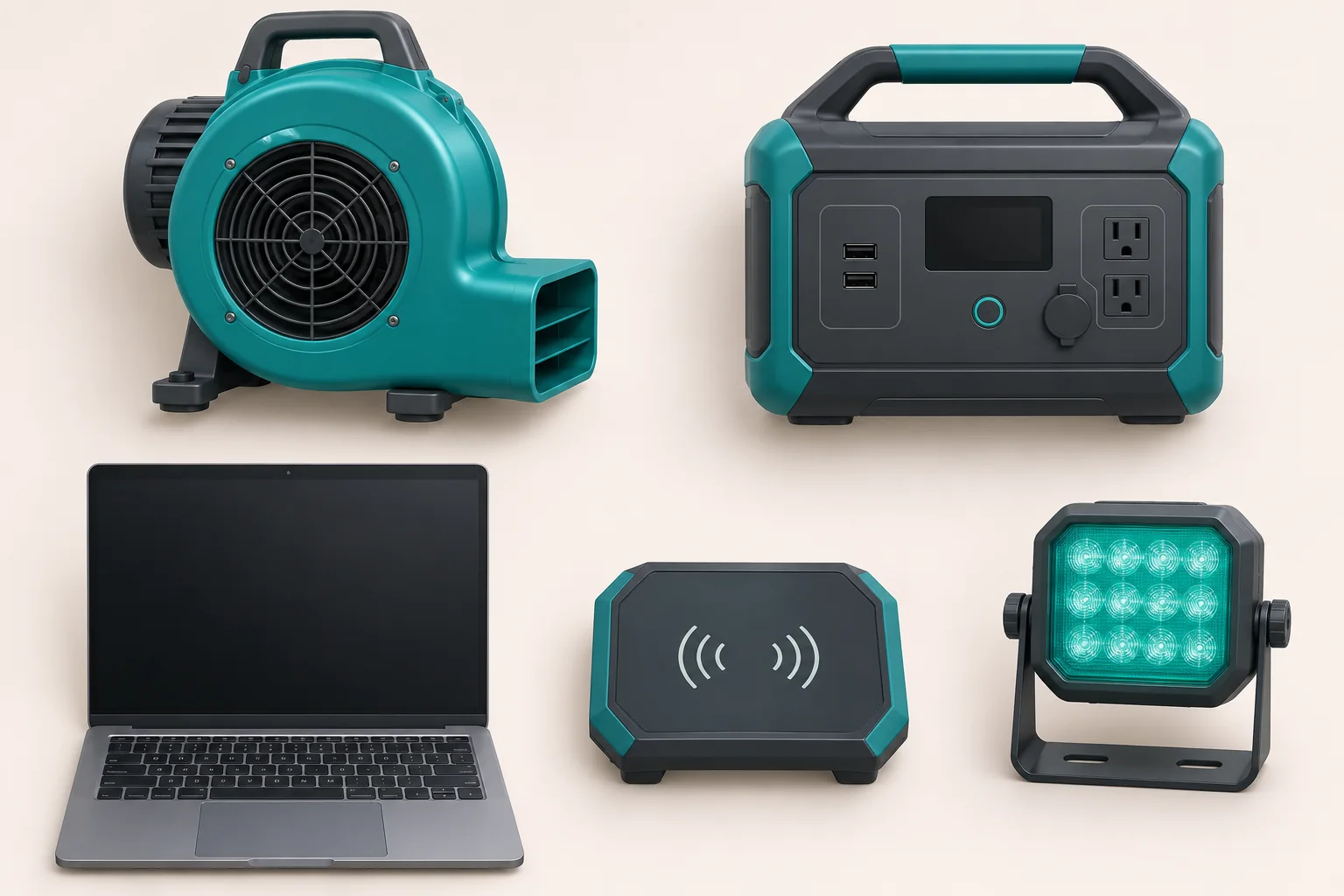
Review destination voltage, frequency and plug details through the blower specification checklist. Cable selection, protective devices and the distribution arrangement should be specified by a qualified person for the site and local rules. Do not modify mains connections, bypass protective devices or improvise adapters to make incompatible equipment fit.
Watts and watt-hours are different checks
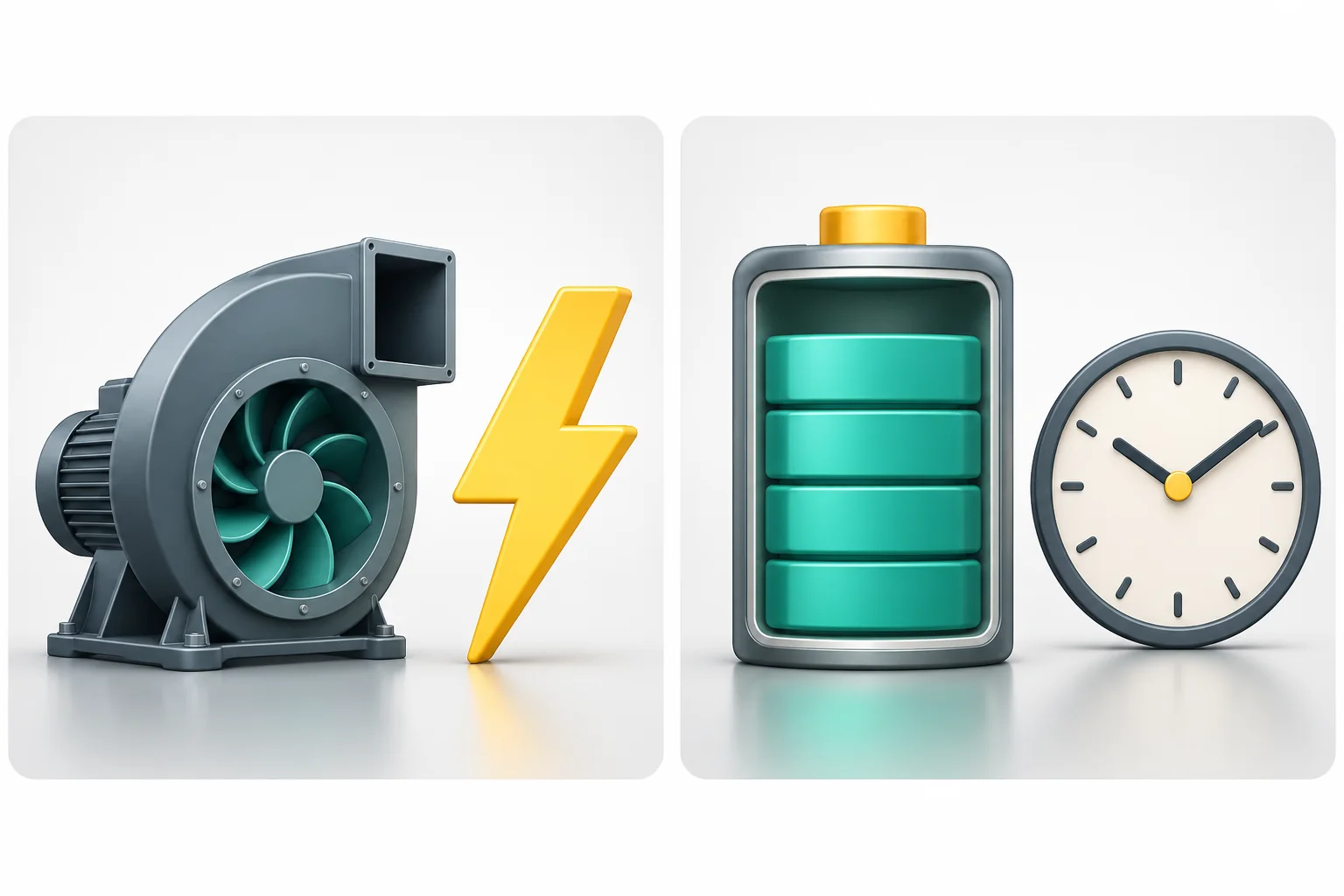
Watts (W) describe power: the rate at which the equipment uses energy at a particular operating condition. Watt-hours (Wh) describe energy over time. A power station can have a large advertised battery capacity yet still be unable to start a particular blower or support its continuous load. Passing the output check does not mean the battery lasts long enough.
For a steady, known load, a planning relationship is runtime in hours approximately equal to usable energy delivered at the relevant output in Wh divided by total average load in W. If you start with nominal battery capacity instead, conversion losses and the station’s own consumption must be accounted for. Do not subtract the same loss twice if the manufacturer already quotes usable AC-output energy.
Arithmetic example only, not an InflatCraft rating: 1,000 Wh divided by 250 W equals four hours in an idealised calculation. That does not establish four hours of usable event operation. The numbers are hypothetical and omit any unknown losses, reserve, temperature effects, battery condition, changing load and shutdown thresholds. They say nothing about whether the supply can start the motor.
Ask how the supplier’s runtime estimate was obtained: which output, load, ambient conditions, battery state and end point were used? A display showing a predicted number of hours is not a substitute for testing the agreed equipment. Do not count an uncertain solar contribution as guaranteed energy for a safety-critical operating window.
Budget the whole event window, not just race time
Begin when the arch must first be inflated for inspection and setup. Add the period before the start, all waves, the expected final participants, scheduled delays and the time needed to close the route and dismantle safely. The winning athlete’s finish time is rarely the right basis for the arch’s energy requirement.
Write a simple schedule with each period and the equipment active during it. Include lights before dawn, a timing laptop left charging and any later accessory additions. Ask the responsible technical team to agree an appropriate reserve and a trigger for action before the supply reaches its shutdown threshold. There is no universal reserve percentage suitable for every event.
Agree who may add a new load. An apparently small last-minute request can invalidate a tested arrangement. Label the agreed equipment schedule and keep a record of changes rather than assuming unused sockets represent spare capacity.
Decide how arch and critical timing equipment are separated
The timing contractor may want continuity that differs from the arch’s needs. Discuss whether the arch, timing system, laptop, audio and display should use separate approved supplies so one problem does not remove several functions at once. This is an operational decision for the event team, not a wiring prescription.
Confirm what happens during a supply interruption or changeover. Do not assume a portable station is an uninterrupted power supply, supports pass-through charging in the proposed conditions, or can be exchanged while the arch remains open. Ask the equipment manufacturers and responsible electrical lead to approve the specific arrangement.
If adequate pressure is lost, follow the arch manufacturer’s safe shutdown procedure and keep participants away from the affected passage. Do not leave a softening arch in service while somebody searches for a charger. Route closure, communication, supervision and restart authority belong in the event plan.
Run a supervised acceptance test with the actual configuration
Test in a controlled area before event day, using the actual arch, blower, supply and agreed accessories. Follow manufacturer instructions and have the appropriate competent people supervise. Record the starting charge, equipment identities, settings, conditions, operating period and any alarms or interruptions.
The test should represent the entire required operating window and the agreed reserve, not just a few minutes of successful inflation. Review starting behaviour using a manufacturer-approved method; do not repeatedly interrupt or stress a blower merely to see when it fails. Observe inflation and equipment behaviour as well as the battery display.
Record the remaining charge or energy indication at the agreed end point and how it was interpreted. Note weather and temperature differences from the intended event. A successful indoor test does not automatically approve outdoor use, rain exposure or a changed electrical configuration. Keep the station ventilated and protected only as its manufacturer permits; do not cover it in a way that obstructs cooling.
If the configuration fails the agreed test, revise the approved equipment or operating plan and test again. A rendering, supplier anecdote or this article is not an acceptance record. For commentary areas, add the separate noise and acoustic acceptance checklist rather than assuming battery power makes a blower silent.
What to send with an inflatable race arch RFQ
Send the arch opening and overall dimensions, quantity, artwork, destination, event date, venue conditions and planned use window. Identify whether you need a continuous-air or another proposed configuration reviewed. Provide the candidate supply’s official data and the other equipment loads rather than only a battery capacity or marketplace screenshot.
| Brief item | Useful buyer detail |
|---|---|
| Operating window | Setup, waiting, race waves, final finisher, shutdown and delay allowance |
| Equipment | Exact proposed blower and accessory identification; data sheets where available |
| Supply proposal | Output and starting information, capacity/usable-energy evidence and manufacturer restrictions |
| Site review | Responsible technical lead, environmental conditions, location and route management |
| Acceptance | Supervised test plan, reserve requirement, records, failure response and sign-off owner |
Ask for an inflatable finish-line arch quotation with the air-system configuration identified, then confirm supply compatibility with the relevant equipment suppliers. InflatCraft can review the custom arch brief; this article does not certify a portable power station or guarantee a particular runtime. Browse the inflatable arch range if you are still selecting the format.
Product Buying Guides
More on choosing and ordering custom inflatables.
Indoor Inflatable Noise Acceptance Checklist | InflatCraft
Define the activity, listening position, equipment configuration and acceptance method before ordering an indoor inflatable display.
Custom Inflatable Spare Parts & After-Sales Scope | InflatCraft
Agree what happens after delivery: included spares, model records, written warranty terms, support evidence and replacement costs.
Custom Inflatable Columns: Single vs Multi-Column Layouts
Compare single inflatable columns and multi-column entrances. Plan footprint, artwork, inflation, lighting and a complete project quotation.
Custom Inflatable Mascots: Print vs 3D | InflatCraft
Decide which mascot details to print and which to build in 3D. Compare character recognition, construction review, packing and quotation scope.
Compare sizes, materials and air systems on the custom advertising inflatable product range page before sending an RFQ.
Relevant Product Pages
Compare specifications before submitting an RFQ.
Related buyer checklists
Buyer FAQ
Additional specification questions.
No. The exact blower, continuous output, starting capability, supply compatibility, usable energy and operating conditions must be reviewed together. Capacity in Wh alone is insufficient.
Start with the approved equipment load and complete operating window, then account for usable output energy, losses where applicable, reserve and conditions. There is no single capacity appropriate for every arch; confirm the calculation and test the actual configuration.
It may not require a continuous blower, but the actual construction and operating instructions must be confirmed. Separate lighting or other equipment may still require power, and pressure management remains necessary.
Only if the responsible technical team approves the combined load, continuity requirements and failure plan. Consider separate approved supplies where a common interruption would compromise several event functions.
No. Available solar input varies and depends on equipment compatibility and conditions. Do not count uncertain charging as guaranteed energy; use an approved plan with tested reserve and failure arrangements.
Follow the manufacturer’s shutdown instructions, keep participants away if adequate pressure is lost, and use the event’s agreed closure and communication plan. Do not keep a softening arch in operation.