Inflatable Cartoon Character Mascots for Brand Campaigns
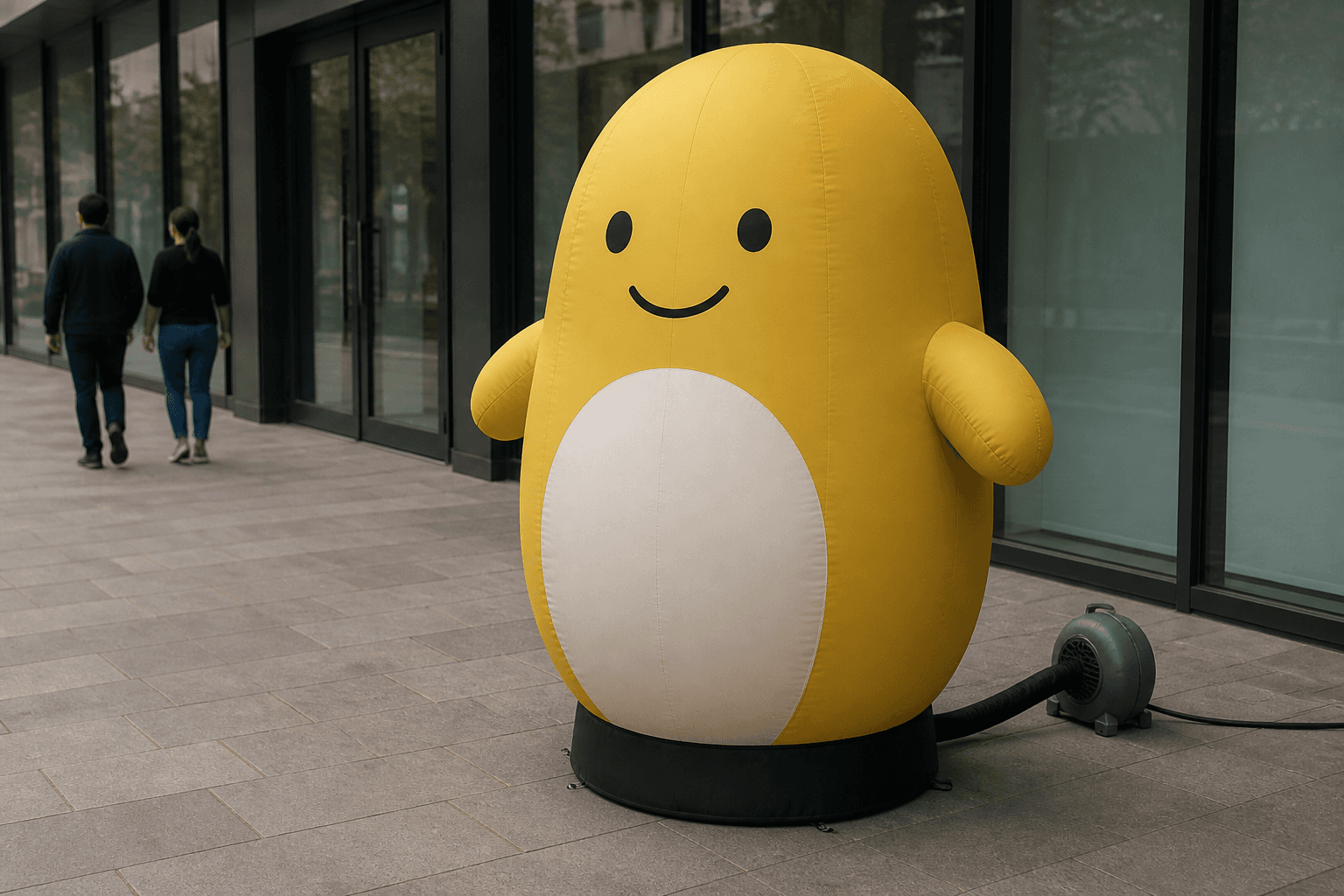
A cartoon character mascot takes a figure that exists as a flat illustration and builds it as a three-dimensional object. The gap between those two things — what the character looks like from the side and the back — is the work that decides whether people recognise it.
Most brand characters were drawn once, in one pose, facing the viewer. Everything else about them is unspecified: the depth of the head, what the back of the costume does, where an arm sits when it is not waving. Building the figure forces every one of those decisions, and each one is a chance for the result to stop looking like the character people know.
The practical fix is to settle it on paper. Ask for a turnaround before the pattern is cut, mark the two or three details that carry the recognition — a silhouette, an ear shape, a colour break — and treat those as fixed while everything else is allowed to adapt to a curved surface.
A front view alone is not enough: the side and back are drawn by someone, and it should be you.
Facial seams are placed to follow the features rather than cut across the expression.
Confirm who owns the character before production; rights are not cleared by the manufacturer.
Specification
What a quotation for this format is built from.
Sizes buyers usually order
A mascot is sized by the sight line it has to hold. As planning references from delivered project types: grand openings 2–5 m high, shopping mall and seasonal displays 2–5 m high, school and campus events 2–4 m high, and team tunnels and pitch-side positions 1.5–3 m high.
Height is the figure that gets quoted; footprint is the one that gets a piece turned away on site. A standing character with an outstretched arm, a wide stance or a base skirt needs floor area and clearance around it, so send the space it has to occupy as well as the height you want.
What a character needs before it can be built
A character needs more than a logo file. Send a turnaround — front, side and back — or at minimum a front view plus a written description of the back, because the back of a character that nobody specified is invented by the person drawing the pattern, and that invention is what you will be asked to approve.
Confirm that you own the character or are licensed to reproduce it. A manufacturer builds to the artwork supplied and does not clear rights, so a licensed property needs the licence holder to sign off the model and the finish before production starts.
Material and air system
Double-layer PVC is the general construction. 0.4 mm PVC is used on large-format projects, and 0.5 / 0.6 / 0.7 mm PVC mesh where the structure carries load, spans further or faces sustained exposure.
The air system is sized to the piece: the 650 W electric pump moves 1,600–2,000 L/min at 2.0 psi and suits smaller spheres, compact displays and short-duration indoor installations; the 1600 W electric pump moves 4,800–5,200 L/min at 4.5 psi for large-format structures, arches and continuously inflated outdoor displays. Both run on 110–240 V, 50–60 Hz, and the destination plug type is confirmed on the order.
Where the seams fall on a face
Inflation turns every flat panel into a curve, and a face is where that shows. Seams are placed to follow the features rather than cut across them, and eyes and mouth are usually carried on a single panel so a seam does not run through the expression.
Fingers, ears, tails and other thin extremities either hold their shape through internal baffles or are simplified into the body. The production drawing shows which parts have been adjusted and by how much, and that drawing is what is approved.
Lead time, quantity and freight
MOQ is 1 piece for most custom projects, so a single piece can be approved before a repeat order. Pattern and print setup are paid once per design, so a second unit costs less per piece than the first.
Bulk production typically takes 3–8 days for simple items, 7–15 days for standard custom work and 15–25 days for complex or large pieces, counted from final design approval. Freight comes on top: express or air usually 4–15 working days, and sea, rail or truck usually 20–45 days, after dispatch and subject to route and customs
All of these sit under inflatable mascots, where the shared specifications and the full buyer checklist live.
Buyer FAQ
Questions that come up before quotation.
Quote Form
Request a Quote for an Inflatable Cartoon Character Mascot
Send the character artwork with a turnaround if you have one, the target height, the floor area available, the quantity, the destination and the date it has to be on site.
Start with four essentials: product type, rough size, quantity, and one way to contact you.
Country, timing, artwork, and technical details are optional at this stage. We will request anything else needed for a usable factory quote.
AI Sourcing Guide
Use ChatGPT, Gemini, or Claude to build a cleaner RFQ before you send it to the factory.
AI works best when the brief is structured. This guide turns rough notes into a supplier-ready checklist, then sends you toward the RFQ form, factory verification, and the buyer questions that usually decide the quote.