Inflatable Entrance Tunnels for Teams and Event Walkways
A tunnel is the one custom shape people go inside, which changes what has to be specified. The internal dimensions, not the external ones, are what decide whether it works, and everything about the structure follows from the fact that it has occupants.
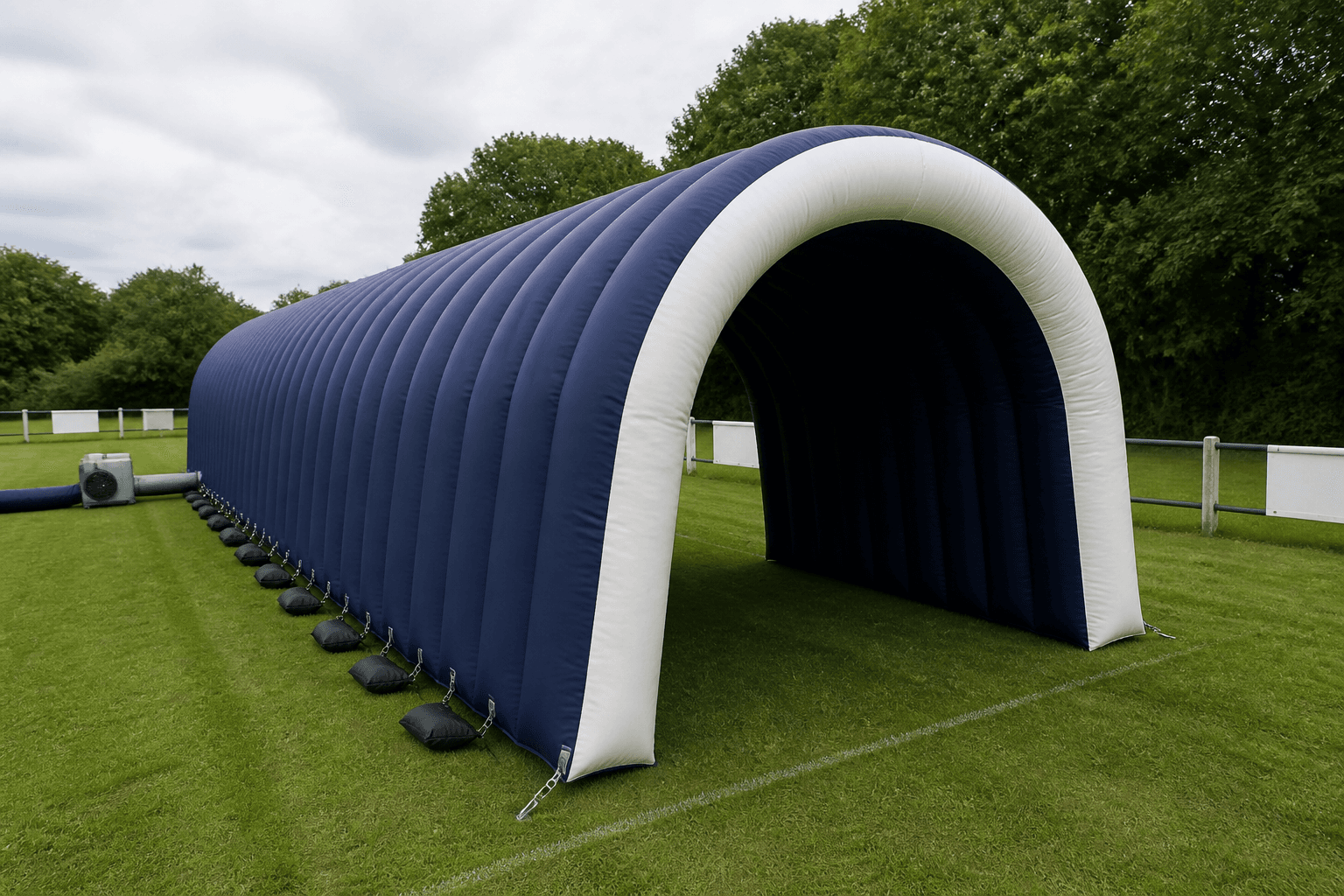
Start with the people. How many go through at once, how fast, carrying what, and in what — studs on grass and wheels on a hard floor are different problems. That traffic sets the internal clear width and height, and only then does the external size follow. A tunnel specified from the outside in usually turns out to be tighter inside than anyone expected. Planning references put walk-through tunnels at 5–15 m long × 3–6 m wide × 3–5 m internal height.
The second thing is the exit. A tunnel is an enclosure with people in it, so both ends stay clear, the route through is kept unobstructed, and the organiser or venue is the one who signs off the arrangement. That conversation happens before the size is fixed, not after the piece is built.
Internal clear width and height are the specification; external size follows from them.
Entry and exit have to stay clear and unobstructed at all times.
A tunnel on grass, on a pitch surround or on hard standing takes a different fixing.
Specification
What a quotation for this format is built from.
Sizes buyers usually order
A custom shape is sized by the site. As planning references from delivered project types: forecourts, race routes and trade show stands are commonly 2–5 m high, shopping mall and seasonal displays 2–6 m high, festival-scale pieces 3–10 m high, and walk-through tunnels 5–15 m long × 3–6 m wide × 3–5 m internal height.
Send the constraint rather than the wish. A ceiling height, a doorway, a stand footprint, a truck bed or a rigging point fixes the size far more reliably than a target figure does, and it is what the manufacturer works back from when the two disagree.
What a shape has to be before it can be quoted
A custom shape needs a reference the manufacturer can build a pattern from: dimensioned drawings, photographs from several angles, a 3D file, or the physical object itself. A single flat illustration is a starting point for a conversation, not something a pattern can be cut from.
The more organic the shape, the more it changes under pressure. Sharp corners soften, thin sections thicken, and undercuts either need internal structure or disappear. The production drawing shows every one of those adjustments before anything is cut, and that drawing — not the original illustration — is what you are approving.
Material and air system
Double-layer PVC is the general construction. 0.4 mm PVC is used on large-format projects, and 0.5 / 0.6 / 0.7 mm PVC mesh where the structure carries load, spans further or faces sustained exposure.
The air system is sized to the piece: the 650 W electric pump moves 1,600–2,000 L/min at 2.0 psi and suits smaller spheres, compact displays and short-duration indoor installations; the 1600 W electric pump moves 4,800–5,200 L/min at 4.5 psi for large-format structures, arches and continuously inflated outdoor displays. Both run on 110–240 V, 50–60 Hz, and the destination plug type is confirmed on the order.
Standing, spanning or suspended
How a piece is supported changes how it is built. A ground-standing shape needs a base and ballast sized to its own footprint; a piece people walk through needs clear internal dimensions and a structure that holds them; a suspended piece needs attachment points designed into the seams with the load spread across them.
Decide this at the brief stage. Where a piece is to hang, the venue confirms rigging points and load per point before the size is fixed, because a shape that cannot be hung where you need it is a shape that has to be rebuilt.
Lead time, quantity and freight
MOQ is 1 piece for most custom projects, so a single piece can be approved before a repeat order. Pattern and print setup are paid once per design, so a second unit costs less per piece than the first.
Bulk production typically takes 3–8 days for simple items, 7–15 days for standard custom work and 15–25 days for complex or large pieces, counted from final design approval. Freight comes on top: express or air usually 4–15 working days, and sea, rail or truck usually 20–45 days, after dispatch and subject to route and customs
Send the shape reference — drawings, photographs from several angles or a 3D file — the size or the constraint that fixes it, the quantity, the destination and the date it has to be on site.
Start with four essentials: product type, rough size, quantity, and one way to contact you.
Country, timing, artwork, and technical details are optional at this stage. We will request anything else needed for a usable factory quote.
AI Sourcing Guide
Use ChatGPT, Gemini, or Claude to build a cleaner RFQ before you send it to the factory.
AI works best when the brief is structured. This guide turns rough notes into a supplier-ready checklist, then sends you toward the RFQ form, factory verification, and the buyer questions that usually decide the quote.