Inflatable Finish Line Arches for Races and Fun Runs
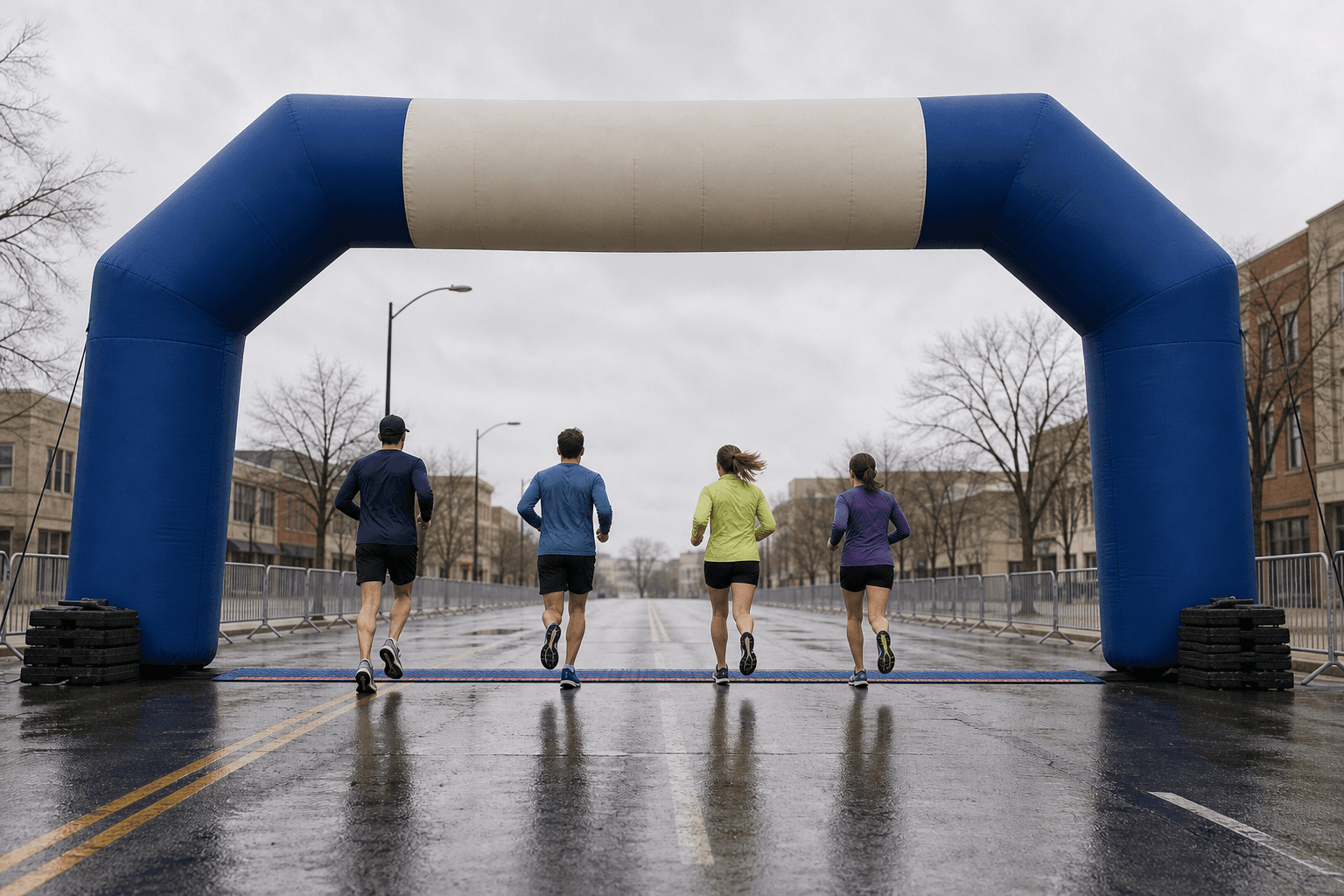
A finish line arch is the one piece of a race that every photograph contains. It has to clear the width of the course, sit above the timing equipment, and carry the sponsor lockups where a camera at the line will actually see them.
Start with the course, not the arch. The clear opening has to take the width of the running lane plus the marshalling either side, and the height has to sit above whatever the timing supplier hangs across the line. Those two figures come from the organiser and the timing company, and they fix the size before any artwork is drawn.
The second constraint is the camera. A finish photograph is taken low and square to the line, which means the crown fills the top of the frame and the legs are mostly cropped out. Sponsor hierarchy follows from that: whoever is paying for the finish line goes on the crown.
Quote the clear opening, not the overall width: the legs sit outside the course.
Timing mats, gantries and camera positions decide the height before the design does.
The crown is the photographed surface, so the main lockup belongs there rather than on a leg.
Specification
What a quotation for this format is built from.
Sizes buyers usually order
An arch is sized by the opening it has to span. As planning references from delivered project types: grand openings and retail forecourts are commonly about 3–8 m wide × 3–5 m high, race and finish-line gantries clear opening 4–8 m wide × 3–5 m high, festival gateways 4–10 m wide × 3–6 m high, school and campus events 3–6 m wide × 3–4 m high, and team tunnels and sponsor gates 4–8 m wide × 3–5 m high.
Send the clear opening you need — the width and height that have to stay unobstructed — rather than an overall size. The legs sit outside that opening, so an arch built to clear six metres is wider than six metres on the ground, and that difference is what decides whether a vehicle, a timing gantry or a field of runners actually fits through.
The span, the legs and the ground it stands on
Three dimensions are quoted, not one: the clear opening, the overall footprint including the legs, and the height at the crown. A site that is measured only at the opening can turn out to have no room for the legs, which is the most common reason an arch has to be rebuilt at a smaller size.
The ground matters as much as the measurement. Grass, sand, tarmac, paving and an indoor floor each take a different fixing method, and the installer needs to know which one before the piece is packed, because the fixing hardware ships with it.
Material and air system
Double-layer PVC is the general construction. 0.4 mm PVC is used on large-format projects, and 0.5 / 0.6 / 0.7 mm PVC mesh where the structure carries load, spans further or faces sustained exposure.
The air system is sized to the piece: the 650 W electric pump moves 1,600–2,000 L/min at 2.0 psi and suits smaller spheres, compact displays and short-duration indoor installations; the 1600 W electric pump moves 4,800–5,200 L/min at 4.5 psi for large-format structures, arches and continuously inflated outdoor displays. Both run on 110–240 V, 50–60 Hz, and the destination plug type is confirmed on the order.
Print area and sponsor panels
Send print-ready vector artwork with colour references, and say which marks are sponsor-owned and which are yours. On an arch the crown carries the main lockup and the legs carry the secondary panels, so the split is agreed before printing rather than argued about afterwards.
A curved crown turns away from the viewer, which compresses type across the top of the span. Where a layout depends on type reading square, the usual answers are a straight-sided profile or a flat printed panel set into the span, and the mockup shows which one you are approving.
Lead time, quantity and freight
MOQ is 1 piece for most custom projects, so a single piece can be approved before a repeat order. Pattern and print setup are paid once per design, so a second unit costs less per piece than the first.
Bulk production typically takes 3–8 days for simple items, 7–15 days for standard custom work and 15–25 days for complex or large pieces, counted from final design approval. Freight comes on top: express or air usually 4–15 working days, and sea, rail or truck usually 20–45 days, after dispatch and subject to route and customs
All of these sit under inflatable arches, where the shared specifications and the full buyer checklist live.
Buyer FAQ
Questions that come up before quotation.
Quote Form
Request a Quote for an Inflatable Finish Line Arch
Send the clear opening width and height, the ground surface it stands on, print-ready artwork, the quantity, the destination and the date it has to be on site.
Start with four essentials: product type, rough size, quantity, and one way to contact you.
Country, timing, artwork, and technical details are optional at this stage. We will request anything else needed for a usable factory quote.
AI Sourcing Guide
Use ChatGPT, Gemini, or Claude to build a cleaner RFQ before you send it to the factory.
AI works best when the brief is structured. This guide turns rough notes into a supplier-ready checklist, then sends you toward the RFQ form, factory verification, and the buyer questions that usually decide the quote.