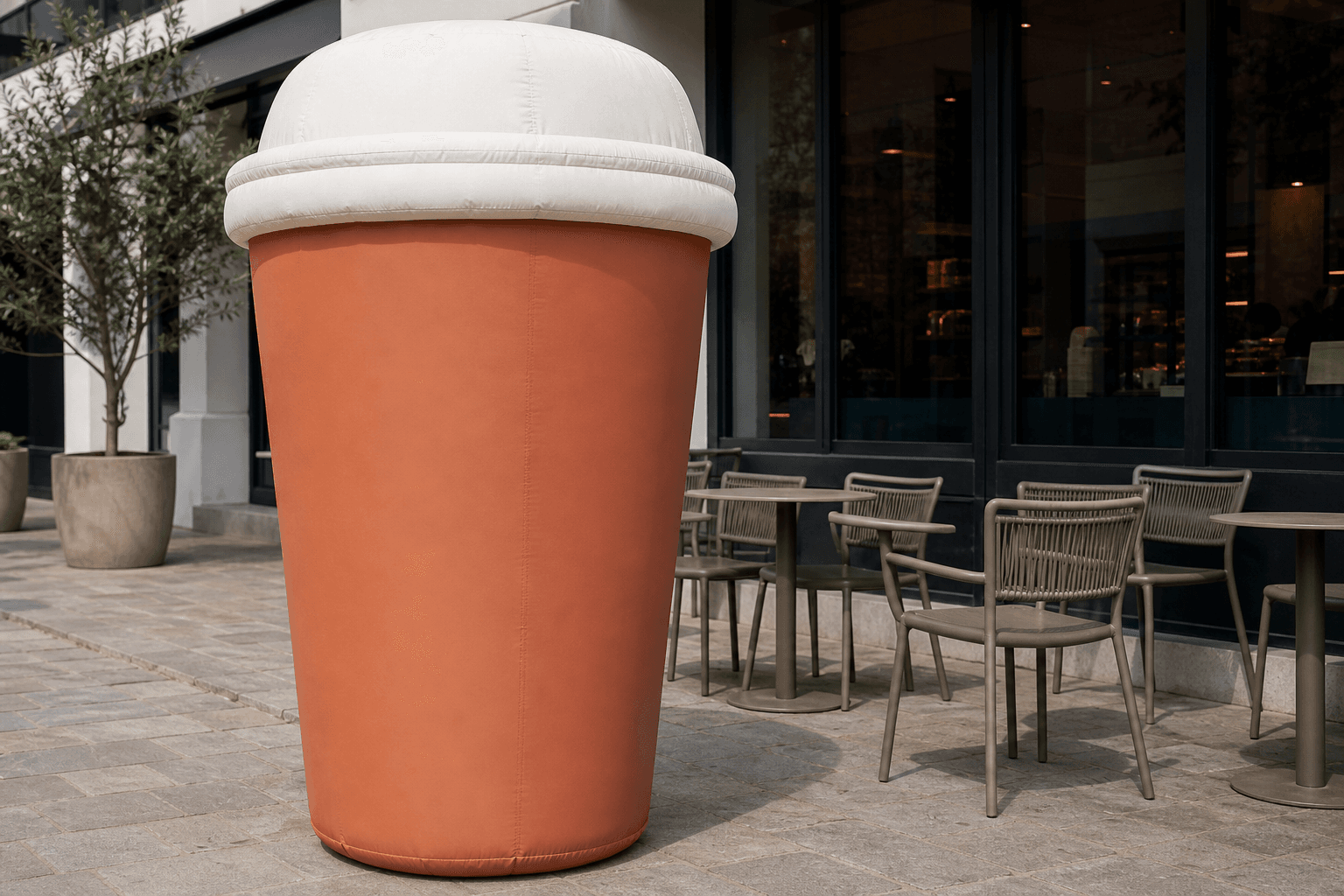
Inflatable Cup Replicas for Coffee, Food and Drink Brands
An inflatable cup replica is an oversized takeaway cup, tumbler or drinks cup built as an air-supported display. Coffee chains, food courts and drinks brands use them at store openings, in mall atriums and at sampling stands.
A takeaway cup is two visual parts: a tapered body and a lid, usually in contrasting colours. Building them as separate sections keeps the colour break sharp, which is what makes the shape read as a cup rather than a generic cone.
Straws, handles and other thin projecting parts are the usual adaptation. At display scale they are thickened, shortened or printed rather than built, and the drawing shows which route was taken.
The taper from base to rim is the shape that identifies a cup; it is held with panel shaping rather than baffles.
A domed lid is usually built as its own section so the two colours separate cleanly.
Sleeve artwork sits on the widest part of the body, where it is most readable.
Specification
What a quotation for this format is built from.
Sizes buyers usually order
Size is set by the viewing distance and the space, not by the original cup. As planning references from delivered project types: trade show and mall displays are commonly 1–5 m high, forecourt and roadside displays undefined, and festival-scale pieces undefined.
Send the height you have in mind, or the constraint that fixes it — a ceiling, a doorway, a stand footprint, a truck. The manufacturer confirms whether the proportions still read correctly at that scale, because a shape that works at product size does not always work at display size.
Material and air system
Double-layer PVC is the general construction. 0.4 mm PVC is used on large-format projects, and 0.5 / 0.6 / 0.7 mm PVC mesh where the structure carries load, spans further or faces sustained exposure.
The air system is sized to the piece: the 650 W electric pump moves 1,600–2,000 L/min at 2.0 psi and suits smaller spheres, compact displays and short-duration indoor installations; the 1600 W electric pump moves 4,800–5,200 L/min at 4.5 psi for large-format structures, arches and continuously inflated outdoor displays. Both run on 110–240 V, 50–60 Hz, and the destination plug type is confirmed on the order.
Artwork and what survives the scale-up
Send print-ready vector artwork with colour references. At display scale the brand mark, the product name and the main colour blocks are what people read from a distance; fine legal copy, barcodes and small icons are usually simplified or left off, and that decision is shown on the mockup rather than made silently.
Curved surfaces stretch artwork. A label designed for a flat print area behaves differently on a cylinder or a shoulder, so the panel layout is drawn and approved before printing starts.
Lead time, quantity and freight
MOQ is 1 piece for most custom projects, so a single piece can be approved before a repeat order. Pattern and print setup are paid once per design, so a second unit costs less per piece than the first.
Bulk production typically takes 3–8 days for simple items, 7–15 days for standard custom work and 15–25 days for complex or large pieces, counted from final design approval. Freight comes on top: express or air usually 4–15 working days, and sea, rail or truck usually 20–45 days, after dispatch and subject to route and customs
All of these sit under inflatable product replicas, where the shared specifications and the full buyer checklist live.
Buyer FAQ
Questions that come up before quotation.
Quote Form
Request a Quote for an Inflatable Cup Replica
Send the real dimensions of the original, print-ready artwork, the target height, the quantity, the destination and the date it has to be on site.
Start with four essentials: product type, rough size, quantity, and one way to contact you.
Country, timing, artwork, and technical details are optional at this stage. We will request anything else needed for a usable factory quote.
AI Sourcing Guide
Use ChatGPT, Gemini, or Claude to build a cleaner RFQ before you send it to the factory.
AI works best when the brief is structured. This guide turns rough notes into a supplier-ready checklist, then sends you toward the RFQ form, factory verification, and the buyer questions that usually decide the quote.