Buyer Guide
How a Custom Inflatable Product Replica Is Scaled from a Real Package
An inflatable product replica is scaled from the actual dimensions of the original package rather than from a photograph, because a photo carries perspective distortion and no absolute measurements. The buyer supplies the real height, diameter or width and depth, the label artwork, and the finished size the venue allows; the factory works out the pattern from those. Fine surface detail, sharp edges and small type do not survive enlargement well, so the design is simplified deliberately as it grows. The final size is usually decided by ceiling height, doorway width, anchoring space and freight, not by how large the replica could theoretically be built.
By InflatCraft Product Team • Last updated
What does scaling actually mean here?
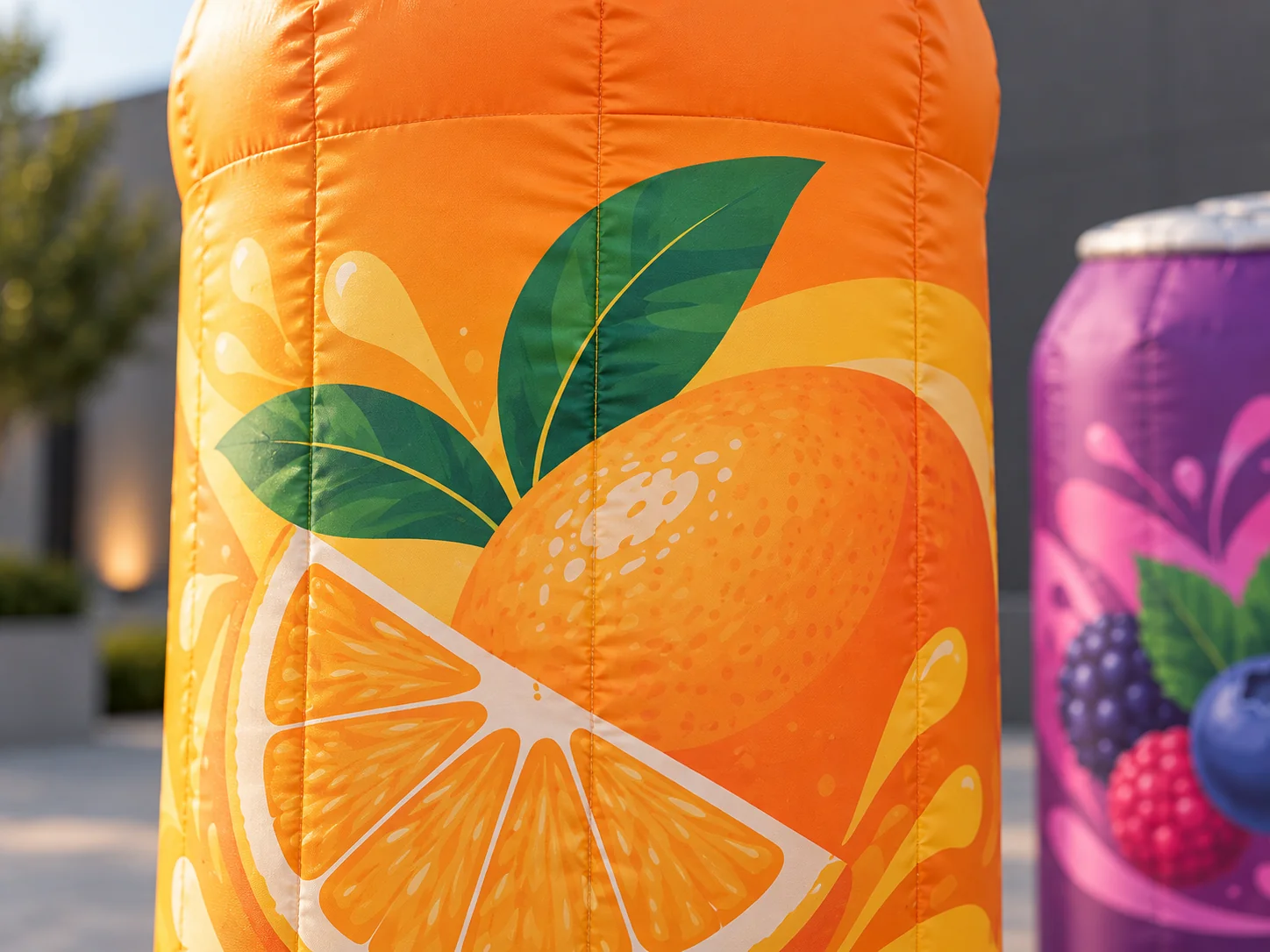
Scaling a product replica means rebuilding a package as a sewn and welded inflatable envelope that reads as the same product at ten or twenty times the size. It is not a photographic enlargement. The shape has to hold air, carry a printed graphic across curved panels, stand up under its own weight, and survive being packed into a box afterwards.
That means the geometry is redrawn rather than copied. A bottle shoulder that curves tightly on a 300 ml package becomes a broad, gentle transition at three metres, because a tight radius at that scale creates stress concentrations and visible creasing. The replica should look correct from the distance people will actually see it, which is usually several metres away rather than in the hand.
Why the real dimensions matter more than a photograph
A photograph carries perspective distortion, an unknown focal length, and no absolute measurement. Two photos of the same bottle from slightly different distances imply different proportions. A factory working only from images has to guess, and the guess shows up in the finished replica as a silhouette that is subtly wrong in a way viewers notice without being able to name.
The reliable input is the measured package: overall height, maximum diameter or width and depth, the height of any distinct section such as a neck or cap, and the position of the label band relative to the base. Those five or six numbers let the pattern be drawn to correct proportion at any scale. Photographs remain useful for colour reference and label placement, but they support the measurements rather than replacing them.
If the physical package is available, sending the actual item is the most reliable reference of all. Where that is not practical, a dimensioned drawing or the packaging specification sheet does the same job.
Which details survive enlargement, and which do not
Large colour fields, the overall silhouette, a primary logo and a short headline all scale well and are what carry recognition at distance. These are the elements worth protecting in the design.
What does not survive is fine detail: embossed textures, thin outlines, small legal type, tight gradients between similar tones, and sharp mechanical edges. Enlarged, these either disappear into the seam structure or draw attention to the fact that the shape is fabric. The practical approach is to decide deliberately what to simplify before production rather than discovering it on the finished unit.
Seam placement interacts with artwork, so the two are resolved together. A logo that sits across a seam on the production pattern will show a break; moving either the seam or the logo solves it, but only if the question is asked before the pattern is cut.
How venue and transport set the final size
Most replica projects are limited by the room rather than by manufacturing. Indoors, the ceiling height minus clearance for the inflated top, the doorway or lift the packed unit has to pass through, and the floor area available for anchoring all cap the size. Outdoors, wind exposure and the anchoring the ground allows matter more than ceiling height.
Freight is the other constraint. An inflatable packs small relative to its inflated size, but the packed volume still grows with the finished dimensions, and air freight is charged on volume rather than weight for goods of this density. A replica that is 20 per cent larger than it needs to be costs more to build and more to ship, every time it ships.
The productive way to set size is backwards: start from the viewing distance and the space, arrive at a target height, then confirm that height is manufacturable and shippable. Starting from "as big as possible" produces a quote that has to be redone.
What to confirm before the pattern is cut
Once the pattern is cut, changes mean a new pattern. Confirm the finished height and the key proportions, the primary viewing side, the artwork placement against the seam layout, the inflation method and where the valve or blower connection sits, and how the unit will be anchored or weighted.
Confirm the packed dimensions too, because that is what determines whether the replica fits the transport and the storage the client actually has. A display that cannot be moved between venues in the vehicle available has a problem that no amount of build quality fixes.
Verified Specifications
Figures this guide is written against.
Size ranges
| Category | Range | Notes |
|---|---|---|
| Inflatable spheres and balls | 30 cm to 5–6 m diameter | Small hand-held spheres through to large suspended and ground-mounted balls. The workable range narrows once print detail, lighting or suspension is added. |
| Arches, mascots, replicas and custom shapes | Defined per product category | Sized against the venue opening, sight lines and transport limits rather than a catalogue size. Send the target dimensions and the constraint that drives them. |
Lead time
- Typical: Bulk production typically takes 3–8 days for simple items, 7–15 days for standard custom work and 15–25 days for complex or large pieces, counted from final design approval
- Can be shorter: Repeat orders on an approved design can run shorter
- Freight and import time come on top. Lead time is confirmed per project once artwork, size, quantity and destination are fixed; treat any figure quoted before that as indicative.
Product Replica Guides
More on custom inflatable product replicas.
Custom Inflatable Replica Quote Checklist
Prepare references, artwork, size, quantity, installation and delivery details for an itemized custom inflatable product replica quotation.
Sealed-Air vs Blower Custom Inflatable Replicas
The air system decides where a replica can be installed, what it costs to run, and who has to look after it. How to choose between a sealed unit and one on a continuous pump.
Indoor vs Outdoor Custom Inflatable Replicas
Moving a replica outdoors changes the material specification, the air system and the anchoring. What to specify differently, and what an indoor unit can get away with.
Product Replica vs Custom Shape Inflatable
A replica reproduces an actual product; a custom shape is designed for the campaign. When the product silhouette is the right choice, when it is the wrong one, and how the brief differs.
Compare sizes, materials and air systems on the inflatable product replica specifications page before sending an RFQ.
Relevant Product Pages
Compare specifications before submitting an RFQ.
Buyer FAQ
Additional specification questions.
It can, but the proportions will be approximate. Photographs carry perspective distortion and no absolute measurements, so the silhouette usually ends up subtly wrong. Sending the measured dimensions of the real package, or the package itself, produces a far more accurate result.
Overall height, maximum diameter or width and depth, the height of any distinct section such as a neck or cap, and where the label band sits relative to the base. A packaging specification sheet or dimensioned drawing covers all of these.
Size ranges are defined per product category and are set in practice by the venue and by transport rather than by an upper manufacturing limit. Ceiling height, doorway width, anchoring area and freight volume usually decide the number.
Not reliably. Fine type, thin outlines and embossed textures soften as the shape is enlarged. Large colour fields, the silhouette and a primary logo are what carry recognition at viewing distance, so the design is normally simplified deliberately.
No. Each replica is patterned from the specific package and the specific target size, so there is no catalogue size to select. Approve the production drawing rather than assuming a standard.
Bulk production typically takes 3–8 days for simple items, 7–15 days for standard custom work and 15–25 days for complex or large pieces, counted from final design approval; repeat orders on an approved design can run shorter. The figure is confirmed per project once artwork, size, quantity and destination are fixed.