Buyer Guide
What to Send for a Custom Inflatable Product Replica Quote
For a custom inflatable product replica quote, send the measured product reference, target finished dimensions, quantity by design, authorized artwork and its approval status, installation conditions, destination and required arrival date. Ask the supplier to itemize the proposed construction, air system, accessories, drawing or sample approval, packing and freight. A bottle, cosmetic tube and package box need different design reviews; compare quotations against the same approved brief rather than a generic replica price.
By InflatCraft Product Team • Last updated
Why replica quotes come back slow or vague
A product replica has no catalogue equivalent. Every project is a new pattern, so there is no stock price to look up. When a supplier receives only a photograph and the words "how much for an inflatable version of this", the honest options are to quote a range wide enough to cover the uncertainty, or to come back with questions. Both take time, and the range is usually not useful for a budget.
The specification gaps that matter most are size, environment and quantity, because each of them changes the build rather than just the price. A three-metre indoor display and a six-metre outdoor one are different products, not the same product at different scales.
The inputs that let a factory quote instead of guess
Product reference: the real package, a dimensioned drawing, or the packaging specification. Photographs alone leave the proportions open.
Target finished size, and whether it is fixed or flexible. If the constraint is a ceiling height or a doorway, say so — a supplier who knows the constraint can propose a size that fits it.
Quantity, and whether the units are identical. Ten identical replicas and ten different ones share almost no tooling.
Indoor or outdoor use, and how long the display stays up. This drives material specification and the air system more than any other single answer.
Destination country, for the air system and for freight. Both pump classes cover 110-240 V at 50-60 Hz, so voltage is rarely the blocker, but plug type and shipping route still need confirming.
Required date, and whether it is a hard deadline tied to an event or a target.
Artwork status: print-ready files, brand guidelines only, or nothing yet. Each implies a different amount of preparation.
What reference material actually helps
The physical product is the strongest reference where it can be sent. Failing that, a packaging specification sheet or a dimensioned drawing carries the same information without ambiguity.
For artwork, vector files or the original design files are more useful than a flattened image, because the graphic has to be redrawn across curved panels and around seams. Brand colour references matter: a print colour matched by eye from a screenshot will not match the brand standard.
Site photographs are the reference most buyers forget and suppliers most want. A photo of where the replica will stand, with something of known size in the frame, answers questions about clearance, anchoring, power access and viewing distance that would otherwise take several emails.
How to compare two replica quotes
Two quotations for "an inflatable replica" are not comparable unless both state what is being built. Ask each supplier to put the material specification, the air system, the finished dimensions, the print coverage and what is included in packing on the quotation itself.
A cheaper number against an unnamed material specification is not a saving; it is an unknown that surfaces later. The same applies to the air system: a quote that omits the pump is not necessarily excluding it, but you cannot tell.
Where quotes differ substantially, the difference is usually in the specification rather than the margin. Establishing that takes one question and saves a wrong decision.
What usually changes after the first quote
Two things commonly move. The first is artwork: once the design is laid against the seam pattern, a logo crossing a seam or type running into a curve needs either the artwork or the seam layout adjusted, and occasionally the print area changes with it.
The second is size, once the venue is confirmed. Buyers frequently discover a clearance or doorway limit after the first quote and revise downward, which usually reduces both the build cost and the freight. Treat the first quote as a working number against a stated specification rather than a fixed price, and confirm it when the specification is final.
Verified Specifications
Figures this guide is written against.
Lead time
- Typical: Bulk production typically takes 3–8 days for simple items, 7–15 days for standard custom work and 15–25 days for complex or large pieces, counted from final design approval
- Can be shorter: Repeat orders on an approved design can run shorter
- Freight and import time come on top. Lead time is confirmed per project once artwork, size, quantity and destination are fixed; treat any figure quoted before that as indicative.
Product Replica Guides
More on custom inflatable product replicas.
Sealed-Air vs Blower Custom Inflatable Replicas
The air system decides where a replica can be installed, what it costs to run, and who has to look after it. How to choose between a sealed unit and one on a continuous pump.
Indoor vs Outdoor Custom Inflatable Replicas
Moving a replica outdoors changes the material specification, the air system and the anchoring. What to specify differently, and what an indoor unit can get away with.
Product Replica vs Custom Shape Inflatable
A replica reproduces an actual product; a custom shape is designed for the campaign. When the product silhouette is the right choice, when it is the wrong one, and how the brief differs.
Giant Custom Inflatable Bottles and Cans for Beverage Brands
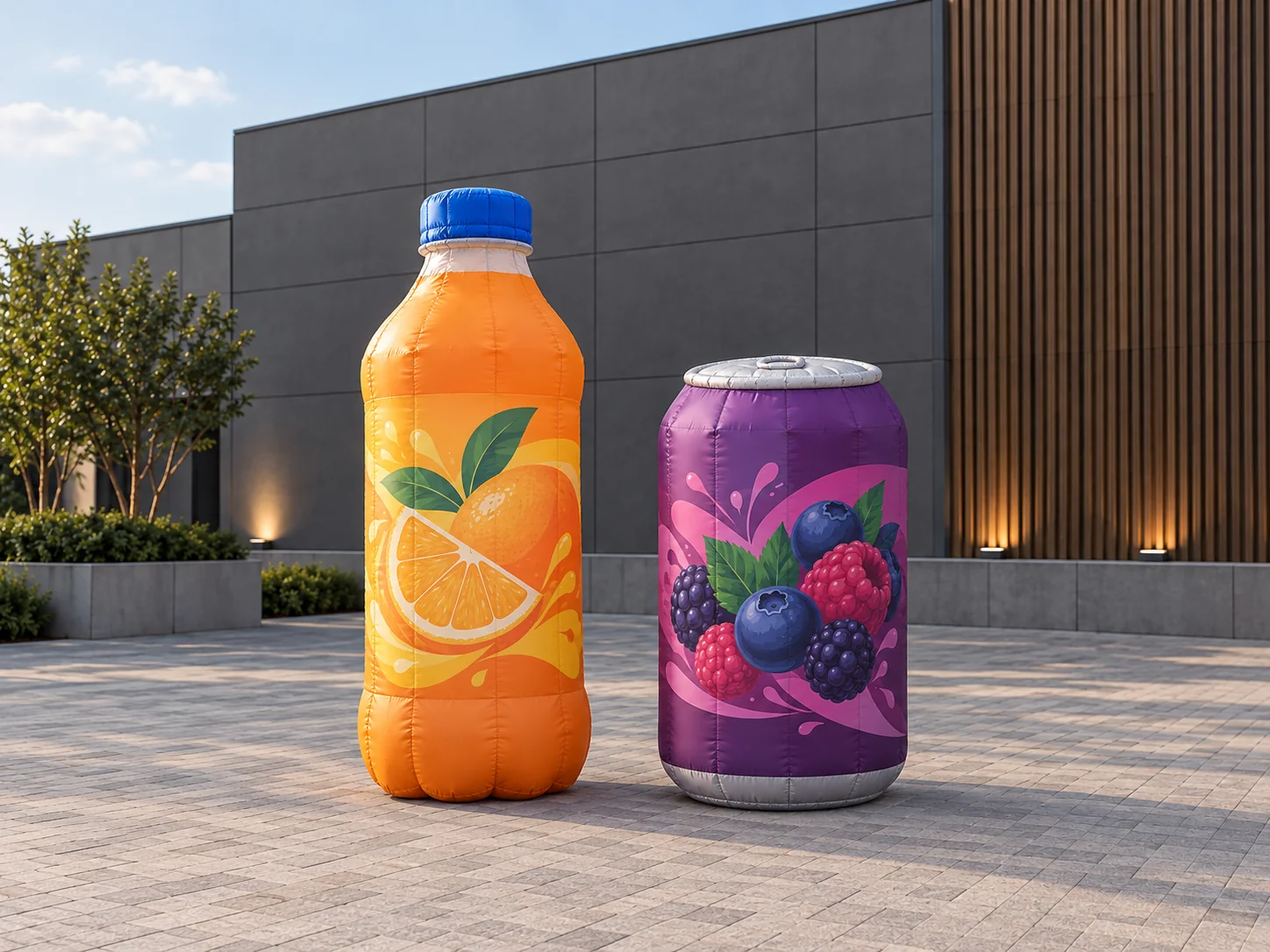
How beverage brands use giant custom inflatable bottles and cans at launches, sampling and trade shows, and how pack shape and labels are reproduced.
Compare sizes, materials and air systems on the inflatable product replica specifications page before sending an RFQ.
Relevant Product Pages
Compare specifications before submitting an RFQ.
Buyer FAQ
Additional specification questions.
Because a replica has no catalogue equivalent and every project is a new pattern. Without size, environment and quantity, the supplier has to cover the uncertainty with a range. Supplying those three usually replaces the range with a number.
The real dimensions of the product being replicated, plus a photograph of where it will stand. Those two answer more questions than anything else in a first message.
No, but say which stage you are at. Print-ready files, brand guidelines only, and nothing yet each imply a different amount of preparation, and a supplier that knows which one applies can price it.
Yes, through freight and through the air system. Both pump classes cover 110-240 V at 50-60 Hz, so voltage rarely blocks anything, but the plug type and the shipping route still need to be confirmed.
With a complete brief, a working quotation is usually straightforward. With a photograph and no dimensions, expect a round of questions first, which is what makes the process feel slow.
Treat it as a working number against the specification you stated. Artwork review against the seam layout and a confirmed venue size are the two things that most often move it.