Buyer Guide
Giant Inflatable Bottles and Cans: How Beverage Brands Use Product Replicas
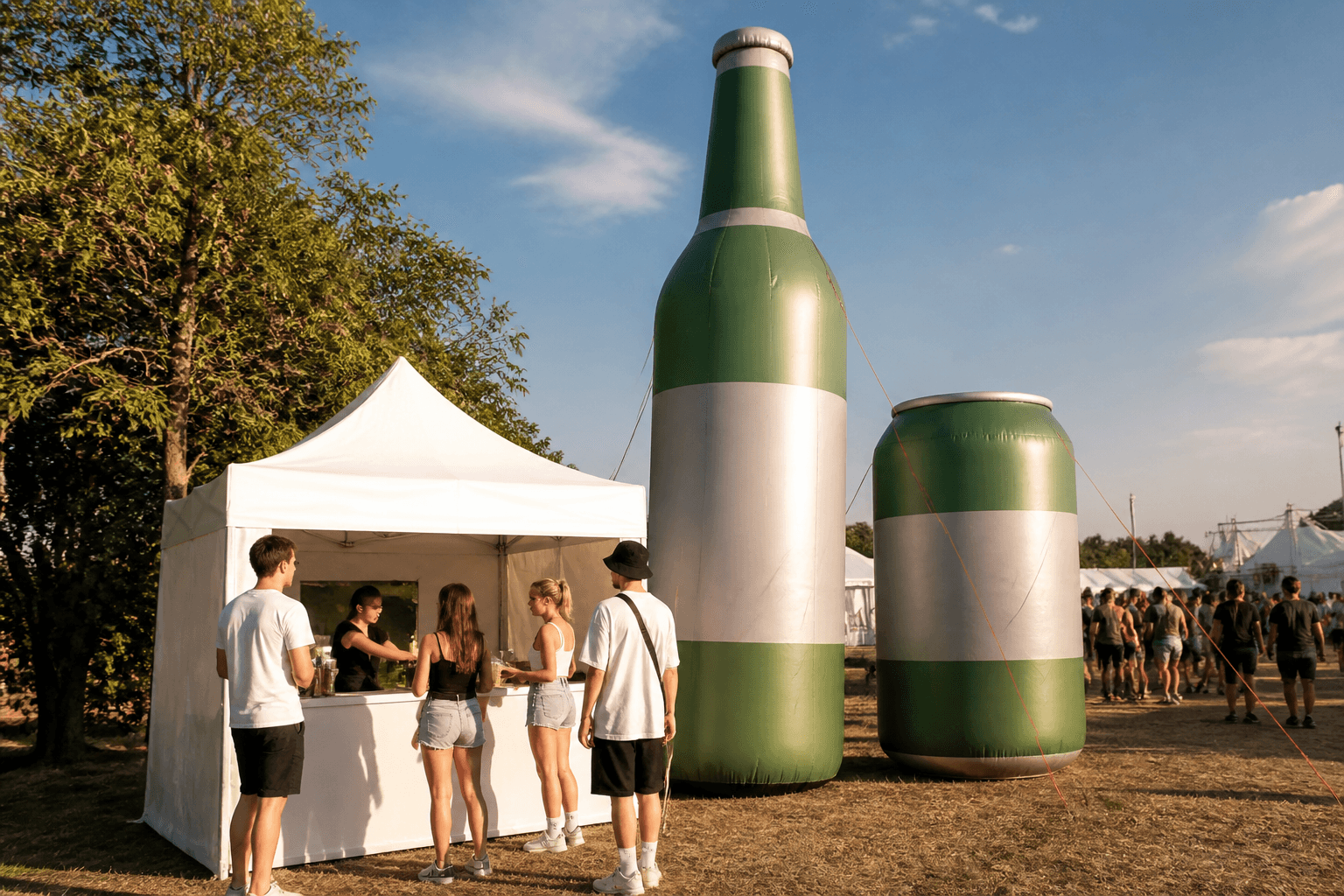
Beverage brands use giant inflatable bottles and cans as landmarks at product launches, sampling events, trade shows, festivals and store fronts, because a scaled-up pack is recognised faster than any sign. Replicas for stands and mall displays are commonly 1–5 m high. Accuracy comes from the real pack dimensions and the print-ready label artwork, not from a photograph, and thin features such as bottle necks and ring pulls are adapted so the replica holds its shape.
By InflatCraft Product Team • Last updated
Why bottles and cans work so well as inflatables
Beverage packs are among the most recognisable objects in retail. Shoppers identify a brand from the shape and colours of its bottle or can long before they can read the name. Scaling that pack up turns recognition into a landmark: a giant can at a festival gate or a bottle at a store entrance tells people which brand is there from far further away than any banner could.
Bottles and cans also suit inflatable construction. They are mostly smooth, rounded and symmetrical, which is exactly the kind of form air pressure holds well, and their labels wrap around a surface that can be printed as one continuous panel.
Where beverage brands use them
Product launches use a giant replica as the reveal and the photograph that travels on social media. Sampling events and pop-up bars use one to mark the stand so people can find the free product in a busy space. Trade shows use replicas to lift the brand above the booth line, within the hall's height rules. Festivals and sports events use them as meeting points and sponsor landmarks. Retail and distributor events use smaller replicas at store fronts, in windows or in mall atriums, where mall displays are commonly 1–5 m high.
Getting the proportions right
A replica is only convincing if the proportions match the real pack. That comes from the pack's actual measurements, not from a photograph, because a photo carries perspective distortion and no absolute scale. Send the real height, the diameter at the widest point, the shoulder and neck measurements for a bottle, and the height and diameter for a can, along with the target finished height. The separate guide on how inflatable product replicas are scaled explains the method in detail.
Bottles need particular care at the neck and cap. A real bottle neck is narrow relative to its body; scaled up as an air-supported structure, a very narrow neck can soften or lean. The usual solution is to widen the neck slightly or reinforce the transition, and to show that adaptation on the production drawing so the brand team approves it deliberately.
Cans are simpler in outline, but their details are small: the ring pull, the rim and the embossed lid. These are usually printed rather than built as separate parts, which keeps the top clean and the structure reliable.
Reproducing the label
The label is what makes a replica recognisably your product. Supply the print-ready label artwork as vector files with Pantone references, not a flattened image of the pack. A label designed for a bottle a few centimetres wide contains text that becomes enormous at replica scale but may also include fine legal copy, barcodes and small icons that serve no purpose on a display. Remove or simplify those so the brand mark and flavour name dominate.
Curvature matters too. Text printed around a cylinder bends away from the viewer towards the sides, so the key brand elements should sit on the front face the audience will see first. Ask for a flat print layout alongside the drawing, and approve colour against a printed swatch of the actual material, because metallic and very saturated beverage colours look different on PVC than on a printed can.
Choosing the size
Indoors, the size is capped by the venue: hall height limits, stand rules, ceiling height, and the doors the packed replica must pass through. Outdoors, it is set by sight lines and the space around the base. A replica that is too large for the space looks out of proportion; one that is too small disappears among the crowd. Give the manufacturer the constraints alongside the height you have in mind, and they can confirm what reads well.
Indoor and outdoor use
Indoor replicas at trade shows and in malls face controlled conditions, while outdoor replicas at festivals and store fronts face sun, rain and repeated handling. The material and air system are chosen for that use; the separate guide on indoor and outdoor product replicas covers the differences. The verified material and air system specifications used on InflatCraft projects are listed below this guide.
Ordering for several events or markets
Beverage brands often need the same replica for several events, or several copies for different distributors. MOQ is 1 piece for most custom projects, so a single unit can be approved first. Pattern and print setup are paid once per design, so additional copies of an approved replica cost less per piece, and a flavour variant that shares the same pack shape usually needs new print artwork rather than a new pattern.
Bulk production typically takes 3–8 days for simple items, 7–15 days for standard custom work and 15–25 days for complex or large pieces, counted from final design approval. Freight comes on top: express or air usually 4–15 working days, and sea, rail or truck usually 20–45 days, after dispatch and subject to route and customs.
What to send for a quote
Send the real pack dimensions, print-ready label artwork with colour references, the target height, indoor or outdoor use, the venue constraints, the quantity and any flavour variants, the event date and the delivery country.
Verified Specifications
Figures this guide is written against.
Material specifications
| Specification | Typical use | Notes |
|---|---|---|
| Double-layer PVC | General construction for custom advertising inflatables | The default build for most promotional structures. |
| 0.4 mm PVC | Large-format projects | Used on delivered large-format orders. |
| 0.5 / 0.6 / 0.7 mm PVC mesh | Engineered structures | Specified where the structure carries load, spans further, or faces sustained wind exposure. |
Air system specifications
| Pump | Airflow | Pressure | Suits |
|---|---|---|---|
| 650 W electric pump | 1,600–2,000 L/min | 2.0 psi | Smaller spheres, compact displays and short-duration indoor installations |
| 1600 W electric pump | 4,800–5,200 L/min | 4.5 psi | Large-format structures, arches and continuously inflated outdoor displays |
Both pumps cover 110–240 V at 50–60 Hz, so the same air system suits 110 V and 220–240 V markets. Confirm the plug type for the destination country.
Lead time
- Typical: Bulk production typically takes 3–8 days for simple items, 7–15 days for standard custom work and 15–25 days for complex or large pieces, counted from final design approval
- Can be shorter: Repeat orders on an approved design can run shorter
- Freight and import time come on top. Lead time is confirmed per project once artwork, size, quantity and destination are fixed; treat any figure quoted before that as indicative.
Product Replica Guides
More on inflatable product replicas.
How Inflatable Product Replicas Are Scaled
How a bottle, can or carton becomes an oversized inflatable: which dimensions the factory works from, which details survive enlargement, and what the venue and transport limits do to the final size.
What a Factory Needs to Quote a Replica
Why replica quotes come back slow, wide or full of caveats, and the specific inputs that let a manufacturer price the real project instead of guessing at it.
Sealed-Air vs Blower Inflatable Replicas
The air system decides where a replica can be installed, what it costs to run, and who has to look after it. How to choose between a sealed unit and one on a continuous pump.
Indoor vs Outdoor Inflatable Replicas
Moving a replica outdoors changes the material specification, the air system and the anchoring. What to specify differently, and what an indoor unit can get away with.
Compare sizes, materials and air systems on the inflatable product replica specifications page before sending an RFQ.
Relevant Product Pages
Compare specifications before submitting an RFQ.
Buyer FAQ
Additional specification questions.
Where to order
Order direct from the manufacturer.
Published by InflatCraft, operated by Tianjin Mufeng Trading Co., Ltd., a custom inflatable manufacturer founded in 2005 and based in Tianjin, China. We export to the United States, United Kingdom, Canada, Australia, Germany, France, Spain and Italy.
Request a quote
Send the brief and get a specification-based quotation.
MOQ and lead time
What sets the minimum order and where the time goes.
Sourcing from China
Brief, approval, Incoterms, freight and import, in order.
Verified specifications
Materials, air systems and lead time this site quotes against.
Export planning by country: United States, United Kingdom, Canada, Australia, Germany, France, Spain, Italy.
