Buyer Guide
Indoor vs Outdoor Custom Inflatable Product Replicas: What Changes
An outdoor product replica needs a heavier material specification, a continuous air supply and real anchoring, because wind loading, temperature swings and weather act on it constantly. An indoor replica faces none of that and can be built lighter, sealed, and weighted rather than anchored. The mistake that costs most is specifying an indoor build for an outdoor position: it does not fail immediately, it underperforms and wears out early. If a replica has to work in both settings, specify it for the outdoor case, because an outdoor-rated unit works indoors and the reverse is not true.
By InflatCraft Product Team • Last updated
What actually changes outdoors
The obvious answer is weather, but the one that determines the specification is wind. A large inflatable presents a substantial surface to moving air, and the load rises sharply with wind speed. That load has to go somewhere: into the anchoring, and into the seams and material carrying it.
Temperature is the second factor. Air inside a sealed unit expands and contracts through a day-night cycle, so a sealed replica that is correct at midday can be visibly soft by early morning. A continuous blower removes that variable entirely, which is a large part of why outdoor installations favour one.
Rain and UV matter over longer exposures, but they rarely decide the build for a campaign-length installation the way wind and temperature do.
Material specification for outdoor exposure
Standard double-layer PVC is the default construction for promotional structures and is appropriate for a great many indoor and short outdoor uses. Heavier PVC is used on large-format work. PVC mesh is specified where the structure carries load, spans further, or faces sustained wind rather than a mild weekend.
Moving up that range costs more per square metre, so it is worth doing when the installation genuinely demands it and worth avoiding when it does not. The useful question to put to a supplier is not "which material is best" but "which specification are you quoting, and why that one for this installation".
Anchoring and why it is designed in
Anchor points are part of the structure. They are positioned during patterning so the load is carried into reinforced areas rather than into a seam that was never intended to take it. Adding attachment points to a finished unit, or improvising with straps around the body, concentrates load exactly where the structure is weakest.
What the anchoring attaches to is the buyer side of the question, and it varies more than most people expect: ground stakes on grass, ballast on a hard surface where nothing can be driven in, fixed building points at a storefront. The available option should be established at the site survey, because it changes how many anchor points are needed and where they sit.
Anchor point customisation is part of the build, so specify the arrangement rather than accepting a default and adapting on site.
What an indoor replica can get away with
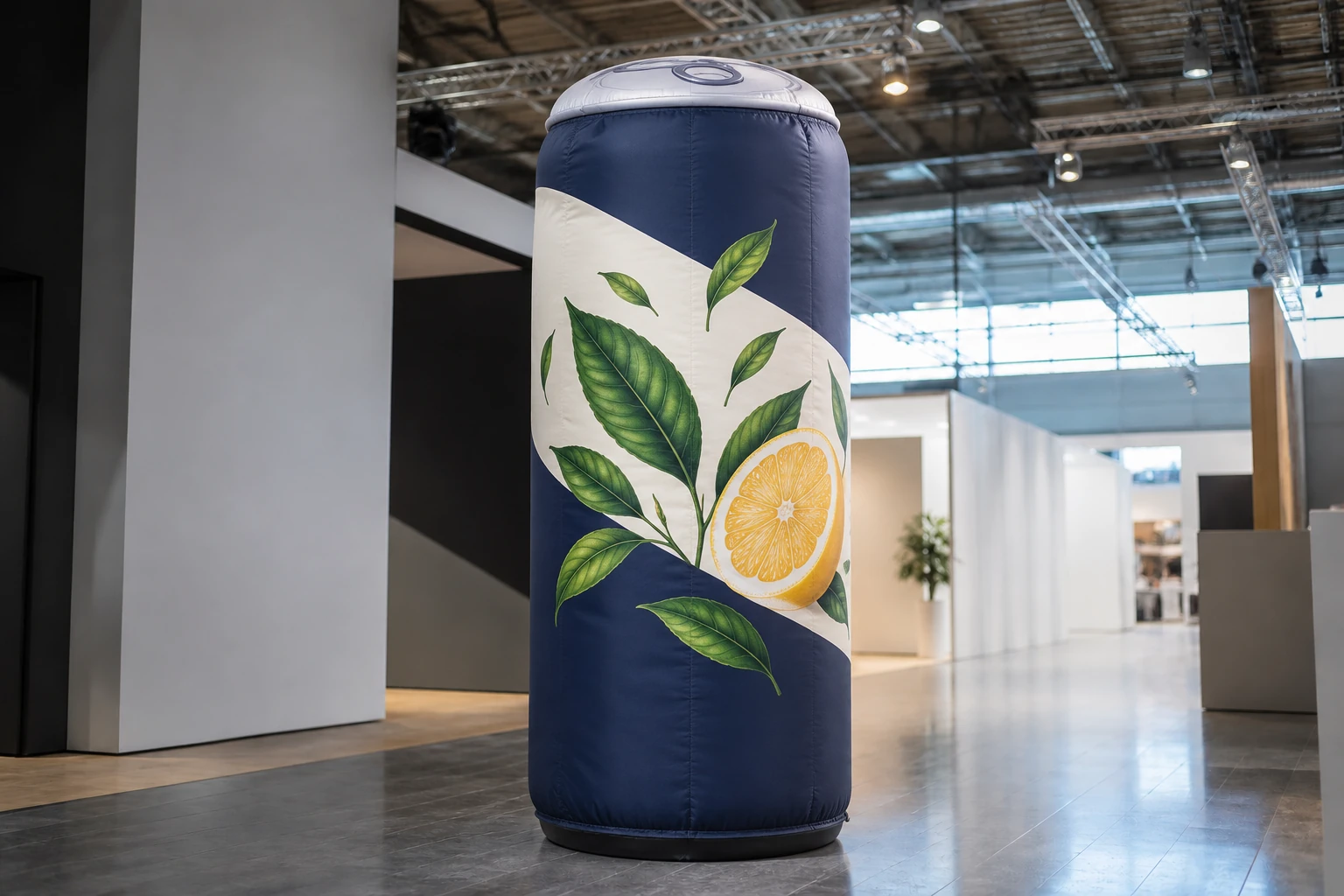
Indoors, there is no wind load, temperature is stable, and there is no weather. That allows a lighter specification, a sealed build with no cable, and weighting instead of anchoring, all of which reduce cost and make the unit easier to install and move.
The constraints indoors are different rather than absent: ceiling height and clearance above the inflated top, the doorway or lift the packed unit must pass through, floor area for the base and any weights, and whether the venue permits suspension. These are usually what caps the size.
Specifying one replica for both
Many campaigns need the same replica indoors at a launch and outdoors at an event weeks later. Where that is the case, specify it for the outdoor condition. An outdoor-rated unit works perfectly well indoors; an indoor-rated unit placed outdoors is the failure mode that ends campaigns early.
Tell the supplier both use cases explicitly rather than describing only the first one. A replica specified for a hall and then taken outside is not a manufacturing fault, it is a brief that did not mention the second venue.
Verified Specifications
Figures this guide is written against.
Material specifications
| Specification | Typical use | Notes |
|---|---|---|
| Double-layer PVC | General construction for custom advertising inflatables | The default build for most promotional structures. |
| 0.4 mm PVC | Large-format projects | Used on delivered large-format orders. |
| 0.5 / 0.6 / 0.7 mm PVC mesh | Engineered structures | Specified where the structure carries load, spans further, or faces sustained wind exposure. |
Air system specifications
| Pump | Airflow | Pressure | Suits |
|---|---|---|---|
| 650 W electric pump | 1,600–2,000 L/min | 2.0 psi | Smaller spheres, compact displays and short-duration indoor installations |
| 1600 W electric pump | 4,800–5,200 L/min | 4.5 psi | Large-format structures, arches and continuously inflated outdoor displays |
Both pumps cover 110–240 V at 50–60 Hz, so the same air system suits 110 V and 220–240 V markets. Confirm the plug type for the destination country.
Product Replica Guides
More on custom inflatable product replicas.
Product Replica vs Custom Shape Inflatable
A replica reproduces an actual product; a custom shape is designed for the campaign. When the product silhouette is the right choice, when it is the wrong one, and how the brief differs.
Giant Custom Inflatable Bottles and Cans for Beverage Brands
How beverage brands use giant custom inflatable bottles and cans at launches, sampling and trade shows, and how pack shape and labels are reproduced.
Custom Inflatable Replica Shipping & Packing Guide
Compare giant custom inflatable replica freight quotes using actual packing dimensions, gross weight, blower and accessory scope, Incoterms, receiving conditions and delivery dates.
Custom Inflatable Bottle Replica Artwork Approval Checklist
Approve artwork for custom inflatable bottle and can replicas: check label files, 3D proportions, seams, brand permissions, color proofs and RFQ evidence.
Compare sizes, materials and air systems on the inflatable product replica specifications page before sending an RFQ.
Relevant Product Pages
Compare specifications before submitting an RFQ.
Related Project Example
Buyer FAQ
Additional specification questions.
Not reliably. An indoor build is lighter, often sealed rather than blower-fed, and weighted rather than anchored. Outdoors it faces wind loading and temperature swings it was not specified for, and the result is underperformance and early wear rather than immediate failure.
It depends on the exposure. Standard double-layer PVC covers many short outdoor uses, heavier PVC is used on large-format work, and PVC mesh is specified where the structure carries load, spans further or faces sustained wind. Ask the supplier which specification they are quoting and why.
Wind, in most cases. A large inflatable presents a substantial surface to moving air and the load rises sharply with wind speed. That load determines the anchoring and the material specification more than rain does.
No. Anchor points are positioned during patterning so load is carried into reinforced areas. Adding them afterwards, or strapping around the body, concentrates load where the structure is weakest.
Usually. Air inside a sealed unit expands and contracts through the day-night cycle, so a sealed outdoor replica can be visibly soft by morning. A continuous blower removes that variable.
Specify it for the outdoor condition and tell the supplier both use cases. An outdoor-rated unit works indoors; the reverse does not hold.