
Buyer Guide
From Character Artwork to a Static Inflatable Mascot: A Buyer Approval Checklist
An approved front-view rendering is not, by itself, an approved inflatable mascot. A procurement-ready design needs recognizable character geometry from multiple directions, dimensioned overall size and installation footprint, an agreed face and logo layout, proposed construction and air-system details, and clearly assigned site and pre-shipment approval responsibilities. The drawing and artwork revisions should match the quotation that the buyer approves.
By InflatCraft Product Team • Last updated
Scope and buyer audience
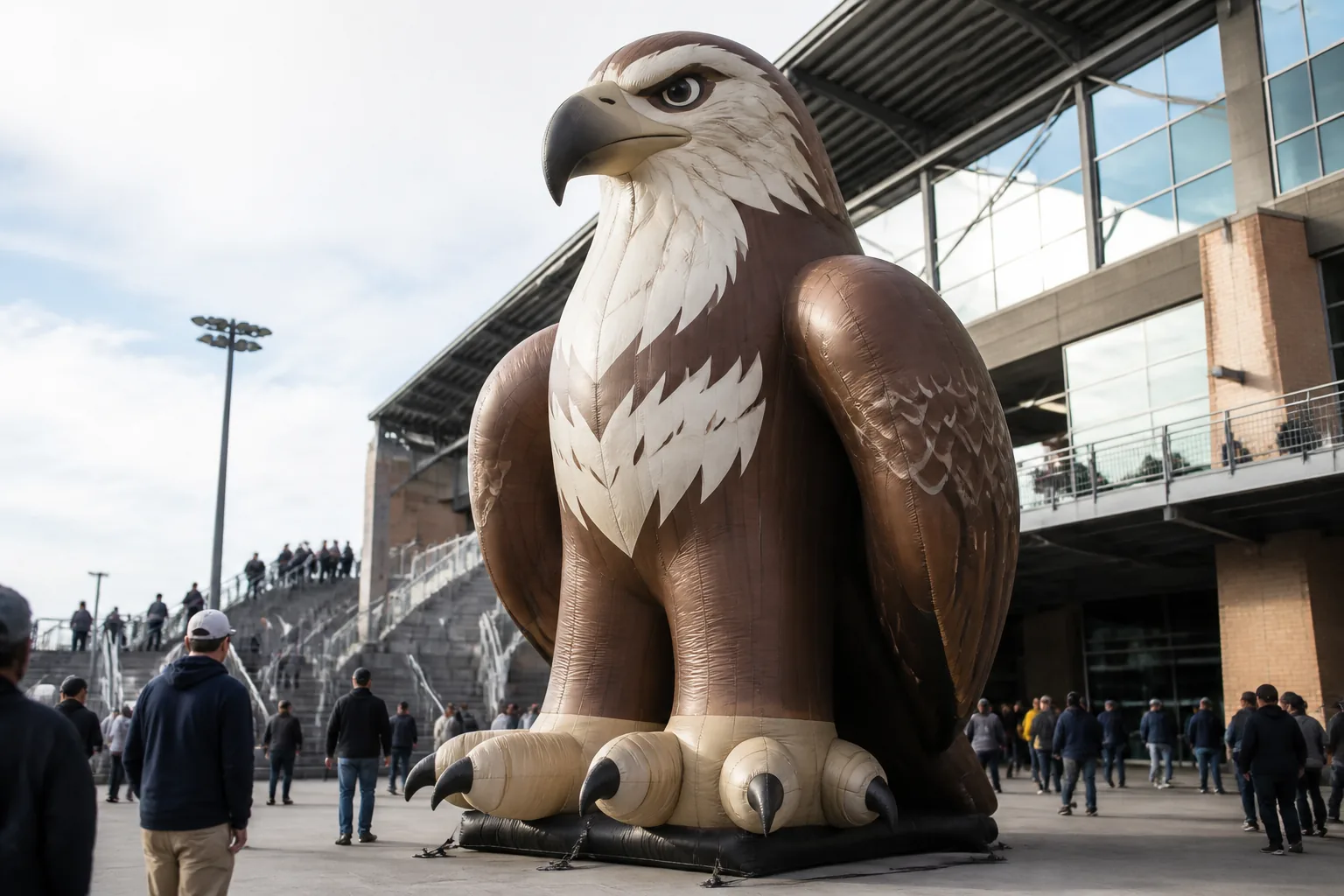
This guide is written for brand owners, event-production agencies, import distributors and project procurement teams in the United States, United Kingdom and Australia buying stationary advertising mascots for retail entrances, exhibitions, launches and supervised photo zones. It does not cover wearable costumes, bounce houses or climbable play equipment. The custom inflatable mascot category is the right product starting point; brand activations and retail promotions provide the installation context.
1. Assemble a reference pack that defines the character
A brand team may have a character style guide, a 2D illustrator's file, a promotional poster or an existing small figurine. These are useful starting points, but each answers a different question. A front illustration indicates the expression; a side profile defines depth; a physical reference shows proportions; an original vector file can be used for selected printed details. A single marketing screenshot does not define the back of the head, the shape of the ears, or the depth of the body.
Ask the character owner to label the front, side, rear and three-quarter references, and identify the current artwork revision. Mark any missing view as "design development pending" rather than allowing an arbitrary back shape to become an assumed production instruction. Supply color references and brand guidelines if they exist. If a third-party character or logo is involved, obtain the appropriate production-use permission from the rights holder; an agency's possession of an image is not proof of a license.
2. Approve the silhouette before fine artwork
An inflatable mascot is made from shaped fabric panels and air-supported volume. A long, thin arm, small neck, tall hat, pointed ear or narrow tail that looks appealing on paper may require structural changes. Ask the supplier to review each conspicuous appendage for buildability and for effects on the final profile. Any proposed simplification must return to the brand approver instead of being accepted informally by the production team.
Evaluate the figure in front, side, rear and three-quarter views against the same proportional reference. Record the head-to-body ratio, widest silhouette, base shape, intended audience-facing direction and any feature that must remain visible when viewed from a distance. Do not infer precise achievable curves, material stiffness or supporting structures from a computer rendering. Require a revised drawing when the shape changes.
3. Make the face a controlled approval zone
Mascot recognition depends heavily on eye spacing, pupil direction, eyebrows, mouth curvature, cheek position and any signature markings. A flat eye graphic may shift in apparent position when printed across a curved inflated surface; panel seams can also interrupt a feature. Ask for close-up views that show the intended face in relation to the actual head geometry, not a floating overlay that ignores seams.
Use an annotated visual proof to distinguish must-match brand features from permissible manufacturing interpretation. For example, a brand may require the relative position of both eyes and a particular mouth expression while allowing minor adjustments to hidden back-panel seams. There is no universal visual tolerance appropriate for every character: agree the acceptance standard with the rights holder and manufacturer before production. A monitor preview cannot guarantee an exact printed-fabric color match.
4. Approve overall dimensions and the full occupied footprint
The headline height is only one measurement. The approved dimensioned drawing should show overall inflated height, maximum width, maximum depth, base footprint and protrusions, as well as where the blower or valve, power cable and attachments sit. A tail or extended hand can require extra space beyond the body's nominal width. Separate these inflated dimensions from packed-case dimensions, which cannot be reliably derived until the packaging method is known.
For photo zones and retail entrances, the organizer must assess circulation, access, supervision and emergency routes. Treat the mascot as a visual advertising display, not an object for visitors to climb or sit on. A venue-approved floor plan, not the supplier's 3D render, determines whether the installation is suitable at that location.
5. Request a character-specific construction proposal
The suitable textile or coated fabric, panel layout, seam approach, reinforcement, inflation method and accessory kit depend on shape, scale, operating environment and reuse requirements. Do not copy a PVC thickness, blower wattage, air-pressure number or wind rating from an unrelated arch or air dancer listing. Ask for the supplier's proposed construction for this mascot and a clear list of what remains subject to technical approval.
If the proposal uses continuous air, review the actual blower model, power supply, plug standard, operating supervision, noise and cable routing. If another air arrangement is proposed, obtain its corresponding operating and handling instructions. Confirm whether the quoted kit includes the air equipment, connectors, storage bag, fixing accessories and any service materials; a shell-only price and a complete-kit price are not equivalent. The site's blower selection resource can help structure the questions, but does not substitute for equipment approval.
6. Separate indoor venue approval from outdoor anchoring review
Indoor halls may impose limits on height, footprint, power connections, surface protection, available setup windows and evidence requested by the organizer. Outdoor sites add exposure to wind and weather, ground conditions, access by the public, approved fixing or ballast methods, and stop-use decisions. No universal outdoor wind limit or ballast weight should be assigned without assessing the actual proposed structure and site.
The buyer should identify the venue contact, responsible installer and any qualified local professional who must review the installation. Request the proposed securing arrangement, but confirm permission and suitability at the venue separately. The outdoor inflatable anchoring guide lists useful briefing inputs; it is not a structural certificate or local permit.
7. Keep brand and site sign-off records separate
One email saying "approved" is often ambiguous. The brand owner may be approving the character's expression, while the contractor is assessing fit, power, accessibility and local permissions. Use separate approval owners and make any outstanding questions visible.
| Approval record | Decision owner | Evidence to retain |
|---|---|---|
| Brand visual approval | Rights holder or authorized brand agency | Versioned multi-view render, key face details, approved artwork and color references |
| Manufacturing specification | Buyer technical contact and supplier | Overall dimensions, proposed construction, air equipment and itemized accessories |
| Venue/installation approval | Venue, organizer and qualified local installer | Site footprint, power, fixing restrictions, visitor separation and shutdown arrangements |
| Pre-shipment acceptance | Buyer-named reviewer | Agreed inflation photos/video, selected dimensions, accessory count and packing list |
If an approval is conditional, record the condition and its owner. A visual design approval should not be represented as proof of electrical compliance, flame performance, outdoor suitability or venue permission.
8. Agree the pre-shipment proof package before production
Request photographs or video of the inflated finished unit from front, both sides, rear and three-quarter angles. Include close-ups of the character's eyes, mouth, important printed marks, visible seams and attachment positions, plus the agreed key dimensions and a counted record of equipment and accessories. Match those records to the approved drawing revision and the purchase order's included items.
These images can document agreed visual and packing checks, but they cannot alone establish a material certificate, electrical safety, a wind rating or local installation approval. Where a physical sample or independent inspection is needed, agree its scope, cost and decision gate in the commercial quotation. For a related method of preparing inspection evidence, see the pre-shipment inspection guide for inflatable product replicas; that separate guide does not certify mascots.
9. Control revisions and brand permissions
Assign one approval owner and a revision code to each drawing and print file. A change to an eye shape, logo, ear, material, size or air arrangement may change the pattern, cost, proofing, packing or schedule. Ask the supplier to identify which elements must be reapproved when a revision is requested. Do not treat a casually edited graphic sent through a chat thread as an approved manufacturing file.
For licensed characters, record who granted permission and what the authorized use covers, including the product type and intended distribution or event use. The buyer and rights holder must resolve their own licensing requirements. This article is a sourcing checklist, not legal advice or a claim that InflatCraft holds third-party trademark permissions.
10. Compare complete quotation scope, not only unit price
For every proposed item, identify the finished dimensions and revision, quantity, proposed material, print coverage, air-system equipment, power accessories, fixing or attachment components, storage arrangement, packing method, and what the buyer's local team must supply. For international orders, request packed dimensions and gross weight after the packing proposal is determined and document the agreed shipping term, named place and exclusions.
Give the supplier both the required physical arrival date and the event opening date. Leave room for site delivery windows, local receiving, installation and inspection. Production duration, shipping route, taxes, applicable compliance documents and arrival timing must be confirmed for the actual order; no generic category claim guarantees them.
11. Copy this initial mascot RFQ matrix
Use "pending" if a field is genuinely unknown. Supplying a qualified unknown is preferable to fabricating a specification.
| RFQ field | What the buyer should provide |
|---|---|
| Product and use | Stationary inflatable mascot; retail, exhibition, launch or supervised photo zone |
| Character references | Source artwork; front/side/rear references; brand authorization status; revision |
| Dimensions | Target height, widest width, maximum depth and available site footprint |
| Quantity | Total units and any different approved size or graphic versions |
| Critical features | Facial proportions, distinctive markings, permitted simplifications |
| Environment | Indoor/outdoor, surface, clearance, public access and operating hours |
| Air/power | Known site supply and plug restrictions; supplier system proposal pending |
| Fixing and supervision | Venue contact, installation operator, permitted securing method |
| Pre-shipment proof | Required inflated views, measurements, accessory and packing record |
| Destination | Country, city, postal code, receiving address restrictions and delivery window |
| Dates | Required arrival, installation and first-use dates |
| Approval contact | Person authorized to sign off brand artwork and technical changes |
12. Request a manufacturable response
Ask the supplier to classify each requirement as confirmed, proposed for approval, or not yet determinable. That distinction helps procurement, the brand approver and the local installer work from the same scope, even when early artwork or venue information is incomplete. An attractive render is a start; a controlled approval set is the basis for a useful quotation.
To move forward, share the character references, approximate dimensions, quantity, intended use, destination and required dates through the InflatCraft RFQ route, or email sales@inflatcraft.com. The form can begin with product type, size, quantity and one reply contact; confidential files can be handled through an agreed follow-up channel. No size, price, certificate or delivery date is guaranteed by this guide.
Continue from this guide
The main Inflatable Mascots product page supports the initial specification; Brand Activations, Retail Promotions and Exhibitions & Trade Shows help define application-specific constraints. Buyers can compare destination requirements for the United States, United Kingdom and Australia. The next step is a practical Request for Quote.
Product Buying Guides
More on choosing and ordering custom inflatables.
Reflective Event Spheres or Helium Advertising Balloons? | InflatCraft
Compare air-filled reflective spheres with helium advertising balloons by installation, artwork, operating responsibilities and quotation scope.
Fixed Character Displays or Wearable Mascots? | InflatCraft
Compare a stationary character display with a wearable inflatable mascot by interaction, performer requirements, staffing and quotation scope.
Sports Entrance Tunnels or Event Tents? | InflatCraft
Plan a branded sports tunnel around usable passage, event operations and artwork, and distinguish it from an occupied event tent.
Custom Inflatable Displays for Trade Shows
A practical B2B guide for choosing custom inflatable arches, mascots, product replicas, logo signs, and air dancers for trade show booths.
Compare sizes, materials and air systems on the custom advertising inflatable product range page before sending an RFQ.
Relevant Product Pages
Compare specifications before submitting an RFQ.
Buyer FAQ
