
Buyer Guide
Factory-Direct vs. Trading Company: How to Verify Who You're Really Buying From
Many buyers sourcing custom inflatables never actually reach a factory — they reach a trading company that forwards their order to one. This adds a markup, slows communication, and removes any visibility into how the product is actually made. Before placing an order, a few direct questions can confirm whether you're dealing with the manufacturer or an intermediary.
By InflatCraft Product Team • Last updated
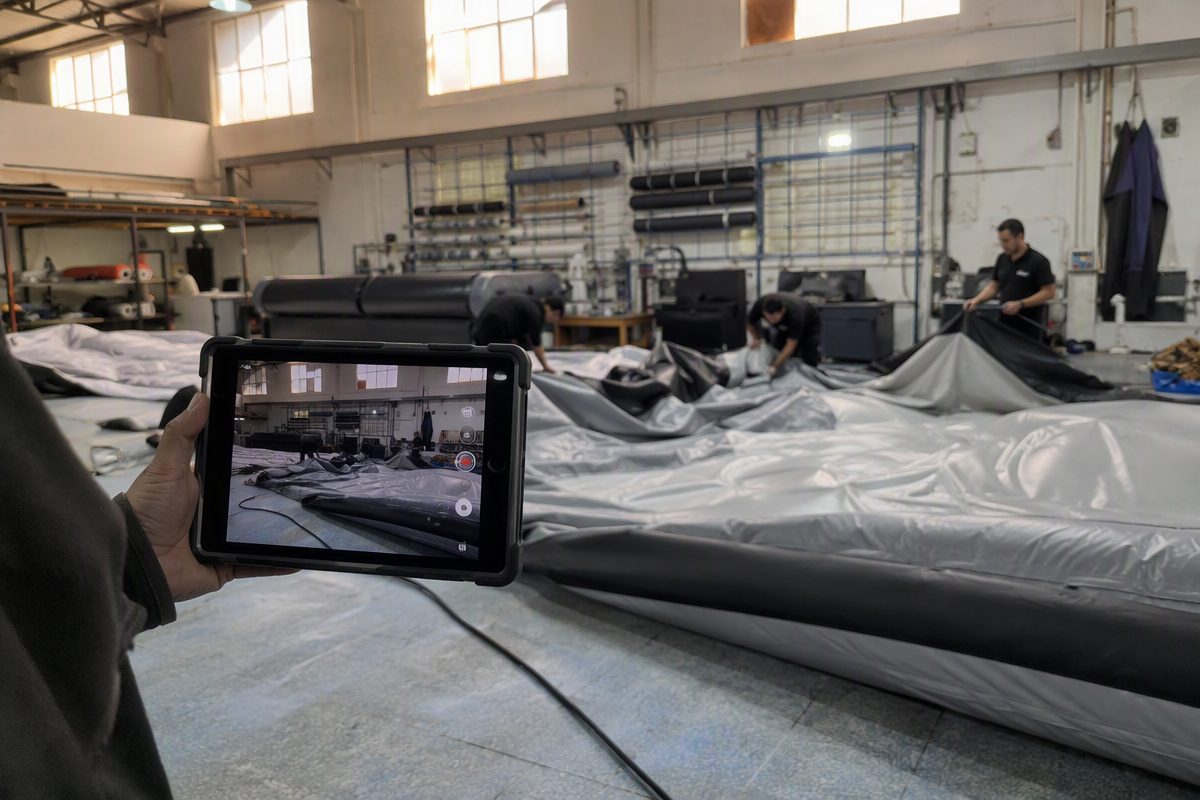
What's the difference between a manufacturer and a trading company?
A manufacturer produces the inflatable in-house — cutting, welding, printing, and quality inspection all happen under one roof. A trading company takes your order, sources it from one or more factories, and manages communication on their behalf, typically adding a margin for that service. Neither model is inherently dishonest, but pricing, lead time accuracy, and your ability to request production changes differ significantly between the two.
Why does it matter which one you're buying from?
Buying through a trading company usually means:
- A price markup you can't see or negotiate directly
- Slower answers to technical questions, since they need to check with the factory
- Limited ability to request mid-production changes or verify progress
- Less accountability if something goes wrong, since responsibility can be passed between parties
Buying factory-direct means the people answering your questions are the people making your product — specification changes, artwork clarifications, and production timing questions can be answered without a relay.
What questions reveal whether you're talking to a factory?
Ask directly:
- "Can you send a photo or video of my product currently in production?"
- "What blower/air system do you use for this specific product size?"
- "What's your in-house printing method — screen print, digital, or heat transfer?"
- "Can I request a small artwork adjustment mid-production?"
A factory answers these immediately and specifically. A trading company either can't answer without delay, or gives a generic answer that doesn't match your exact product.
What should I look for in early communication?
- **Specificity**: Does the reply reference your exact dimensions and product type, or is it a generic template response?
- **Speed on technical detail**: Trading companies are often fast on price, slow on engineering specifics
- **Willingness to share production evidence**: Photos or short videos from the production floor are a strong signal
- **Consistency across conversations**: A factory's answers about material, MOQ, and lead time should stay consistent if you ask the same question twice
How does this affect pricing?
Factory-direct pricing reflects actual production cost plus the manufacturer's margin — no added layer. This doesn't guarantee the lowest price on every order, but it means the number you're quoted maps directly to what's being produced, not to a negotiated markup on top of an unseen factory price.
When a trading company is the better choice for you
This page is published by a manufacturer, so it is worth being explicit about the cases where the other option wins. There are several, and a buyer who picks a factory in one of them usually regrets it.
The clearest is a mixed basket. If the campaign needs inflatables, printed banners, branded tents, giveaways and flooring on one purchase order and one shipment, a factory that makes only inflatables cannot serve that. A trading company consolidates suppliers, consolidates freight, and gives you one invoice and one person to chase. Buying those five things from five factories costs more in coordination than it saves on unit price.
The second is scale. A very small order is a small order to a factory too, and it queues behind larger work. An intermediary who aggregates many small buyers can sometimes get attention and turnaround that a single small order would not.
The third is working hours and language. If a project needs same-day answers inside your own business day, in your own language, and nobody on your side is set up to work across an eight-hour gap, an agent in your timezone is a real service and worth paying for.
The honest summary is that the factory route pays off when the product is the whole job, the specification matters, and you want to talk to the people who cut the material. It pays off less when the product is one line item in a larger logistics problem.
How to tell which one you are actually talking to
The distinction matters more than the label on the website, because both describe themselves the same way. A few questions separate them quickly, and none of them are confrontational.
Ask who prepares the production drawing and whether you can have a change made to it directly. Ask which material specification is being quoted, by name, and why that one. Ask what happens to the schedule if the artwork changes after approval. An answer that has to go away and come back for all three is an answer from someone who is not cutting the material.
None of this makes an intermediary dishonest. It makes them an intermediary, which is a legitimate business with real advantages. It only becomes a problem when the buyer believes they are talking to the factory, prices the job on that basis, and then discovers a margin and a communication delay they had not budgeted for.
What a factory cannot do for you
The case for buying direct is usually made in terms of price and control. Both are real, but they come with limits that are rarely stated, and a buyer who has not planned for them will find the experience worse rather than better.
A factory holds no local stock. There is no warehouse in your country to pull a replacement from, so a damaged piece two days before an event is a production and freight problem, not a swap. If the campaign cannot survive that, the mitigation is to order earlier or to order a spare, not to assume the supplier can absorb it.
A factory works in its own hours. Questions asked at the end of your day are answered at the start of theirs, which is a real cost on a project with daily decisions. It is manageable when the specification is settled and the exchange is periodic; it is painful when the design is still moving.
And a factory quotes its own product. Consolidating several suppliers into one shipment, handling local delivery, or taking responsibility for items it did not make are services an intermediary provides and a manufacturer generally does not.
The quotation looks different, and that is the point
A factory quotation and an intermediary quotation are not the same document, and comparing them line for line is how buyers reach the wrong conclusion.
A factory quote tends to be specification-led: material named, air system class stated, accessories listed, incoterm explicit, lead time counted from design approval. It is harder to read and easier to verify. An intermediary quote is more often outcome-led: a delivered price for a described item. It is easier to read and harder to check, because the specification sits behind a margin you cannot see.
Neither is dishonest. But they answer different questions. If what you need is a number you can put in a budget with one supplier to chase, the second is genuinely more useful. If what you need is a product you can specify, compare and reorder to the same build in a year, the first is the only one that supports it.
When the factory is not the factory
The category itself can be blurred, and it is worth knowing where the line sits before treating a supplier as one or the other.
Manufacturers subcontract. A workshop that cuts and welds PVC may not make its own blowers, and almost certainly does not make the lighting, the ballast bags or the carry cases. That is normal and not a red flag: the question is whether the core product is made in house, not whether every accessory is.
The signal worth checking is the production drawing. A supplier who prepares the drawing, can explain why a panel layout is what it is, and can change it while you are talking, is working on the product. A supplier who has to send every specification question away and bring an answer back the next day is passing it on, regardless of what the website says.
What to verify, in the order that is worth doing it
Verification is usually described as a list of documents. In practice the order matters more than the length, because the cheap checks eliminate most of the uncertainty before anyone has to inspect anything.
Start with the registered entity. A business licence names a legal person, a registered address and a scope of business, and it is the thing any later claim would be made against. On this site that entity is Tianjin Mufeng Trading Co., Ltd., stated on the company page rather than left to be discovered.
Then ask process questions that only someone with production access can answer specifically: how the pattern for your shape will be developed, where the print is done, what the drawing will show, and how the piece will be test-inflated before packing. Vague answers here are more informative than any certificate.
Only then is a video call or an inspection worth arranging, and by that point you know what to look at. Reversing the order — inspecting first, asking process questions later — is how buyers spend money confirming things a two-line question would have settled.
The intermediary you might actually want
The honest version of this comparison has to admit that some intermediaries add more than they cost, and that a buyer who rules them out on principle can end up worse off.
The clearest case is a buyer running one project with several components from several sources — an arch, printed banners and a stage set, say — who needs them consolidated into one shipment and one set of documents. Coordinating that is real work, and paying someone to do it is not a markup for nothing.
The second is the buyer with no capacity to manage the process at all. Someone who cannot review a drawing, cannot chase an approval and cannot handle a customs query is better served by a competent intermediary than by a direct relationship they do not have time to run.
What is not a good reason is the belief that an intermediary carries the quality risk. They carry the commercial relationship; the piece is still made by whoever makes it, and a drawing approved through an intermediary is exactly as binding as one approved directly.
What to keep on file either way
The distinction matters most at the moment something goes wrong, and at that moment what protects a buyer is not who they bought from but what they can produce in writing.
Four documents cover almost everything. The registered entity name on the proforma invoice, which is the party any claim is made against and which should match the name receiving the payment — a mismatch between the two is the single clearest warning sign in this trade. The approved production drawing, which is what defines whether the delivered piece is correct. The specification itself, written out rather than implied: material and thickness, accessories, packing and incoterm. And the packing list showing what was actually shipped.
Keep the approval trail too, not just the final files. A drawing approved by email on a dated message is evidence; a drawing approved verbally on a call is a recollection, and the two are not equivalent when a dimension is disputed.
None of this requires a factory relationship or an intermediary relationship. It requires the same four documents in either case, which is why the verification question, useful as it is, matters less than buyers tend to assume once the paperwork is in order.
Sourcing and Ordering Guides
More on quoting, terms and shipping.
Payment Terms and Deposits for Custom Inflatable Orders
A buyer's guide to how payment terms and deposits typically work when ordering custom inflatable products — what's standard, what varies, and what to confirm before ordering.
How to Brief a Custom Inflatable Manufacturer
A step-by-step checklist for briefing a custom inflatable manufacturer — what information to prepare before you request a quote, from product type to shipping details.
Sample Lead Time vs Bulk Production
How to separate sample approval, production lead time, artwork confirmation, technical review, quantity, and delivery planning.
Shipping and Packing Custom Inflatables
How packed volume, export cartons, carry bags, accessories, freight options, destination, and delivery deadlines affect custom inflatable shipping.
Compare sizes, materials and air systems on the custom advertising inflatable product range page before sending an RFQ.
Relevant Product Pages
Compare specifications before submitting an RFQ.
Buyer FAQ
