
Buyer Guide
Sample Lead Time vs Bulk Production: What Buyers Should Expect
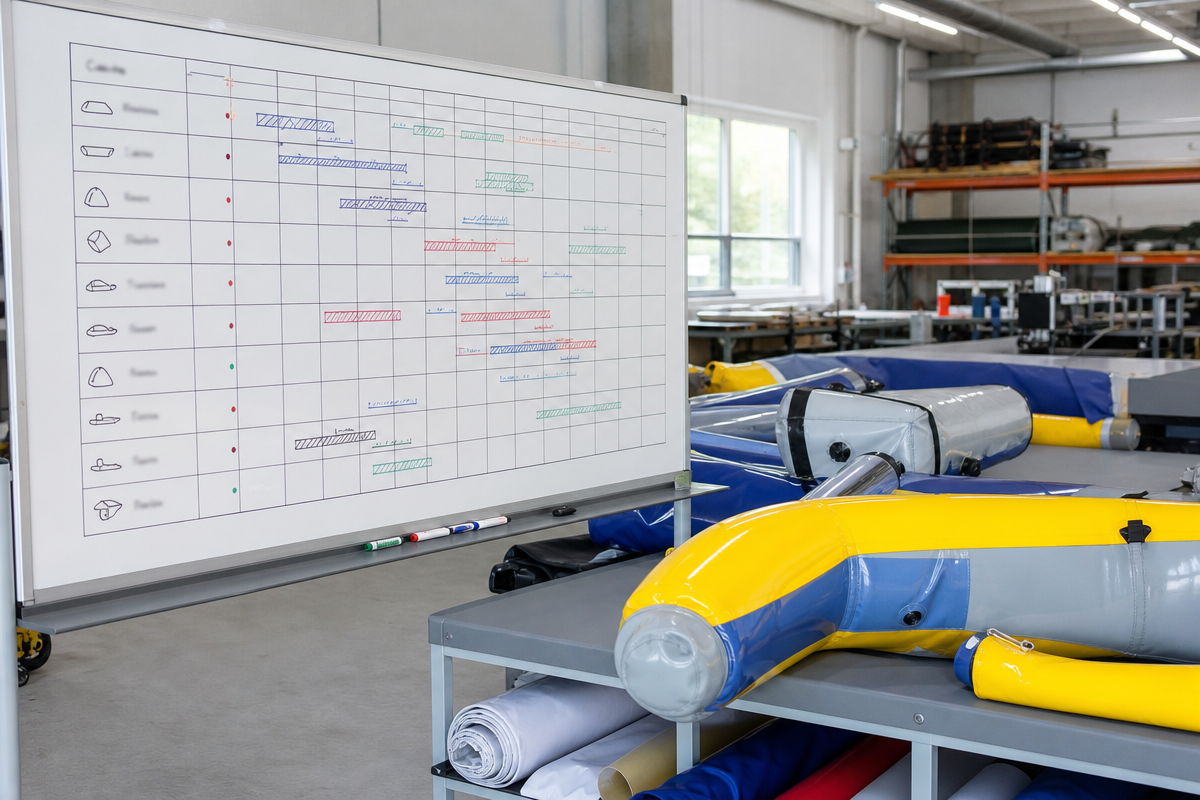
Sample lead time and bulk production lead time should be treated as separate planning questions. InflatCraft’s typical production reference is 3–8 days for simple items, 7–15 days for standard custom work and 15–25 days for complex or large pieces after final artwork, dimensions, and technical specification approval, but a sample or approval unit may require its own drawing, material, printing, review, and shipping steps. Buyers should state whether they need a sample, one finished unit, or a multi-unit order and request a project-specific schedule before confirming a delivery date.
By InflatCraft Product Team • Last updated
What is the difference between a sample and a production unit?
A sample or approval unit is used to review shape, material, color, artwork, seams, accessories, and operation before a larger order. A finished one-piece order may follow a different route from a sample that precedes bulk production.
State the purpose of the unit clearly so the quotation identifies what is being approved.
When does the production lead-time clock start?
The typical production reference (3–8, 7–15 or 15–25 days, by complexity) begins after final artwork, dimensions, and technical specification approval. Earlier concept discussions, drawing revisions, material selection, and artwork corrections are not the same as the production period.
Complex geometry, larger quantities, special printing, and additional approval rounds may require a project-specific schedule.
Which inputs can change the schedule?
Product complexity, target size, quantity, print coverage, special finish, air system, accessories, packaging, destination, and delivery deadline all influence planning.
A buyer should provide these inputs at RFQ stage rather than request a generic promise before the structure is defined.
How should delivery timing be documented?
Ask the quotation to separate drawing and approval milestones, production timing, packing completion, and shipping or freight timing. The final schedule should reflect the agreed specification and destination rather than a generic lead-time claim.
When a sample is a waste of time and money
Samples are treated as automatically prudent, and on a complex piece they are. On a simple one they can cost a project its date for no information gained.
Do the arithmetic before deciding. A sample runs through the same production queue as any other piece, then ships, then gets reviewed, then any change is made, then bulk production starts and ships again. With production at 3–8 days for simple items and freight at 4–15 working days by air, a sample and a bulk run are two full cycles, not one plus a little. If the installation date cannot absorb both, the sample is not a safety measure; it is the thing that makes you late.
There is also the question of what the sample would tell you. On a standard arch in two colours, the production drawing and a printed colour proof answer almost everything a physical sample would, at a fraction of the time. Samples earn their place where the shape is unusual, where a character has to be recognisable, where the print wraps a complex curve, or where the piece will be reordered many times and the first one is the reference for all of them.
What a sample proves, and what it does not
A sample proves the shape, the colour on the actual material, the seam placement and the way the piece stands up. Those are real answers and they are hard to get any other way.
It does not prove durability, because one piece run in a few days tells you nothing about how the same build behaves after a season outdoors. It does not prove the supplier can repeat it, because a sample is made with more attention than a production run. And it does not prove the lead time, because a single piece moves through a queue differently from a batch.
So a buyer sampling to answer "is this shape right" is using the tool correctly. A buyer sampling to answer "can I trust this supplier" is using an expensive tool for a question it does not answer. The second question is better tested with a written specification, a production drawing and an inspection arrangement.
What to specify so a sample is worth having
A sample ordered as "one of these to see what it looks like" answers less than it should, because the thing it is meant to test was never stated.
Decide the question first and specify to it. If the question is colour, the sample needs to be printed on the same material specification as the bulk run and viewed in the light the piece will actually stand in; a colour approved under office lighting can look wrong on a forecourt. If the question is shape recognition on a character, the sample can be smaller than the final piece, which saves cost and time without losing the answer.
If the question is whether it fits the venue, a sample is the wrong tool entirely. A drawing with the inflated dimensions and the footprint answers that, and answers it in a day rather than in two production cycles.
The cheaper things to do before ordering one
Several pre-production checks give a large part of what a sample gives, at a fraction of the time, and are worth exhausting first.
The production drawing is the main one. It shows the inflated dimensions, the footprint, the panel layout and where the seams fall, and it is the document that later defines whether the delivered piece is correct. Most disagreements that buyers hope a sample will prevent are actually drawing disagreements.
A printed colour proof on the actual material answers the colour question at a cost closer to postage than to production. A material swatch answers the texture and finish question. Together those two cover most of what a physical sample would show about the surface.
What none of them show is how the piece stands up, which is the one thing that genuinely requires a built sample. If that is the open question, order one. If it is not, the drawing and the proofs are faster and cheaper.
Treating the approved sample as the reference
On a design that will be reordered, the sample has a second life that buyers often waste: it is the reference the later runs are matched against.
That only works if it is kept and recorded. Keep the approved sample rather than using it at an event and losing it, and keep the approved drawing and print file reference alongside it. A reorder against a documented reference is a rerun; a reorder against a memory of last year is a new job with a new set of small differences.
It also sets the expectation properly. A production run matched to an approved sample is a reasonable thing to ask for. A production run matched to a sample nobody kept is not, and the resulting argument has no evidence on either side.
The schedule arithmetic, done in the right direction
A sample adds a full cycle to the project, and the mistake is to discover that by adding it forwards from today rather than subtracting it backwards from the date that matters.
Work backwards. Fix the in-hand date. Subtract the freight window: 4–15 working days by express or air, or 20–45 days by sea, rail or truck, after dispatch and subject to route and customs. Subtract the bulk production band: 3–8 days for simple items, 7–15 days for standard custom work, 15–25 days for complex or large pieces, counted from final approval. What is left is the window available for the sample and for the approval rounds around it.
Two things usually go missing from that sum. The approval time itself, which is the buyer's own turnaround on a drawing or a proof and is frequently the longest single delay. And the possibility that the sample shows a problem, because a sample that can only be approved is not a test — the schedule has to survive the sample being wrong.
If the arithmetic leaves no room, the honest conclusion is that there is time for a sample or there is time for the event, not both. Choosing that deliberately is better than starting a sample and abandoning it halfway.
When to ask for progress evidence instead
Between "order a sample" and "wait and hope" there is a middle option that costs nothing and is underused: agreeing in advance what evidence will be sent during the run.
A photograph of the cut panels against the drawing catches a pattern error before it is sewn. A photograph of the printed panel catches a colour or artwork problem before it is assembled. A test inflation photograph before packing catches almost everything else, and it is the one worth insisting on because it is the last point at which a fix is cheap.
None of that requires a sample order or an inspection visit. It requires asking at quotation stage rather than at shipping stage, and it works because the factory is taking those photographs anyway.
Why a perfect sample does not guarantee a perfect run
The assumption behind most sample orders is that approving one piece guarantees the rest. It narrows the risk considerably, and it is worth being clear about what it does not cover.
Print colour can shift between material batches. A colour approved on one roll is a strong indication rather than a certainty on another, which is why a serious colour requirement is stated as a reference to match rather than as "the same as the sample".
Hand-finished work varies. Seams, welds and attachment points on these products are made by people, and a run of twenty has more variation than a run of one — which is the argument for checking a batch rather than checking the first piece out of the carton.
And a sample made in a quiet week and a run made in a busy one are not made under identical conditions. That is not a reason to skip the sample. It is a reason to keep the approved sample as the reference and to inspect the batch against it rather than treating approval as the end of the quality question.
Who should pay for the sample, and what that tells you
Sample cost is treated as a negotiation, and the way a supplier handles it is informative beyond the money involved.
The normal arrangement is that the buyer pays for the sample, because it is a custom piece made to a drawing and consumes the same pattern development and print setup that a production unit does. A supplier who offers a free custom sample on a first enquiry is either treating it as a marketing cost or has recovered it somewhere in the quotation, and it is worth knowing which.
What is reasonable to ask is whether the sample cost is credited against a subsequent production order. That arrangement aligns both sides: it makes the sample cheap if the project proceeds and keeps it paid for if it does not.
What is not reasonable is expecting a sample to be quick because it is small. A sample is a full production cycle on one piece — pattern, print, assembly, test inflation — so it occupies the same bands as the run it precedes, and ordering one is a schedule decision before it is a cost decision.
Deciding it in one question
All of the above reduces to a single test, and applying it early saves the fortnight that the deliberation otherwise takes.
Ask what you would do differently if the sample came back wrong. If the answer is concrete — change the material, change the size, change the supplier, cancel — the sample is worth its cycle, because it is buying a decision you would actually act on.
If the answer is that you would proceed anyway because the date leaves no alternative, the sample is not a test. It is an expensive reassurance, and the same money spent on tightening the drawing and agreeing progress photographs protects the order better.
That test also explains the timing. A sample is worth most at the start of a programme, where the decision it informs still has room to change things, and worth least immediately before a deadline, where nothing can change regardless of what it shows.
Sourcing and Ordering Guides
More on quoting, terms and shipping.
Shipping and Packing Custom Inflatables
How packed volume, export cartons, carry bags, accessories, freight options, destination, and delivery deadlines affect custom inflatable shipping.
Using AI to Brief a Custom Inflatable Manufacturer
A practical guide for using AI tools to organize a buyer brief, spot missing RFQ inputs, and prepare a cleaner quotation request before you contact a manufacturer.
Importing Custom Inflatables into the UAE
How a custom inflatable clears into the UAE: GCC duty, 5% import VAT, who acts as importer, and the documents to have ready before the shipment leaves.
Dubai Event Permits for Inflatable Installations
Who issues an event permit in Dubai, what the venue or mall adds on top, and which drawings and specifications the supplier is asked for.
Compare sizes, materials and air systems on the custom advertising inflatable product range page before sending an RFQ.
Relevant Product Pages
Compare specifications before submitting an RFQ.
Buyer FAQ
