
Buyer Guide
Shipping and Packing Custom Inflatables: A Buyer's Guide
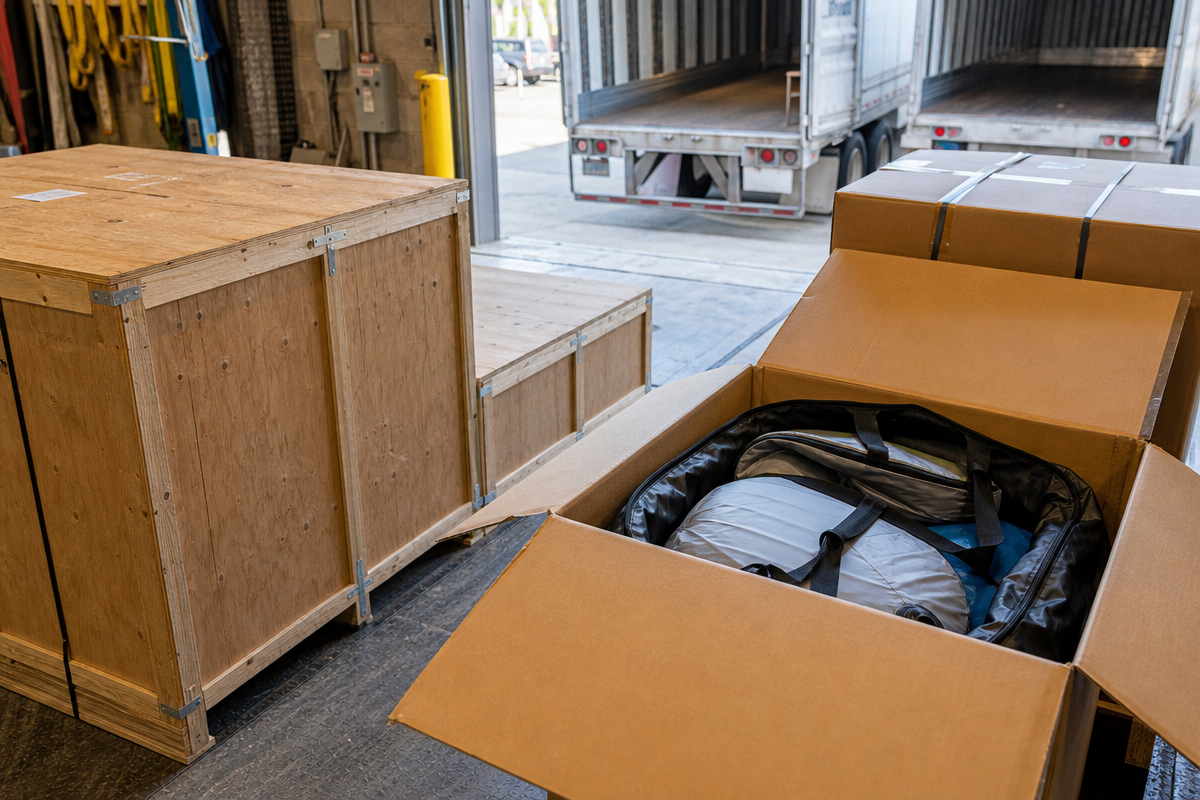
Shipping a custom inflatable starts with the packed specification, not the inflated size alone. Confirm the storage or carry bag, export carton, packed volume, gross weight, accessory list, surface protection, destination, quantity, and required delivery date before comparing express, air freight, or sea freight. Blowers, ballast, lighting, repair material, and other accessories may change the carton and freight assumptions, so they should be listed in the quotation.
By InflatCraft Product Team • Last updated
What should be included in an inflatable packing specification?
The packing specification should identify the heavy-duty storage or carry bag, export carton, protective measures, accessory list, packed volume, gross weight, and any handling or shipping marks required for the destination.
For printed, reflective, or delicate surfaces, confirm how folding, abrasion, moisture, and carton compression will be managed.
How do accessories change the shipment?
Blowers, ballast, lighting, ropes, repair material, and other accessories can change carton size, weight, and packing arrangement. Ask whether each item ships in the same carton or under a separate line in the quotation.
This matters when comparing freight options or planning venue delivery and storage.
Which freight option should a buyer choose?
Express, air freight, or sea freight can be compared according to packed volume, destination, quantity, and required delivery date. There is no single best option without the packed specification and deadline.
A buyer should also confirm whether the quoted freight is door-to-door, port-to-port, or another agreed service basis before ordering.
How early should shipping be reviewed?
Review packing and freight during technical approval, not after production. Destination voltage, venue access, delivery date, carton handling, and customs or documentation requirements can affect the final order route.
When air freight is the wrong answer even though it is faster
Air is 4–15 working days after dispatch and sea is 20–45 days, so air looks like the safe choice whenever a date is tight. On this product it often is not, because inflatables are bulky for their weight and air freight is charged on volumetric weight rather than actual weight.
The practical consequence is that a large arch can cost more to fly than it cost to make. At that point the sensible question is not how to move it faster but whether the schedule should have started earlier, and whether a smaller piece or a sea shipment booked three weeks sooner would have served the same campaign at a fraction of the freight.
Air is genuinely right for small, high-value or late-decision pieces, for a replacement, and for anything where the alternative is missing the event entirely. It is the wrong default for a large structure ordered on a normal timeline.
Why the packing list is a cost document
Buyers read the packing list as a formality and the invoice as the commercial document. On this product the packing list is the one that moves the freight number, because volume decides the cost.
Ask for packed dimensions, carton count and gross weight in the quotation rather than after production. With those three figures a freight forwarder gives a real quote instead of an estimate, and the landed cost becomes comparable between suppliers. Without them, two offers that look equal on goods price can differ substantially once the cartons exist.
The same list is what customs sees. The invoice has to match the cartons, accessories included. A blower on the packing list but missing from the invoice is the most common paperwork mismatch on this route, and it delays clearance at the worst possible moment.
What actually decides the packed volume
Since freight is charged on volume, packed volume is the number that moves the landed cost, and it is set by choices made long before shipping.
Material specification is the first. A heavier build folds bulkier than a lighter one at the same finished size, so a specification chosen for durability has a freight consequence that should be considered at the same time rather than discovered later.
Accessories are the second, and they are easy to overlook. The blower is rigid and does not compress. Ballast bags, ground stakes, cable covers and a carry case all add volume that the fabric alone does not suggest. A quotation that lists the accessories is also telling you something about the carton count.
The third is whether the piece ships as one unit or several. A large structure that separates into sections can sometimes pack into standard cartons instead of a crate, which changes the handling as well as the volume. It is worth asking whether the design allows it before the pattern is cut, because afterwards it does not.
Choosing the incoterm before the quotation, not after
Incoterms are treated as a shipping detail and settled late. They are a pricing decision and belong at the start, because they determine what the number in front of you actually covers.
An ex-works price is the goods at the factory door. Everything after that is the buyer's to arrange and to pay: inland transport, export handling, main freight, insurance, import clearance, duty and tax, and final delivery. It is the most transparent basis and the most work.
A free-on-board price adds the inland leg and export clearance, which removes the part of the job hardest to do from a distance. It is the common middle ground for buyers who have a freight forwarder but no presence at origin.
A delivered price looks simplest and is the least comparable, because the duty and tax position depends on who imports and where, and those vary by destination. Delivered arrangements here are reviewed by quotation rather than offered as standard for exactly that reason.
The practical step is to ask every supplier to quote on the same basis. Two offers on different incoterms are not two prices for the same thing, and the cheaper-looking one is frequently the one that covers less.
What the packing is protecting against
Packing on this product is not mainly about impact. Fabric tolerates handling better than most freight, and the damage that actually arrives tends to come from three other directions.
Moisture is the first. A piece packed with any residual damp and then shipped by sea for 20–45 days arrives with a problem that no amount of careful handling would have prevented. Anything that has been used outdoors before shipping should be dried properly first, and that is a scheduling question as much as a packing one.
Abrasion from the accessories is the second. Stakes, buckles and the blower housing will work against folded fabric over a long transit unless they are packed separately or boxed. Asking how the hardware is separated from the fabric is a reasonable question and a quick one.
Compression is the third. Cartons stacked in a container carry the weight above them, and a soft carton at the bottom of a stack deforms. This is where crating earns its cost on large pieces, and where it is unnecessary overhead on small ones.
The costs that land after the freight invoice
The freight quotation is the visible number. Several others arrive afterwards, and a landed cost built from freight alone is reliably too low.
Import duty and tax come first, and they depend on the destination and on the classification applied, which is why they cannot be stated here as one figure for every market. What can be said is that they are assessed on a declared value and should be estimated before the order rather than discovered at clearance.
Customs brokerage is a separate charge from freight and is usually billed per entry. Terminal and port handling at destination is another. Final-mile delivery from the port or depot to the venue is a third, and on a large crate it is not a small one — a piece that needs a tail-lift or two people to receive is a different delivery from a parcel.
Storage is the one that surprises people. A shipment that arrives before anyone is ready to receive it accrues demurrage or storage charges at the terminal, which is why the arrival date and the receiving arrangements matter as much as the dispatch date.
Who receives it, and whether they can
Shipping planning concentrates on the origin and stops at the port. The receiving end fails more often, and it fails in ways that are entirely foreseeable.
Ask who physically takes delivery. A venue is usually the wrong answer: venues rarely accept freight for an event that has not started, and a crate refused at the door is a storage charge and a rebooking. A business address with someone present during working hours is the right answer, which often means a warehouse or an office rather than the site.
Ask what equipment is there. A crate on a pallet cannot be received by one person on a residential doorstep, and a delivery quoted to a commercial address with a loading dock is not the same service as one to a location without.
And ask how long the piece will sit before use. Fabric stored damp, or stored under other freight, arrives in service in worse condition than it arrived in the country — which puts the storage conditions back into the shipping decision rather than after it.
When to consolidate and when not to
Because freight is charged on volume with a minimum, several small shipments cost disproportionately more than one larger one. That makes consolidation the default advice, and the default advice is sometimes wrong.
It is right when the pieces are for the same programme, needed on the same date, and going to the same receiving address. One set of documents, one clearance, one delivery, and the per-piece freight falls.
It is wrong when it forces the earliest-needed piece to wait for the latest-finished one. A consolidated shipment moves at the speed of its slowest component, so a single complex piece in the batch — 15–25 days rather than 3–8 — sets the dispatch date for everything travelling with it.
The workable compromise, where the dates genuinely differ, is to split by deadline rather than by piece: an urgent group and a main group, each consolidated within itself. That keeps most of the volume saving without letting one item hold the programme.
The documents that decide whether it clears
Freight moves the piece; documents release it. Most delays at destination are documentary rather than physical, and they are almost all avoidable at the point the order is placed.
The commercial invoice and packing list have to describe the same shipment, and the description has to be specific enough for a customs officer who has never seen the product. "Advertising material" invites a question; a description naming the item, the material and the quantity does not.
The declared value is the buyer's exposure and should match what was actually paid. A supplier who offers to declare a lower value is offering a customs problem rather than a saving, and the buyer is the importer of record who carries it.
Where a certificate of origin, a preferential origin declaration or a destination-specific document is needed, it has to be requested before shipping rather than after arrival. Issuing one retrospectively is difficult and occasionally impossible, and a shipment sitting at a terminal accrues storage while it is sorted out.
The practical step is to ask, at quotation stage, which documents will travel with the shipment and which the buyer has to arrange. It is a single question and it moves the whole documentary problem from the arrival week to the ordering week.
The shipping questions that belong in the RFQ
Nearly everything above is settled more cheaply at quotation stage than at shipping stage, and it takes five questions rather than a conversation.
What are the packed dimensions and the gross weight, and how many cartons or crates. That is the freight quotation, the handling plan and the receiving arrangement in one answer.
What is included in the packing: the blower, the fixings, the carry bag, any repair material, and how the hardware is separated from the fabric in transit.
Which incoterm the price is quoted on, so the figure can be compared with the others on the table rather than assumed to cover the same ground.
Which documents travel with the shipment and which the buyer arranges, including anything destination-specific that has to be issued before dispatch.
And what the dispatch date is, counted from final approval rather than from today, so the freight window can be chosen against a real date instead of an optimistic one.
Sourcing and Ordering Guides
More on quoting, terms and shipping.
Using AI to Brief a Custom Inflatable Manufacturer
A practical guide for using AI tools to organize a buyer brief, spot missing RFQ inputs, and prepare a cleaner quotation request before you contact a manufacturer.
Importing Custom Inflatables into the UAE
How a custom inflatable clears into the UAE: GCC duty, 5% import VAT, who acts as importer, and the documents to have ready before the shipment leaves.
Dubai Event Permits for Inflatable Installations
Who issues an event permit in Dubai, what the venue or mall adds on top, and which drawings and specifications the supplier is asked for.
Planning Gulf Outdoor Inflatables Around the Summer
Why Gulf campaigns cluster in the cooler months, how the trade fair calendar sets the deadlines, and what changes for a piece that has to stand outdoors in summer.
Compare sizes, materials and air systems on the custom advertising inflatable product range page before sending an RFQ.
Relevant Product Pages
Compare specifications before submitting an RFQ.
Buyer FAQ
