Inflatable Advertising Columns for Narrow Footprints
A column buys height where there is no floor area to spare. It is the format for a walkway, a corridor, a stand edge or a plaza where a wide piece would obstruct people but a tall narrow one reads from the far end.
A column is tall and thin, which is exactly the proportion that is least stable on its own. Stability comes from the base: a weighted ring or plate sized against the height, which is why a taller column needs a wider or heavier base rather than the same one scaled up. That base is part of the quotation and part of the shipping weight.
Because the artwork wraps, there is no safe flat panel to put a detailed lock-up on. Marks are sized and spaced so that a complete one is visible from any direction, which in practice means fewer, larger elements repeated around the circumference.
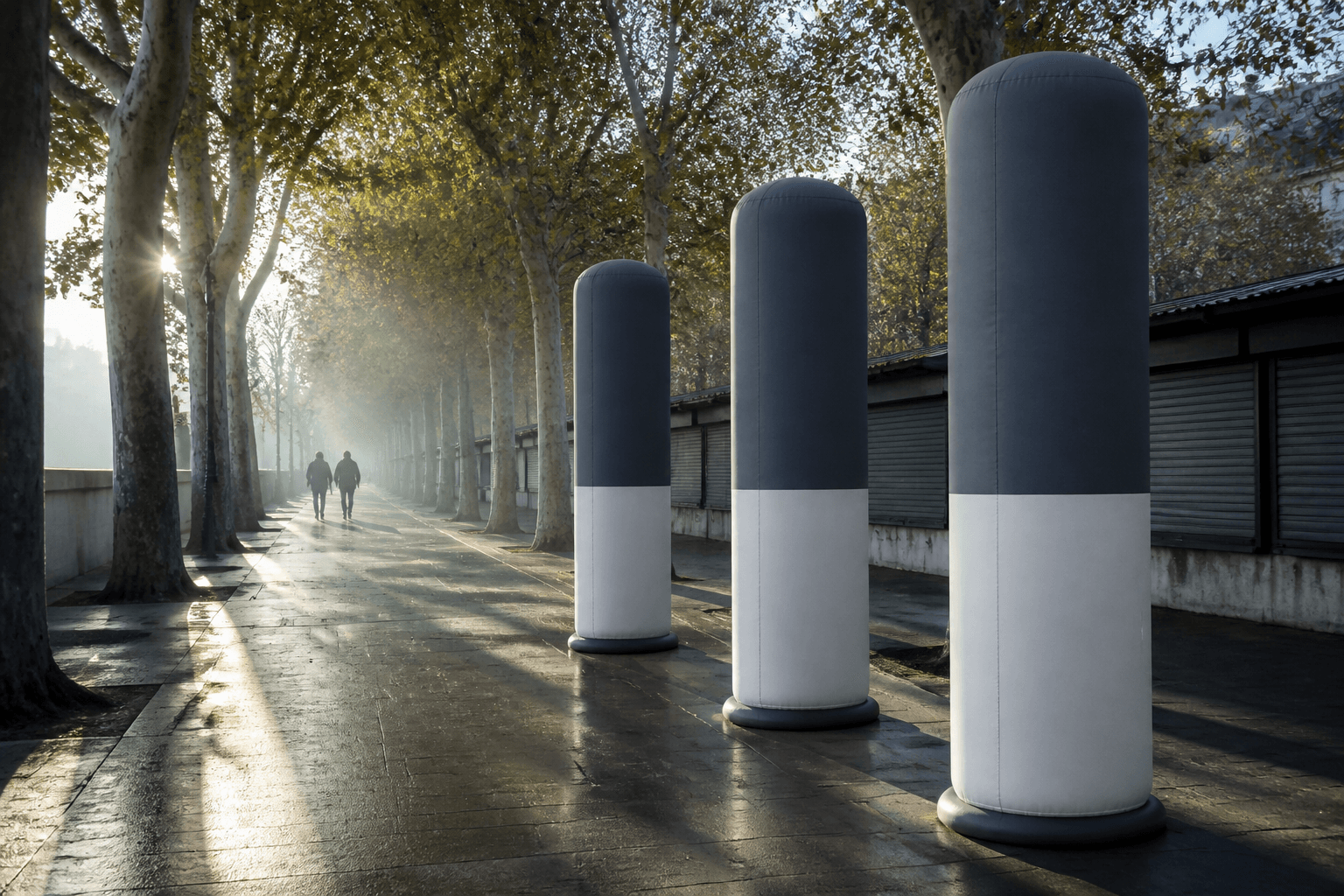
Height without footprint: the base is only slightly wider than the column itself.
Artwork wraps continuously, so there is no front and no back to get wrong.
A run of identical columns marks a route more effectively than one large sign does.
Specification
What a quotation for this format is built from.
Sizes buyers usually order
A logo sign is sized by the distance the mark has to read from. As planning references from delivered project types: trade show stands, forecourts, grand openings, race routes and campus events are commonly 1–3 m high, and festival sites 1–4 m high, where sight lines are longer.
The figure that decides legibility is not the height of the piece but the height of the mark inside it. A tall sign carrying a small logo on a lot of background reads no further than a short one, so send the artwork together with the sign dimensions and the manufacturer will show how large the mark actually lands.
What a flat printed face costs
Air pushes every panel outward, so a surface that has to stay flat for a logo is tied front-to-back with internal baffles. That is a construction decision with a weight and a price attached, and it is the one thing that separates a sign that photographs cleanly from a sign that bulges in the middle.
Where the layout can live on a curve, the baffling can be lighter and the piece is cheaper and quicker to build. Say at the brief stage whether the face has to read flat, because it is not a change that can be made later.
Material and air system
Double-layer PVC is the general construction. 0.4 mm PVC is used on large-format projects, and 0.5 / 0.6 / 0.7 mm PVC mesh where the structure carries load, spans further or faces sustained exposure.
The air system is sized to the piece: the 650 W electric pump moves 1,600–2,000 L/min at 2.0 psi and suits smaller spheres, compact displays and short-duration indoor installations; the 1600 W electric pump moves 4,800–5,200 L/min at 4.5 psi for large-format structures, arches and continuously inflated outdoor displays. Both run on 110–240 V, 50–60 Hz, and the destination plug type is confirmed on the order.
Artwork, colour and the edges of the print
Send print-ready vector artwork with colour references. Brand colours are matched to the print process rather than to a screen, and where a colour sits outside what the process reaches, the manufacturer shows the nearest achievable match on the mockup instead of substituting it silently.
Keep the mark clear of the seams and the edges. A logo that runs to the boundary of a panel will be interrupted by a seam or wrapped around a curve, so the safe area is drawn on the panel layout before printing starts.
Lead time, quantity and freight
MOQ is 1 piece for most custom projects, so a single piece can be approved before a repeat order. Pattern and print setup are paid once per design, so a second unit costs less per piece than the first.
Bulk production typically takes 3–8 days for simple items, 7–15 days for standard custom work and 15–25 days for complex or large pieces, counted from final design approval. Freight comes on top: express or air usually 4–15 working days, and sea, rail or truck usually 20–45 days, after dispatch and subject to route and customs
All of these sit under inflatable logo signs, where the shared specifications and the full buyer checklist live.
Buyer FAQ
Questions that come up before quotation.
Quote Form
Request a Quote for an Inflatable Advertising Column
Send print-ready artwork with colour references, the target dimensions, whether it stands or is suspended, the quantity, the destination and the date it has to be on site.
Start with four essentials: product type, rough size, quantity, and one way to contact you.
Country, timing, artwork, and technical details are optional at this stage. We will request anything else needed for a usable factory quote.
AI Sourcing Guide
Use ChatGPT, Gemini, or Claude to build a cleaner RFQ before you send it to the factory.
AI works best when the brief is structured. This guide turns rough notes into a supplier-ready checklist, then sends you toward the RFQ form, factory verification, and the buyer questions that usually decide the quote.