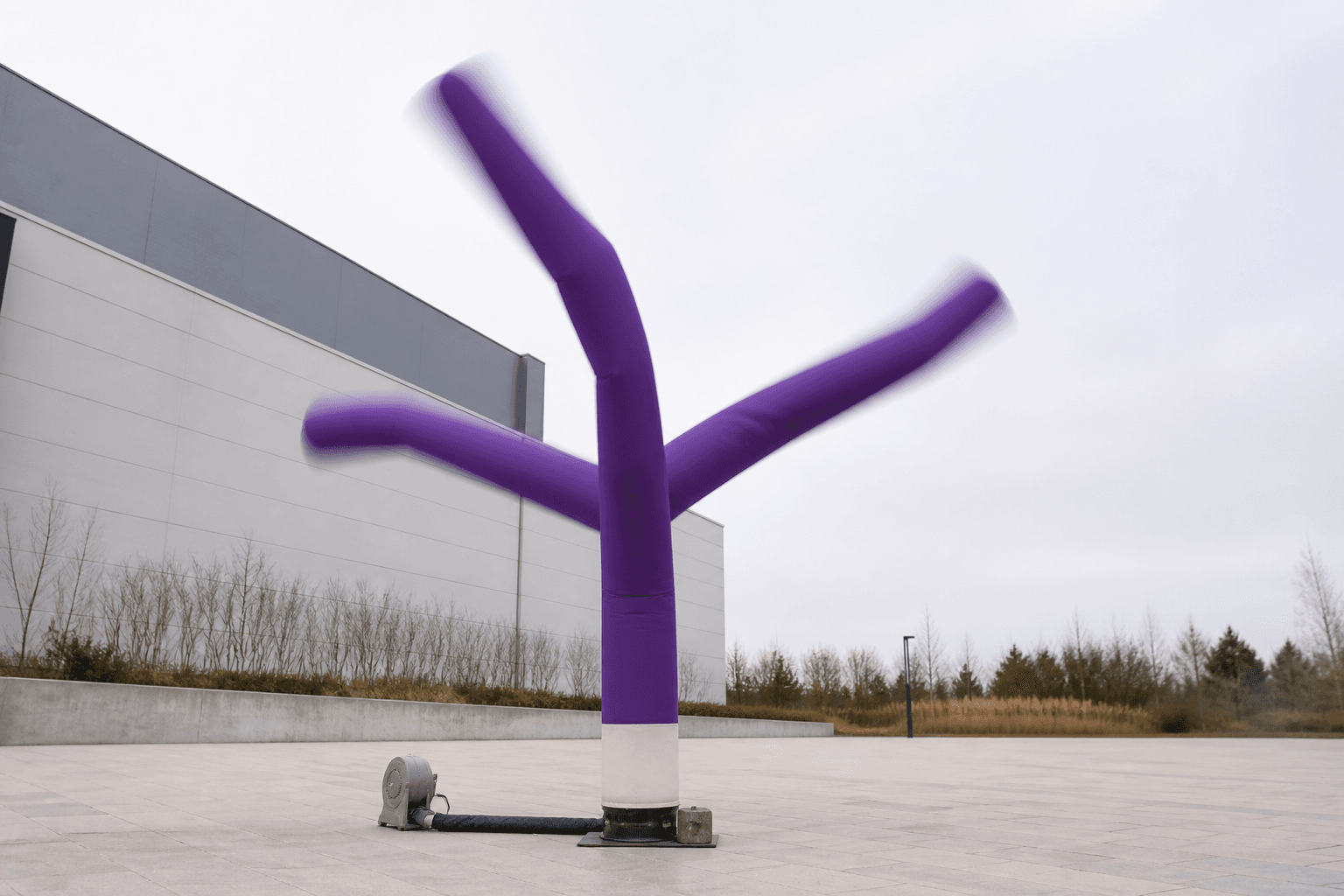
Adding legs changes the character of the movement rather than the height. Two and three leg units fill more width, move less predictably, and read as a figure rather than a line — which is why they are chosen for entrances rather than kerbsides.
A single tube whips in a fairly regular arc. Add a second or third leg and the legs interfere with each other, which produces the irregular, limb-like motion these units are bought for. It also means the unit sweeps a noticeably wider cylinder of space, so a position that comfortably held a single leg may not hold a three.
The air system is sized to the leg count rather than to the height, because the air has to be split between the legs and still keep each of them standing. A multi-leg tube run on an air system specified for a single leg droops rather than dances, and that is a specification error, not a fault.
Extra legs widen the space the unit sweeps through; measure that, not the tube width.
The movement is less regular than a single leg, which is usually the point.
More legs means more air, so the air system is matched to the leg count.
Specification
What a quotation for this format is built from.
Sizes buyers usually order
Air dancers are sized simply. As a planning reference from delivered project types, forecourt and grand opening units are commonly 2–5 m high. Within that range the constraint is almost always overhead clearance rather than budget: signage, cables, canopies, awnings and trees.
The height quoted is the standing height with the air on. A unit also needs a clear cylinder of space around it that is wider than the tube, because the whole point of the format is that it does not stay still — measure the space it moves through, not the space it occupies at rest.
Where the format wears out
An air dancer is in constant motion for every hour it runs, which makes it the one advertising inflatable that is consumed rather than stored. The fabric flexes hardest at the base and along the seams, and that is where a unit reaches the end of its life, usually while the blower is still perfectly serviceable.
This is why operators buy the tube and the air system as separate lines rather than as one disposable unit. If the piece is going into a fleet or onto a forecourt that runs it daily, ask about spare tubes at the quotation stage rather than after the first one fails.
Material and air system
Double-layer PVC is the general construction. 0.4 mm PVC is used on large-format projects, and 0.5 / 0.6 / 0.7 mm PVC mesh where the structure carries load, spans further or faces sustained exposure.
The air system is sized to the piece: the 650 W electric pump moves 1,600–2,000 L/min at 2.0 psi and suits smaller spheres, compact displays and short-duration indoor installations; the 1600 W electric pump moves 4,800–5,200 L/min at 4.5 psi for large-format structures, arches and continuously inflated outdoor displays. Both run on 110–240 V, 50–60 Hz, and the destination plug type is confirmed on the order.
Printing on a surface that never stops moving
Artwork on a moving tube is read in glimpses, not studied. Large marks, strong colour contrast and short words survive; detailed lock-ups, small type and fine gradients are lost at any distance, and they are the first thing to simplify when the design is adapted.
The tube also stretches and twists in use, so artwork is laid out with that movement in mind rather than as a flat rectangle. The panel layout is shown on the mockup for approval before printing.
Lead time, quantity and freight
MOQ is 1 piece for most custom projects, so a single piece can be approved before a repeat order. Pattern and print setup are paid once per design, so a second unit costs less per piece than the first.
Bulk production typically takes 3–8 days for simple items, 7–15 days for standard custom work and 15–25 days for complex or large pieces, counted from final design approval. Freight comes on top: express or air usually 4–15 working days, and sea, rail or truck usually 20–45 days, after dispatch and subject to route and customs
All of these sit under air dancers, where the shared specifications and the full buyer checklist live.
Buyer FAQ
Questions that come up before quotation.
Quote Form
Request a Quote for a Multi Leg Air Dancer
Send the height, the number of legs, print-ready artwork, the destination plug type, the quantity, and say whether you also need spare tubes or a separate air system.
Start with four essentials: product type, rough size, quantity, and one way to contact you.
Country, timing, artwork, and technical details are optional at this stage. We will request anything else needed for a usable factory quote.
AI Sourcing Guide
Use ChatGPT, Gemini, or Claude to build a cleaner RFQ before you send it to the factory.
AI works best when the brief is structured. This guide turns rough notes into a supplier-ready checklist, then sends you toward the RFQ form, factory verification, and the buyer questions that usually decide the quote.