Buyer Guide
Product Replica vs Custom Shape: Which Inflatable Fits the Campaign
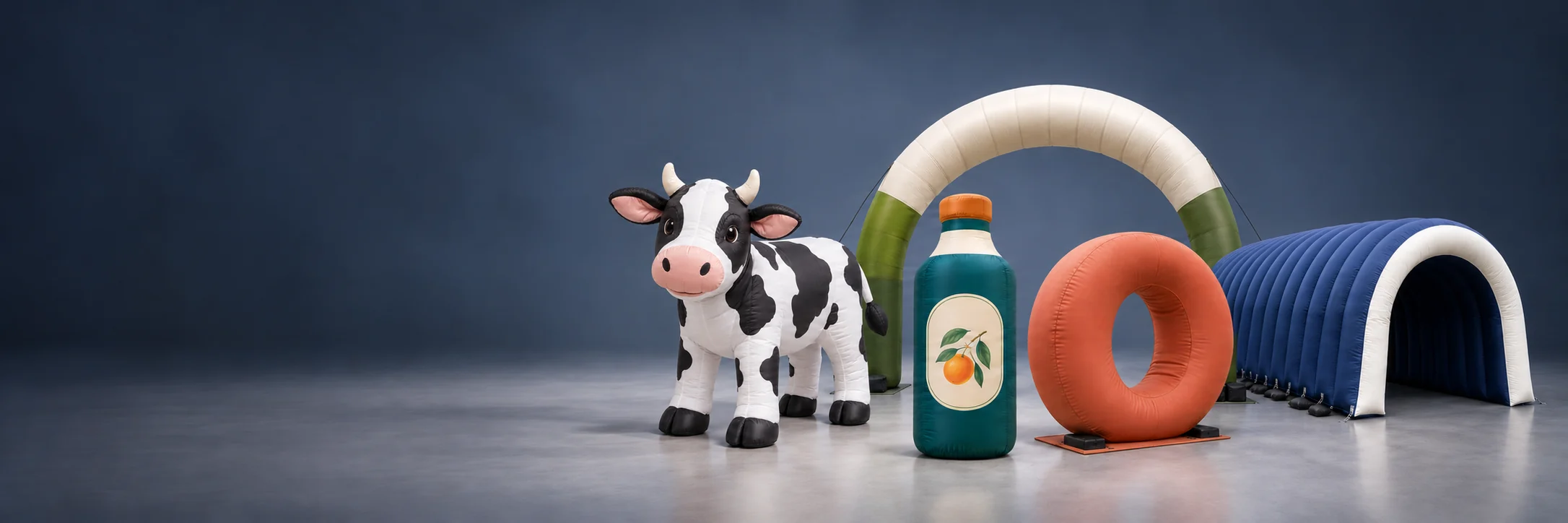
A product replica reproduces a real package at large scale and works when the product itself is what people should recognise, typically at launches, retail promotions and distributor events. A custom shape is designed for the campaign rather than copied from an object, and works better when the message is an idea, a mascot or a brand device, or when the product silhouette is too plain or too complex to read at distance. The decision is about what the audience should recognise from across a space, not about which format costs less.
By InflatCraft Product Team • Last updated
What separates the two formats
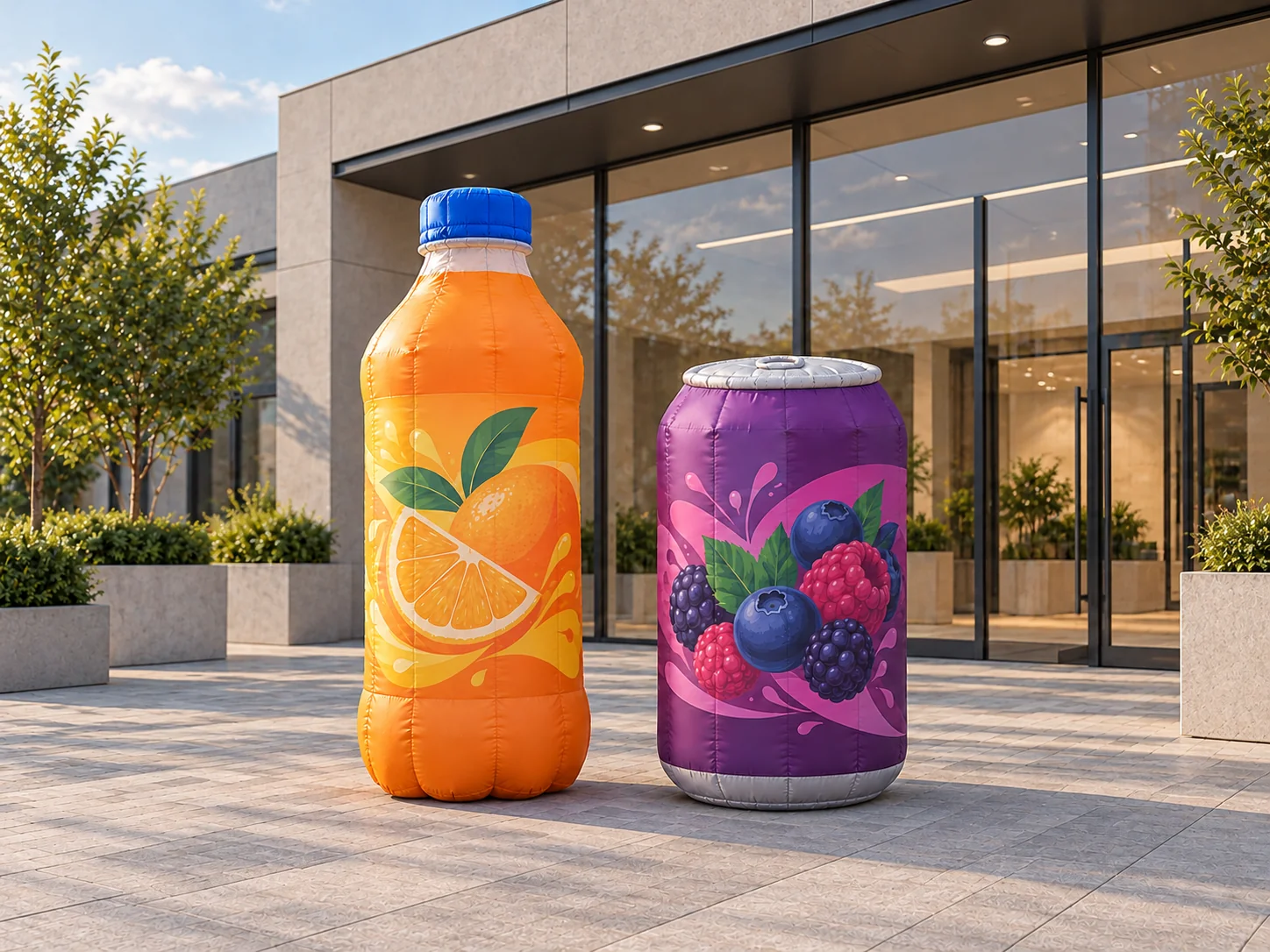
A product replica takes an existing package and reproduces it as an oversized inflatable. Its value is instant recognition: people know what the product is before they read anything. A custom shape is drawn for the campaign — a character, an object, a brand device, a form that exists only for this activation.
Mechanically they are similar builds and share the same downstream decisions about size, material, air system and anchoring. What differs is the input. A replica is patterned from measurements of a real object; a custom shape is patterned from a concept that has to be resolved into something manufacturable first.
When the product silhouette is the wrong choice
Some products do not read at scale. A flat rectangular carton enlarged to three metres is a large box: recognisable up close, anonymous at fifty metres. A product with intricate detail loses that detail as it grows, and what remains can look like a generic shape rather than the specific item.
Products in categories where every competitor shares the same silhouette have the same problem in a different form. If the shape alone does not distinguish the brand from three others on the shelf, an enlarged version will not either, and the work falls entirely on the printed graphic — at which point a simpler shape carrying the same graphic would have cost less.
The practical test is to look at the product silhouette in outline, with no colour or label, from across a room. If it is still identifiable, a replica will work. If it is not, the recognition has to come from somewhere else.
When a replica clearly outperforms
A replica is strongest when the product has a distinctive shape and the campaign is about that specific product: a launch, a bottle or can with a recognisable profile, a package the audience already knows from shelves and advertising. The oversized version reads as the product itself rather than as advertising for it, which is a different and stronger effect.
It also carries weight at distributor and trade events, where the audience knows the category well. A correctly proportioned replica signals that the brand invested in getting its own product right, and the audience notices when the proportions are wrong.
How cost and complexity differ
Neither format is reliably cheaper. A replica of a simple bottle can be less complex than an elaborate custom character, and a simple geometric custom shape can be less complex than a replica with an awkward profile and a wraparound label.
What drives cost in both is the same list: finished size, structural complexity, print coverage, material specification, air system, quantity and freight. A replica adds a patterning step tied to the real dimensions; a custom shape adds a design resolution step. Which is more work depends entirely on the specific object and the specific concept.
How the brief differs
For a replica, the brief is measurement-led: the real dimensions of the package, artwork files, target finished size, and the venue constraint driving that size.
For a custom shape, the brief is concept-led: a sketch or reference images, the impression it should create, the viewing distance, and any elements that must be recognisable. Expect a conversation about what is manufacturable, because a drawing that works on paper may need adjustment to hold air and stand up.
Where the choice is genuinely open, send both directions to a supplier and ask for comment before committing to a pattern. That conversation is cheap; changing direction after the pattern is cut is not.
Verified Specifications
Figures this guide is written against.
Size ranges
| Category | Range | Notes |
|---|---|---|
| Inflatable spheres and balls | 30 cm to 5–6 m diameter | Small hand-held spheres through to large suspended and ground-mounted balls. The workable range narrows once print detail, lighting or suspension is added. |
| Arches, mascots, replicas and custom shapes | Defined per product category | Sized against the venue opening, sight lines and transport limits rather than a catalogue size. Send the target dimensions and the constraint that drives them. |
Material specifications
| Specification | Typical use | Notes |
|---|---|---|
| Double-layer PVC | General construction for custom advertising inflatables | The default build for most promotional structures. |
| 0.4 mm PVC | Large-format projects | Used on delivered large-format orders. |
| 0.5 / 0.6 / 0.7 mm PVC mesh | Engineered structures | Specified where the structure carries load, spans further, or faces sustained wind exposure. |
Product Replica Guides
More on custom inflatable product replicas.
Giant Custom Inflatable Bottles and Cans for Beverage Brands
How beverage brands use giant custom inflatable bottles and cans at launches, sampling and trade shows, and how pack shape and labels are reproduced.
Custom Inflatable Replica Shipping & Packing Guide
Compare giant custom inflatable replica freight quotes using actual packing dimensions, gross weight, blower and accessory scope, Incoterms, receiving conditions and delivery dates.
Custom Inflatable Bottle Replica Artwork Approval Checklist
Approve artwork for custom inflatable bottle and can replicas: check label files, 3D proportions, seams, brand permissions, color proofs and RFQ evidence.
How Custom Inflatable Product Replicas Are Scaled
How a bottle, can or carton becomes an oversized custom inflatable: which dimensions the factory works from, which details survive enlargement, and what the venue and transport limits do to the final size.
Compare sizes, materials and air systems on the inflatable product replica specifications page before sending an RFQ.
Relevant Product Pages
Compare specifications before submitting an RFQ.
Related Project Example
Buyer FAQ
Additional specification questions.
A replica reproduces a real package at large scale so people recognise the product itself. A custom shape is designed for the campaign rather than copied from an object. Mechanically they are similar builds; the difference is whether the pattern comes from measurements or from a concept.
Neither reliably. Cost is driven by finished size, structural complexity, print coverage, material specification, air system, quantity and freight. A simple replica can cost less than an elaborate custom shape and vice versa.
Look at its silhouette in outline, without colour or label, from across a room. If it is still identifiable, a replica will work. If it is not, the recognition has to come from the graphic, and a simpler shape would carry that graphic just as well.
Often poorly. A rectangular carton enlarged to three metres reads as a large box at distance. It can still work if the printed graphic does the identifying, but then the shape is not contributing much.
Yes, and it is common — a character holding a recognisable package, or a scene built around the product. That combines the recognition of the replica with the flexibility of a designed shape.
Send both directions: the product dimensions for the replica option and a sketch or references for the custom shape. Asking a supplier to comment before the pattern stage is inexpensive; changing direction afterwards is not.