
Buyer Guide
PVC Tarpaulin Weight and Thickness: A Guide for Outdoor Inflatables
PVC tarpaulin for outdoor inflatables is described either by weight per square metre or by thickness in millimetres, and a quotation should state both along with the base fabric. Heavier or thicker material resists abrasion and handling better, but it also weighs more to carry, folds into a larger bundle and costs more to ship. The right specification depends on how the inflatable is used outdoors, how often it is set up and how large the structure is, not on choosing the heaviest option available.
By InflatCraft Product Team • Last updated September 2, 2026
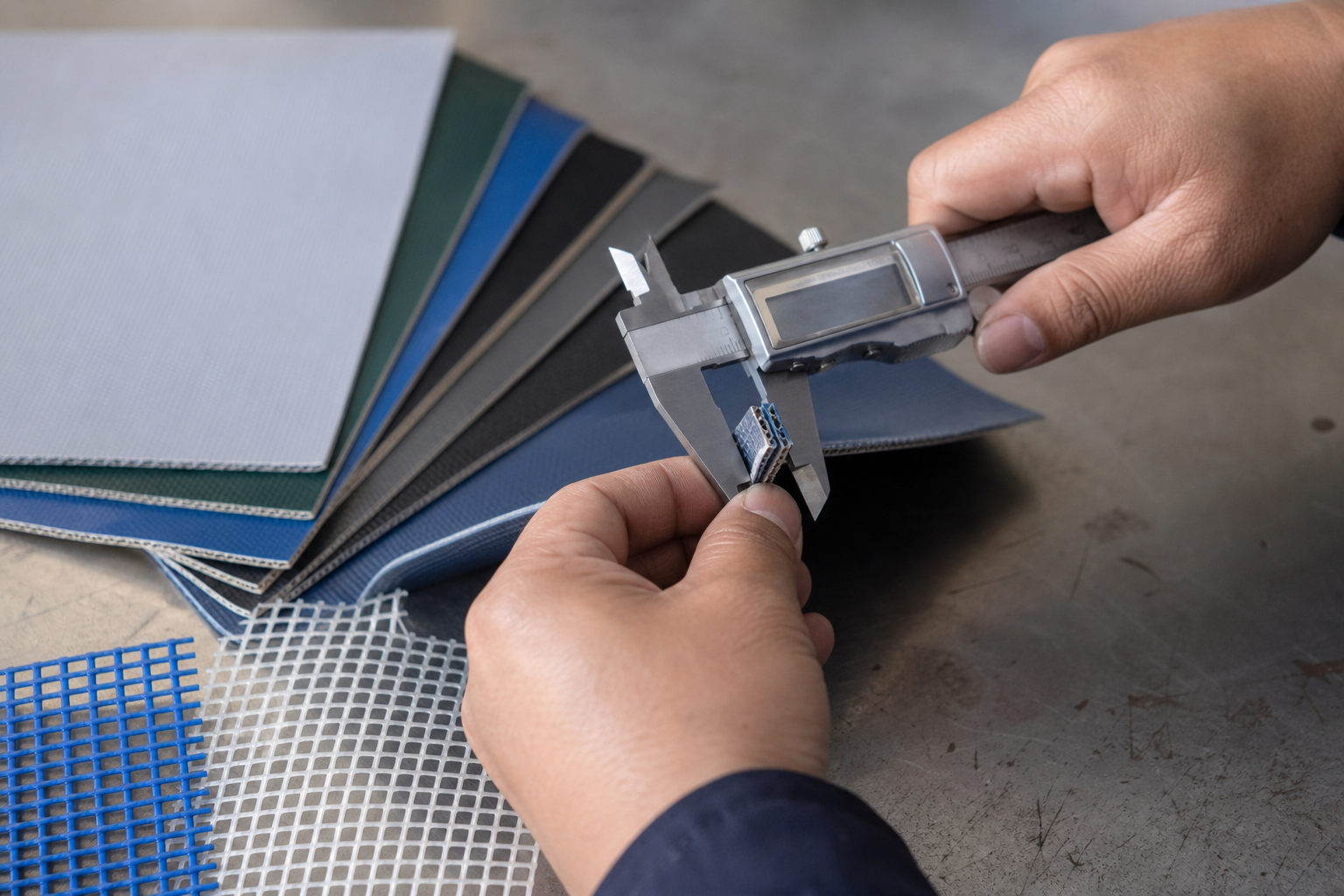
How weight and thickness are stated
Suppliers describe PVC tarpaulin in two ways. Weight is given per square metre of the finished coated fabric. Thickness is given in millimetres. Both describe the same material from different angles, and neither on its own tells the whole story, because two fabrics of similar thickness can differ in weight and strength depending on the base fabric and the coating.
When comparing quotations, ask each supplier to state the weight, the thickness and the base fabric for the material they propose. A quote that says only "commercial-grade PVC" cannot be compared with anything. The verified material specifications offered on this site are listed below this guide.
What the base fabric and the coating each do
PVC tarpaulin is a composite. At its core is a woven polyester base fabric, which provides the tensile strength that stops the material stretching and tearing under the pressure of the structure. On both sides is a PVC coating, which makes the fabric airtight, waterproof and printable.
This matters because the two layers fail differently. A weak base fabric tears; a thin or poorly bonded coating wears through, leaks or cracks. A heavier tarpaulin can come from a stronger base fabric, a thicker coating, or both, which is why weight alone is not a complete specification.
Why heavier is not automatically better
It is tempting to specify the heaviest material available for anything used outdoors. The material will resist abrasion and handling better, but the whole inflatable becomes heavier to carry and set up, folds into a larger and stiffer bundle, needs a bigger bag and costs more to ship.
Stiffer, heavier material can also be harder to form into tight curves and fine details, which matters for mascots, product replicas and custom shapes. For those, a very heavy material can make the shape less accurate without adding much useful durability.
The goal is enough material for the actual use, not the maximum material available. Over-specifying adds cost to every setup and every shipment for the whole life of the unit.
Matching the material to outdoor use
Start with how the inflatable will be used. An inflatable displayed outdoors occasionally, on grass, handled by a careful team, places very different demands on its material than one set up every weekend on concrete by a rental crew. A large-format structure places different demands again, because the material has to carry more load across wider spans.
Describe that use to the manufacturer and ask which specification suits it, and why. Pay particular attention to the base and lower panels, which take the most abrasion, and ask whether heavier material or reinforcement is used there rather than across the whole unit. That often gives the durability where it is needed without the weight everywhere.
Mesh versus solid tarpaulin
PVC mesh is not simply a heavier or lighter tarpaulin. It is an open-weave material used where a structure needs to behave differently: carrying load, spanning further, or reducing the surface presented to sustained exposure. It has its own thickness range and its own applications, shown in the verified specification table below.
Because mesh and solid tarpaulin do different jobs, the choice between them is made in the structural design, not by comparing weights. Ask the manufacturer where mesh is used in the design and what it is doing there.
What to ask a supplier
For the main body material, ask for the weight per square metre, the thickness, and the base fabric. Ask whether different material or reinforcement is used at the base, tie points and other wear areas. Ask how the material prints, and how print holds up in outdoor use.
If the inflatable will be used somewhere that requires documentation on material fire performance, ask which documentation is available for the specific material and confirm the requirement with the venue first; do not assume every material comes with every document. Finally, ask for a swatch of the actual material. Handling it tells you more about weight and stiffness than any figure on a quotation.
Seeing and handling the material before ordering
Figures on a quotation describe a material; a swatch shows how it behaves. Ask for a sample of the actual material proposed for your order, ideally printed, and handle it the way the finished inflatable will be handled. Fold it sharply, unfold it and look at the crease. Flex it repeatedly in the same place. Rub the printed surface. Compare it with a swatch of any alternative being considered.
Look at the coating too. A consistent, smooth coating across the swatch, with no thin patches where the base fabric shows through, is what keeps the finished inflatable airtight. Check the edges of the swatch, where the layers can be seen, to understand how the base fabric and coating are combined.
If the inflatable will be used somewhere cold, handle the swatch after it has been somewhere cold. Coated fabrics become stiffer at low temperatures, and a material that folds easily indoors can feel very different at an outdoor event on a winter morning. The purpose of all of this is simple: to discover how the material feels before the whole inflatable is made from it.
Verified Specifications
Figures this guide is written against.
Material specifications
| Specification | Typical use | Notes |
|---|---|---|
| Double-layer PVC | General construction for custom advertising inflatables | The default build for most promotional structures. |
| 0.4 mm PVC | Large-format projects | Used on delivered large-format orders. |
| 0.5 / 0.6 / 0.7 mm PVC mesh | Engineered structures | Specified where the structure carries load, spans further, or faces sustained wind exposure. |
Materials and Durability Guides
More on inflatable materials and durability.
Oxford Fabric vs PVC for Inflatable Mascots
Why the material choice matters more for a mascot than for simpler shapes, how Oxford fabric and PVC differ in detail, print, weight, cleaning and outdoor handling, and how to choose.
UV Degradation in Outdoor Inflatable Fabric
What prolonged sunlight does to coated inflatable fabric and print, where the damage shows first, what to ask a manufacturer about outdoor exposure, and the habits that reduce it.
Inflatable Seam Construction and Failure Modes
Sewn, welded and bonded seams in commercial inflatables: how each is made, where each suits, how each typically fails, where stress concentrates, and how to check seams on delivery and in service.
Compare sizes, materials and air systems on the verified material and air system specifications page before sending an RFQ.
Relevant Product Pages
Compare specifications before submitting an RFQ.
Buyer FAQ
Additional specification questions.
Where to order
Order direct from the manufacturer.
Published by InflatCraft, operated by Tianjin Mufeng Trading Co., Ltd., a custom inflatable manufacturer founded in 2005 and based in Tianjin, China. We export to the United States, United Kingdom, Canada, Australia, Germany, France, Spain and Italy.
Request a quote
Send the brief and get a specification-based quotation.
MOQ and lead time
What sets the minimum order and where the time goes.
Sourcing from China
Brief, approval, Incoterms, freight and import, in order.
Verified specifications
Materials, air systems and lead time this site quotes against.
Export planning by country: United States, United Kingdom, Canada, Australia, Germany, France, Spain, Italy.