
Buyer Guide
Oxford Fabric vs PVC for Inflatable Mascots: Detail, Handling and Use
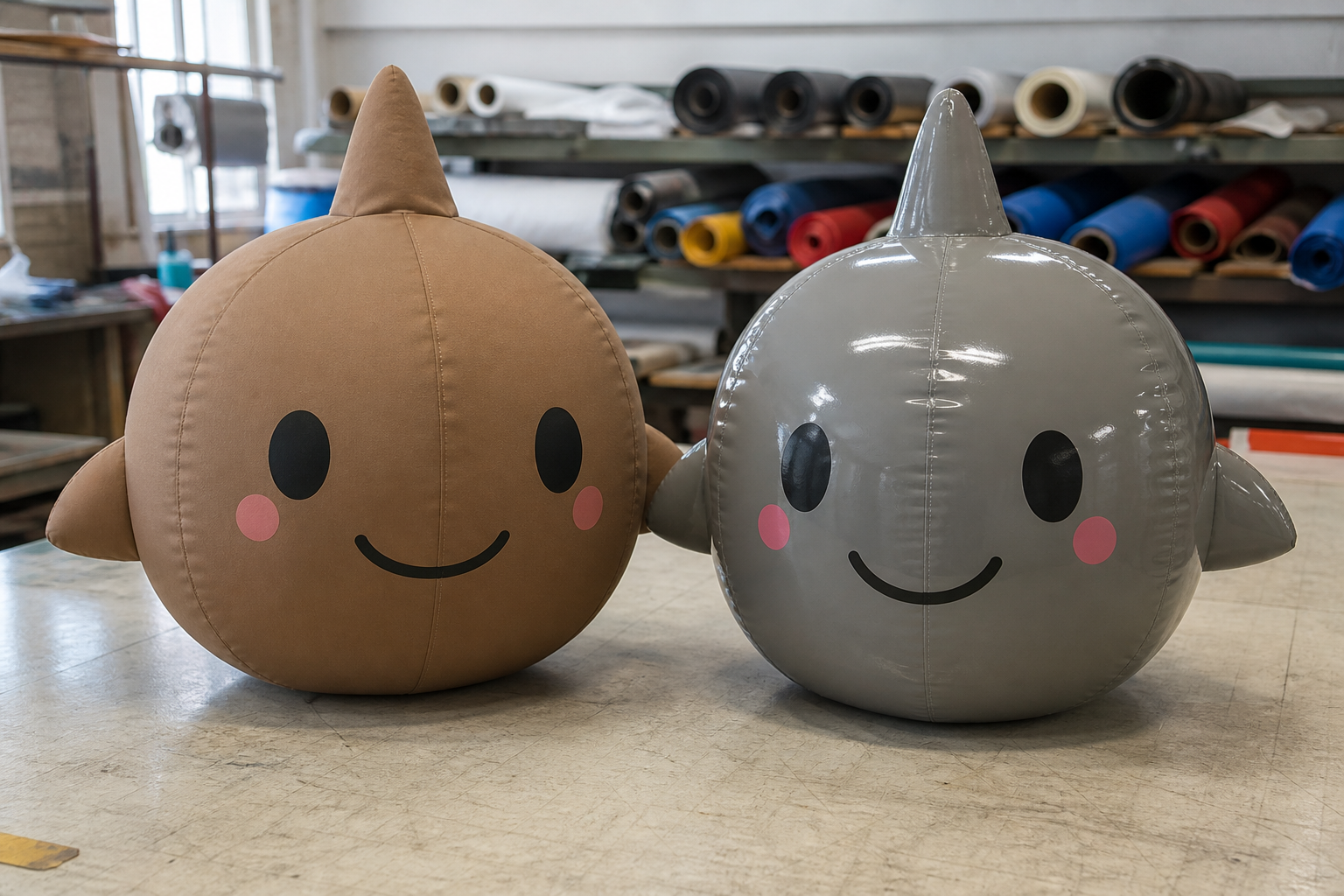
For an inflatable mascot, Oxford fabric is lighter, more portable and well suited to indoor and short-term use with a continuous blower, while PVC is heavier, more resistant to handling and weather, easier to wipe clean and better suited to repeated outdoor use. Because mascots have curves, faces and small features, the choice also affects how accurately the character is reproduced and how its print looks up close. Decide by where the mascot will be used and how often it will be moved, then check how each material reproduces the details that make the character recognisable.
By InflatCraft Product Team • Last updated September 2, 2026
What changes when the product is a mascot
A logo sign or an arch is mostly broad panels. A mascot is a character: rounded heads, faces with eyes and mouths, arms, hands, accessories and expressions that people recognise instantly and notice immediately when they are wrong. It is also the inflatable people most want to stand next to and photograph up close.
That combination puts more weight on the material choice than for simpler formats. The material affects how smoothly curves form, how small features hold their shape, how the print looks at arm's length, how heavy the mascot is to move between venues, and how it copes with being touched. The general comparison between these materials for advertising inflatables is in the PVC versus Oxford fabric guide; this guide focuses on what matters for characters.
Oxford fabric for mascots
Oxford fabric is a coated polyester textile that is lighter than PVC tarpaulin. Panels are typically sewn together, and mascots made this way are usually continuous-air units kept inflated by a blower. The lighter material makes the mascot easier to carry, set up and pack, and it folds into a smaller bundle.
Those qualities suit mascots that travel: roadshows, indoor events, retail appearances and short outdoor activations where the mascot is set up, used for a day and packed away. A lighter mascot is also easier for a small team to handle without damage.
The trade-off is that a lighter textile is less resistant to abrasion, rough handling and prolonged outdoor exposure than PVC, and it is not wiped clean as easily.
PVC for mascots
PVC tarpaulin is heavier and tougher. It resists abrasion, handling and weather better, and its smooth coated surface can be wiped clean, which matters for a mascot that is touched by hundreds of visitors. PVC panels are usually joined by welding or bonding rather than only sewing.
Those qualities suit mascots used outdoors repeatedly, set up on rough surfaces, or placed where the public can reach them. The trade-offs are weight, a larger packed size and, on very small or tightly curved features, material stiffness that can make the finest details harder to form.
How each reproduces detail and print
The recognisability of a mascot often depends on small features: the shape of the eyes, the curve of a smile, fingers, ears, a logo on a shirt. Ask the manufacturer how the chosen material and construction method will reproduce those specific features, and whether any simplification is needed.
Print finish also looks different on each material, and colour can read differently on a matte textile than on a coated PVC surface. For a character with brand colours that must match, approve colour against physical references rather than a screen, on the material that will actually be used.
Handling, cleaning and storage
A mascot that moves between venues is handled far more than a fixed display. Lighter Oxford fabric makes that handling easier and the packed mascot smaller. PVC makes the mascot heavier to move but more forgiving of rough handling and easier to wipe down after a day of public contact.
Both need the same care in storage: cleaned, completely dried, rolled or loosely folded away from creases through the face and printed details, and stored dry. The cleaning and storage guides in this series cover the routine in detail.
Choosing for your use
Start with where the mascot will spend its working life. Mostly indoors, moving between events, carried by a small team: Oxford fabric is usually the practical choice. Mostly outdoors, set up repeatedly, touched by the public or handled by rental crews: PVC is usually the safer one.
Then check the character. Ask to see how the chosen material will reproduce the features that make the mascot recognisable, and approve a drawing or rendering before production. A mascot that is durable but looks wrong has failed at the only job people will judge it on.
Transport and setup for travelling mascots
A mascot that travels spends as much of its working life being moved as being displayed. Before choosing a material, think about the whole journey: from storage to the vehicle, from the vehicle to the venue, through the venue's doors and corridors, and back again at the end of the day.
The packed size and weight decide how many people are needed at each step and whether the mascot fits the vehicles you already use. A lighter, more compact Oxford fabric mascot can often be handled by a small team. A PVC mascot of the same size may need more people or a trolley, and a larger bag.
Venue access matters as much as the event itself. Service lifts, doorways, stairs and loading areas all limit what can be brought in, and a mascot is usually inflated where it will stand, which may be a long way from where the vehicle can stop. Ask the venue about access before the event.
Finally, plan for setup time on site. A mascot that travels should be one the team can set up, secure, check and pack away within the time the venue allows. Rehearse the setup once before the first event rather than learning it in front of the client.
Materials and Durability Guides
More on inflatable materials and durability.
PVC Tarpaulin Weight Guide for Outdoor Inflatables
How PVC tarpaulin weight and thickness are stated, what the base fabric and coating each do, why heavier is not automatically better, and how to match material to outdoor use.
UV Degradation in Outdoor Inflatable Fabric
What prolonged sunlight does to coated inflatable fabric and print, where the damage shows first, what to ask a manufacturer about outdoor exposure, and the habits that reduce it.
Inflatable Seam Construction and Failure Modes
Sewn, welded and bonded seams in commercial inflatables: how each is made, where each suits, how each typically fails, where stress concentrates, and how to check seams on delivery and in service.
Compare sizes, materials and air systems on the verified material and air system specifications page before sending an RFQ.
Relevant Product Pages
Compare specifications before submitting an RFQ.
Buyer FAQ
Additional specification questions.
Where to order
Order direct from the manufacturer.
Published by InflatCraft, operated by Tianjin Mufeng Trading Co., Ltd., a custom inflatable manufacturer founded in 2005 and based in Tianjin, China. We export to the United States, United Kingdom, Canada, Australia, Germany, France, Spain and Italy.
Request a quote
Send the brief and get a specification-based quotation.
MOQ and lead time
What sets the minimum order and where the time goes.
Sourcing from China
Brief, approval, Incoterms, freight and import, in order.
Verified specifications
Materials, air systems and lead time this site quotes against.
Export planning by country: United States, United Kingdom, Canada, Australia, Germany, France, Spain, Italy.