
Buyer Guide
UV Degradation in Outdoor Inflatable Fabric: What Happens and What to Ask
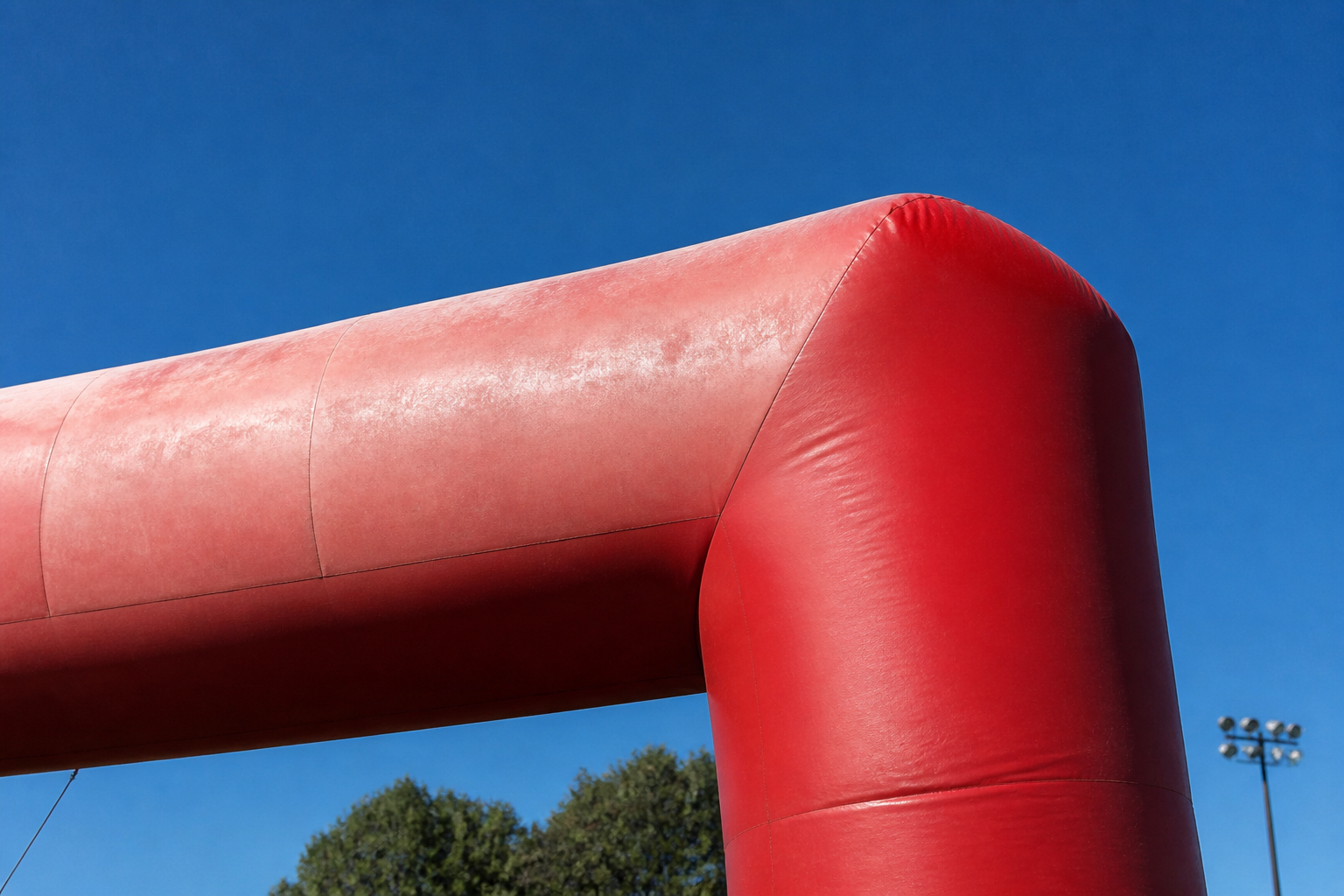
Prolonged sunlight gradually fades print and ages the coating on outdoor inflatable fabric, making it less flexible, more prone to cracking at folds and, eventually, weaker. Print usually shows the effect first, on the surfaces that face the sun most. The effect cannot be avoided for a unit used outdoors, but it can be slowed: ask the manufacturer about material and ink suitability for outdoor exposure, keep the unit out of the sun when it is not working, store it away from light, and inspect for early signs.
By InflatCraft Product Team • Last updated September 2, 2026
What sunlight does to coated fabric
Outdoor inflatable fabric is a coated textile: a polyester base fabric with a PVC or similar coating, printed with the artwork. Ultraviolet light in sunlight slowly breaks down parts of that system. The pigments in the print fade. The coating gradually loses flexibility as it ages, becoming stiffer and more prone to cracking where it is folded or flexed. Over a longer period, the base fabric can lose strength too.
None of this happens overnight, and it happens at different rates depending on the material, the ink, the intensity of sunlight where the unit is used, and how many hours it actually spends in direct sun. That is why a single figure for UV life is not meaningful without knowing the conditions.
Why print fades before the fabric fails
For an advertising inflatable, the first visible sign of sun exposure is usually the artwork. Colours shift and lose intensity, and some colours fade faster than others, so a brand colour can drift noticeably while the rest of the design still looks acceptable.
This matters because the unit's job is to carry the brand. An inflatable can remain structurally sound long after its print has faded enough to make it unsuitable for representing a client. For businesses that care about brand accuracy, faded print is often what ends a unit's working life.
Where the damage shows first
Sun damage concentrates on the surfaces that face the sun for the longest: the tops of arches and signs, the upper surfaces of mascots and shapes, and any panel that faces the same direction at every installation. Those areas fade and age while the underside and shaded panels still look new, which makes the difference easy to see once it starts.
Folds and flex points age visibly too, because a coating that has lost flexibility cracks where it bends. Printed areas along fold lines are especially vulnerable to combined sun and folding damage.
What to ask when specifying for sun exposure
If the inflatable will spend long periods outdoors, say so at the quotation stage and describe the conditions: how many hours in direct sun, in what climate, over how many events. Ask how the proposed material and inks suit that exposure, and whether any options are available for greater outdoor exposure.
Ask these as questions and get the answers for your specific material in writing; avoid relying on general claims of "UV-resistant" or "all-weather" without detail. Also ask which colours in your artwork are most likely to fade, so brand-critical colours can be discussed before production.
Operating habits that reduce exposure
The most effective protection is also the simplest: do not leave an inflatable standing in the sun when it is not doing its job. Inflate it for the hours it is needed, and take it down or cover it outside those hours where practical.
Vary orientation between installations where the site allows, so the same panels are not always facing the sun. Dry the unit in shade with airflow rather than in full sunlight. Store it in the dark. Each habit adds up to many hours less exposure over a season.
Inspecting for UV damage
Check outdoor units regularly, and compare sun-facing panels with shaded ones. Early signs include colour loss or shift in the print, a surface that feels stiffer or rougher than before, a chalky residue that rubs off, and fine cracks along fold lines.
Early signs are a prompt to change handling and plan ahead, not necessarily to retire the unit. Cracking at folds, however, is a sign the coating is losing its ability to keep the unit airtight, and those areas will need attention before they start to leak. For how service life is judged more broadly, see the guide on how many seasons a commercial inflatable can last.
Planning for faded print before it happens
Because print usually fades long before the structure fails, it makes sense to plan for replacing the branding rather than the whole inflatable. When ordering a unit that will spend long periods outdoors, ask whether branding can be carried on panels that attach to the structure rather than printed directly across it.
Attachable panels can be reprinted and replaced when they fade, while the structure stays in service. They also allow the same structure to carry updated artwork after a rebrand or a campaign change. For businesses running the same inflatable across several seasons, that can change the economics of sun exposure entirely.
Where branding has to be printed directly on the structure, keep the artwork files and colour references from the original order. When the time comes to replace the unit, matching the colours to the original, rather than to a faded example, keeps the brand consistent across old and new units in use at the same time.
Ask the manufacturer which parts of your design will face the sun most in the way it is usually set up. Sometimes a small change in where brand-critical colours sit on the structure keeps them away from the surfaces that fade first.
Materials and Durability Guides
More on inflatable materials and durability.
PVC Tarpaulin Weight Guide for Outdoor Inflatables
How PVC tarpaulin weight and thickness are stated, what the base fabric and coating each do, why heavier is not automatically better, and how to match material to outdoor use.
Oxford Fabric vs PVC for Inflatable Mascots
Why the material choice matters more for a mascot than for simpler shapes, how Oxford fabric and PVC differ in detail, print, weight, cleaning and outdoor handling, and how to choose.
Inflatable Seam Construction and Failure Modes
Sewn, welded and bonded seams in commercial inflatables: how each is made, where each suits, how each typically fails, where stress concentrates, and how to check seams on delivery and in service.
Compare sizes, materials and air systems on the verified material and air system specifications page before sending an RFQ.
Relevant Product Pages
Compare specifications before submitting an RFQ.
Buyer FAQ
Additional specification questions.
Where to order
Order direct from the manufacturer.
Published by InflatCraft, operated by Tianjin Mufeng Trading Co., Ltd., a custom inflatable manufacturer founded in 2005 and based in Tianjin, China. We export to the United States, United Kingdom, Canada, Australia, Germany, France, Spain and Italy.
Request a quote
Send the brief and get a specification-based quotation.
MOQ and lead time
What sets the minimum order and where the time goes.
Sourcing from China
Brief, approval, Incoterms, freight and import, in order.
Verified specifications
Materials, air systems and lead time this site quotes against.
Export planning by country: United States, United Kingdom, Canada, Australia, Germany, France, Spain, Italy.