Buyer Guide
Promotional Inflatables: 8 Formats Brands Use and When Each One Works
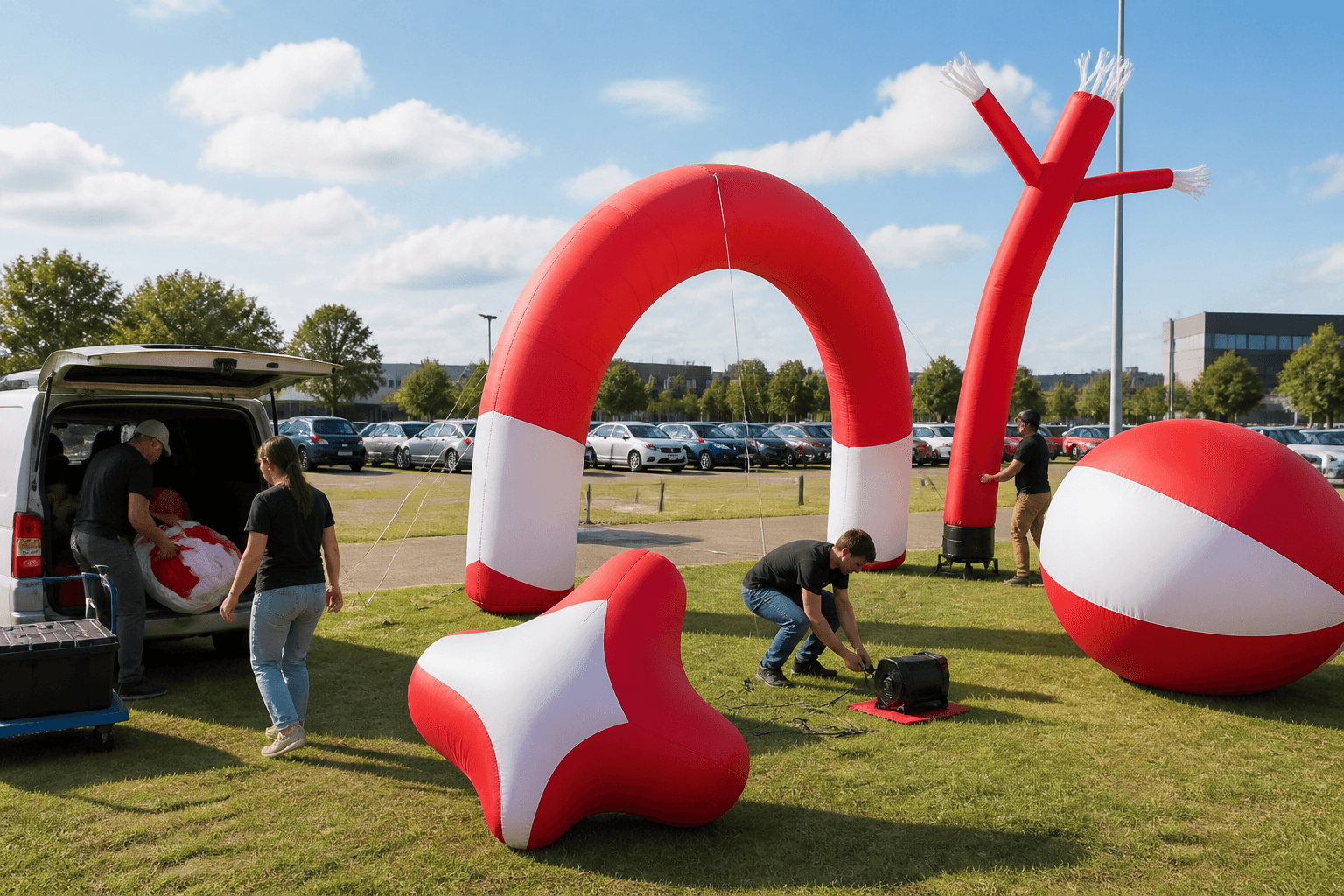
Promotional inflatables come in eight main formats: arches, air dancers, product replicas, mascots, logo signs, custom shapes, spheres and mirror balls, and seasonal displays. Choose by the job the display has to do. Arches frame an entrance or a finish line, air dancers catch drivers with movement, replicas and logo signs make the product or brand the landmark, mascots create photo moments, custom shapes carry a campaign idea, spheres and mirror balls fill ceilings and atriums, and seasonal displays lead holiday campaigns. MOQ is 1 piece for most custom projects, so one piece can test a format before a wider roll-out.
By InflatCraft Product Team • Last updated
Start with the job the inflatable has to do
Promotional inflatables are bought for very different reasons. Some exist to be seen from a moving car, some to frame an entrance, some to make a product recognisable across a hall, and some to give visitors something to photograph. The format that does one of those jobs well can do another badly, so the useful first question is not which inflatable looks best, but what the display must achieve and where the audience will be standing.
The eight formats below cover almost every promotional brief. Most campaigns use one or two of them; larger events combine several so each does the job it is best at.
1. Inflatable arches
An arch frames a space people pass through: a store entrance, a race start or finish, a festival gate or a sponsor tunnel. Its strength is that it turns a doorway into an event and carries sponsor artwork at eye level and above. Entrance arches for grand openings are commonly about 3–8 m wide × 3–5 m high, and finish line arches for races are built around a clear opening 4–8 m wide × 3–5 m high.
Arches are weaker where there is no clear route to frame, or where the space in front of the entrance is too tight for the structure's footprint. The separate guide to square, round and angled arch styles covers how to choose the outline.
2. Air dancers
Air dancers are the format built for peripheral vision. Continuous movement catches the eye of drivers who would never read a static sign, which is why they are a standard choice for dealerships, roadside retail and opening days. For car dealerships they are commonly 2–5 m high.
Movement is also their limitation: they carry a short brand mark or a single word, not a message, and they suit roadside attention better than a premium indoor setting.
3. Product replicas
A product replica makes the product itself the sign: a bottle, can, package or device scaled up until it can be recognised from across a car park or an exhibition hall. Replicas for trade show booths and mall displays are commonly 1–5 m high.
Replicas work best when the product already has a distinctive silhouette or packaging that shoppers know. A generic box with small text on it gains little from being scaled up, and a custom shape designed for the campaign may do the job better.
4. Mascots and characters
Mascots turn a brand character into a photo moment for families, fans and social media. For grand openings they are commonly 2–5 m high, and in mall atriums 2–5 m high. A standing display mascot is a different product from a wearable mascot costume; the dedicated mascot buying guide explains the difference.
Mascots depend on having a character people recognise or can warm to. Without one, a mascot built for a single event can cost more design effort than the attention it earns.
5. Logo signs
An inflatable logo sign puts the brand mark itself in three dimensions, above a booth, on a forecourt or at a festival stage. Logo signs are commonly 1–3 m high. They read best when the logo is bold and compact; thin script lettering loses definition in an air-supported structure.
6. Custom shapes
A custom shape carries a campaign idea rather than a catalogue product: an oversized key for a car launch, a giant fruit for a food brand, an object that stands for a service. Custom shapes are commonly 2–5 m high for dealerships and 3–10 m high at music festivals.
They take the most design and pattern work, so they suit campaigns where standing out matters more than speed, and where the idea is strong enough to be understood without explanation.
7. Spheres and mirror balls
Spheres are the simplest promotional form and the most flexible in size, from 30 cm to 5–6 m diameter. Printed spheres carry a logo all the way round; mirror balls, in silver or chrome mirror and gold reflective finishes, reflect venue lighting and are used as ceiling features in atriums, halls and stages. Suspended mirror balls for stands and atriums are commonly 0.4–3 m diameter.
8. Seasonal and holiday displays
Seasonal inflatables are the centrepiece of holiday campaigns in malls, retail parks, town centres and venues. Christmas designs include Santa Claus, reindeer, snowmen, Christmas trees, gift boxes, oversized ornaments, snow globes and nutcrackers and toy soldiers; Halloween designs include ghosts, jack-o'-lanterns and pumpkins, witch-hat pumpkins and Halloween trees and arches. Because the season fixes the event date, seasonal displays are the format where planning production and freight early matters most.
Combining formats in one campaign
Larger promotions rarely rely on a single format. A dealership sales weekend might use air dancers to catch traffic, an arch to frame the entrance and a logo sign on the showroom. A product launch might pair a replica at the stand with a custom shape at the entrance. Each format then does the job it is best at, and the visitor is guided from the road, to the entrance, to the product.
When combining formats, keep the artwork and colours consistent so the pieces read as one campaign, and plan power and space for each unit at the brief stage.
What to send for a quote
Describe the job the display must do, where the audience will stand, the space available, indoor or outdoor use, the artwork, the quantity, the event date and the delivery country. If you are unsure which format fits, describe the goal and ask the manufacturer to suggest one or two options. Bulk production typically takes 3–8 days for simple items, 7–15 days for standard custom work and 15–25 days for complex or large pieces, counted from final design approval; express or air usually 4–15 working days and sea, rail or truck usually 20–45 days, after dispatch and subject to route and customs.
Verified Specifications
Figures this guide is written against.
Size ranges
| Category | Range | Notes |
|---|---|---|
| Inflatable spheres and balls | 30 cm to 5–6 m diameter | Small hand-held spheres through to large suspended and ground-mounted balls. The workable range narrows once print detail, lighting or suspension is added. |
| Arches, mascots, replicas and custom shapes | Defined per product category | Sized against the venue opening, sight lines and transport limits rather than a catalogue size. Send the target dimensions and the constraint that drives them. |
Air system specifications
| Pump | Airflow | Pressure | Suits |
|---|---|---|---|
| 650 W electric pump | 1,600–2,000 L/min | 2.0 psi | Smaller spheres, compact displays and short-duration indoor installations |
| 1600 W electric pump | 4,800–5,200 L/min | 4.5 psi | Large-format structures, arches and continuously inflated outdoor displays |
Both pumps cover 110–240 V at 50–60 Hz, so the same air system suits 110 V and 220–240 V markets. Confirm the plug type for the destination country.
Lead time
- Typical: Bulk production typically takes 3–8 days for simple items, 7–15 days for standard custom work and 15–25 days for complex or large pieces, counted from final design approval
- Can be shorter: Repeat orders on an approved design can run shorter
- Freight and import time come on top. Lead time is confirmed per project once artwork, size, quantity and destination are fixed; treat any figure quoted before that as indicative.
Product Buying Guides
More on choosing and ordering custom inflatables.
Custom Inflatable Displays for Trade Shows
A practical B2B guide for choosing custom inflatable arches, mascots, product replicas, logo signs, and air dancers for trade show booths.
Inflatable Arch vs Retractable Banner
A practical comparison of inflatable arches and retractable banners for event entrances, trade shows, sponsor visibility, setup, reuse, transport, and buyer requirements.
Air Dancers for Car Dealerships: Buyer's Guide
A practical guide to selecting dealership air dancers by height, roadside visibility, artwork, blower, power, anchoring, operating hours, replacement sleeves, and rollout logistics.
How to Choose the Right Inflatable Arch Size
A buyer guide to choosing clear opening width, visible height, anchoring, blower placement, packing volume, and destination requirements for a custom inflatable arch.
Compare sizes, materials and air systems on the custom advertising inflatable product range page before sending an RFQ.
Relevant Product Pages
Compare specifications before submitting an RFQ.
Buyer FAQ
Additional specification questions.
Where to order
Order direct from the manufacturer.
Published by InflatCraft, operated by Tianjin Mufeng Trading Co., Ltd., a custom inflatable manufacturer founded in 2005 and based in Tianjin, China. We export to the United States, United Kingdom, Canada, Australia, Germany, France, Spain and Italy.
Request a quote
Send the brief and get a specification-based quotation.
MOQ and lead time
What sets the minimum order and where the time goes.
Sourcing from China
Brief, approval, Incoterms, freight and import, in order.
Verified specifications
Materials, air systems and lead time this site quotes against.
Export planning by country: United States, United Kingdom, Canada, Australia, Germany, France, Spain, Italy.
