Buyer Guide
Inflatable Mirror Ball Buying Guide: Finishes, Sizes and Installation
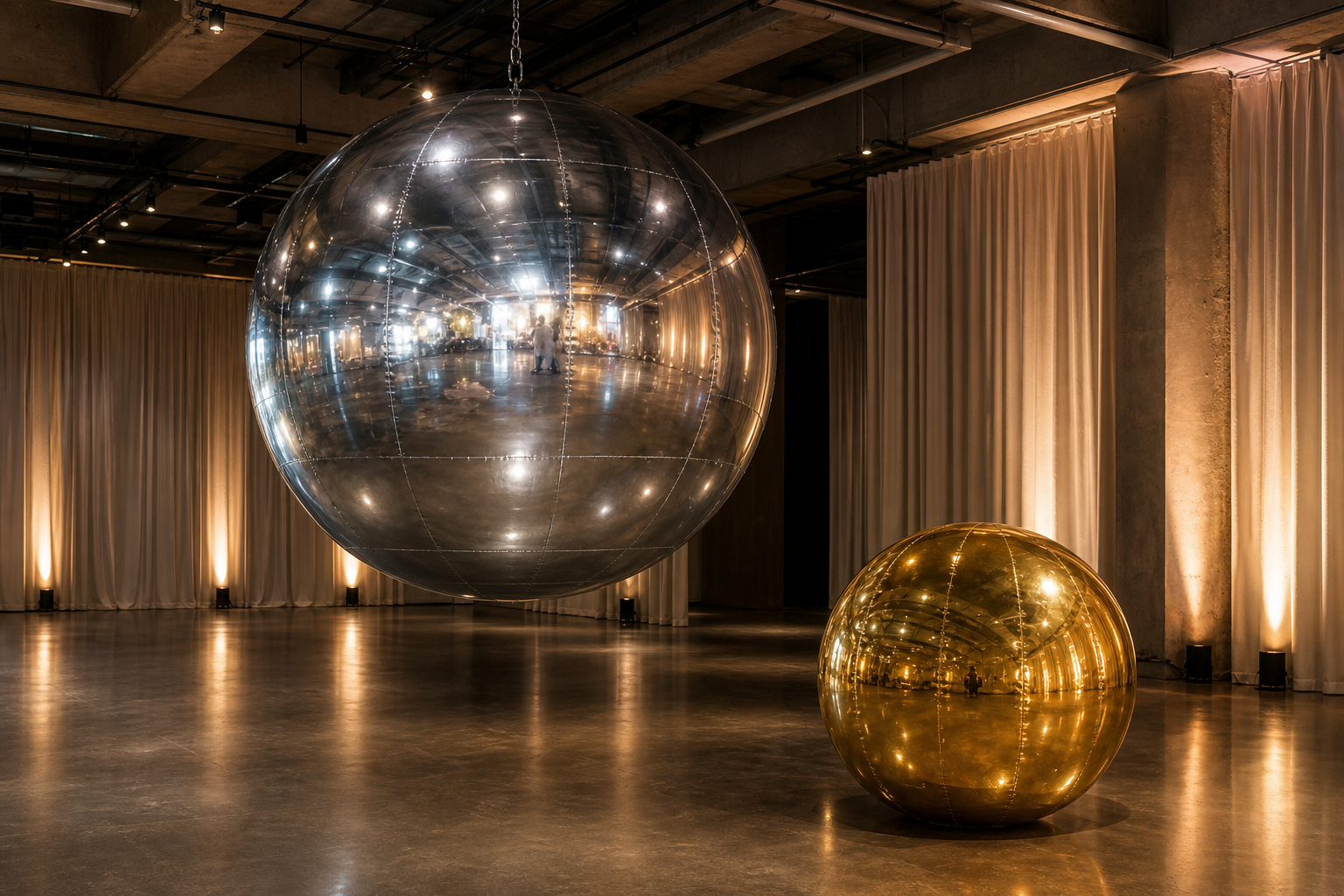
Inflatable mirror balls are supplied in silver or chrome mirror and gold reflective finishes. Iridescent, holographic and custom-printed mirror finishes are not standard, so confirm availability before planning a campaign around one. Spheres run from 30 cm to 5–6 m diameter, and the workable range narrows once print detail, lighting or suspension is added. Decide first whether the ball hangs or stands, because the suspension points are built into the seams, then fix the diameter against the ceiling height and sight lines of the actual venue.
By InflatCraft Product Team • Last updated
The finishes that exist
Two finishes are supplied: silver or chrome mirror and gold reflective. Silver or chrome reads as a classic mirror ball and works with almost any lighting scheme. Gold reads warmer and photographs well against dark backdrops and warm stage lighting.
Iridescent, holographic, colour-shift and custom-printed mirror surfaces are often requested, but they are not part of the standard offer. If a campaign depends on one, ask before the concept is signed off rather than after, because the answer changes the design, not only the price.
A brand mark can be considered on a reflective surface, but printing onto mirror film behaves differently from printing onto matte PVC and can dull the reflection around the logo. Raise it at the brief stage and ask for a mockup.
Choosing the diameter
Spheres are made 30 cm to 5–6 m diameter. Small balls suit table displays, window schemes and hand-held use; large balls work as a focal point over a dance floor, an atrium or a stage. Small hand-held spheres through to large suspended and ground-mounted balls. The workable range narrows once print detail, lighting or suspension is added.
Work from the venue, not from a catalogue number. Measure the ceiling or rigging height, the clear space below the ball when inflated, and the sight line from the furthest point of the audience. A ball that looks right in a render can hang too low over a walkway or disappear into a high ceiling void.
For a suspended ball, confirm what the venue allows before fixing the size: rigging points, maximum load per point, and whether anything may be attached to the structure at all. Many venues require the ball to be rigged by their own crew.
Hanging or standing
A suspended ball needs its attachment points designed into the seams, with the load spread rather than taken by a single patch. A ground-standing ball needs a stable base and ballast, and the air inlet has to sit where nobody trips over the hose or cable.
That decision cannot be changed after production without rebuilding the piece, so make it at the brief stage. If a ball has to work both ways across a tour, say so at the start; the design can allow for it, but only if it is planned.
Air supply and power
A continuously inflated ball needs an air system sized to the diameter. The 650 W electric pump moves 1,600–2,000 L/min at 2.0 psi and suits smaller spheres, compact displays and short-duration indoor installations, while the 1600 W electric pump moves 4,800–5,200 L/min at 4.5 psi for large-format structures, arches and continuously inflated outdoor displays. Both run on 110–240 V, 50–60 Hz, so the destination plug type is confirmed on the order.
Plan where the pump sits and how the cable is routed and covered, especially for a ball hung over an audience area. Noise matters indoors: ask where the pump can be placed relative to the ball and any seating.
Looking after a reflective surface
Mirror surfaces are less forgiving than printed PVC. Hard creases, abrasion and grit show up under lighting, so the piece is folded along agreed lines, kept clean and dry, and stored away from heat. Ask what the quotation includes for the carry bag and the export carton, and how the ball should be cleaned between events.
For a touring installation, ask for a spare valve cap and repair material, and agree who inspects the surface between venues.
What to send for a quote
Send the diameter you have in mind or the ceiling height it must hang under, the finish, whether it hangs or stands, indoor or outdoor use, the venue's rigging rules if known, any brand mark with vector artwork, the quantity and the event date.
MOQ is 1 piece for most custom projects. Bulk production typically takes 3–8 days for simple items, 7–15 days for standard custom work and 15–25 days for complex or large pieces, counted from final design approval. Freight comes on top: express or air usually 4–15 working days, and sea, rail or truck usually 20–45 days, after dispatch and subject to route and customs
Verified Specifications
Figures this guide is written against.
Material specifications
| Specification | Typical use | Notes |
|---|---|---|
| Double-layer PVC | General construction for custom advertising inflatables | The default build for most promotional structures. |
| 0.4 mm PVC | Large-format projects | Used on delivered large-format orders. |
| 0.5 / 0.6 / 0.7 mm PVC mesh | Engineered structures | Specified where the structure carries load, spans further, or faces sustained wind exposure. |
Air system specifications
| Pump | Airflow | Pressure | Suits |
|---|---|---|---|
| 650 W electric pump | 1,600–2,000 L/min | 2.0 psi | Smaller spheres, compact displays and short-duration indoor installations |
| 1600 W electric pump | 4,800–5,200 L/min | 4.5 psi | Large-format structures, arches and continuously inflated outdoor displays |
Both pumps cover 110–240 V at 50–60 Hz, so the same air system suits 110 V and 220–240 V markets. Confirm the plug type for the destination country.
Lead time
- Typical: Bulk production typically takes 3–8 days for simple items, 7–15 days for standard custom work and 15–25 days for complex or large pieces, counted from final design approval
- Can be shorter: Repeat orders on an approved design can run shorter
- Freight and import time come on top. Lead time is confirmed per project once artwork, size, quantity and destination are fixed; treat any figure quoted before that as indicative.
Product Buying Guides
More on choosing and ordering custom inflatables.
How to Compare Two Custom Inflatable Quotes
The lines that make two custom inflatable quotes comparable: material, air system, accessories, packing, lead time, freight terms and payment.
Reusable Custom Inflatables Checklist | InflatCraft
Planning to reuse a custom advertising inflatable across events? Use this buyer checklist for accessories, changeable artwork, storage, repair material, packing and RFQ details.
Air Dancer Replacement Tubes: Blower Fit | InflatCraft
Buying an air dancer replacement tube? Check the blower model, connection, tube dimensions and air requirements before ordering fabric-only replacements.
Inflatable Hanging Signs: Venue Checks | InflatCraft
Plan an inflatable hanging sign with the right venue approvals, dimensions, rigging review, documents and power arrangements before placing your order.
Compare sizes, materials and air systems on the custom advertising inflatable product range page before sending an RFQ.
Relevant Product Pages
Compare specifications before submitting an RFQ.
Buyer FAQ
Additional specification questions.
Where to order
Order direct from the manufacturer.
Published by InflatCraft, operated by Tianjin Mufeng Trading Co., Ltd., a custom inflatable manufacturer founded in 2005 and based in Tianjin, China. We export to the United States, United Kingdom, Canada, Australia, Germany, France, Spain and Italy.
Request a quote
Send the brief and get a specification-based quotation.
MOQ and lead time
What sets the minimum order and where the time goes.
Sourcing from China
Brief, approval, Incoterms, freight and import, in order.
Verified specifications
Materials, air systems and lead time this site quotes against.
Export planning by country: United States, United Kingdom, Canada, Australia, Germany, France, Spain, Italy.
