
Buyer Guide
Two Quotes, One Project: How to Compare Custom Inflatable Quotations Line by Line
Two quotations for the same inflatable are rarely comparable as written. Put them side by side and fill in seven lines for each: material and thickness, air system model and power, accessories and spares, packed specification, production lead time by complexity, freight terms and route, and payment and validity. A lower total usually means something is missing rather than cheaper, and the gap becomes visible as soon as the missing line is quoted.
By InflatCraft Product Team • Last updated
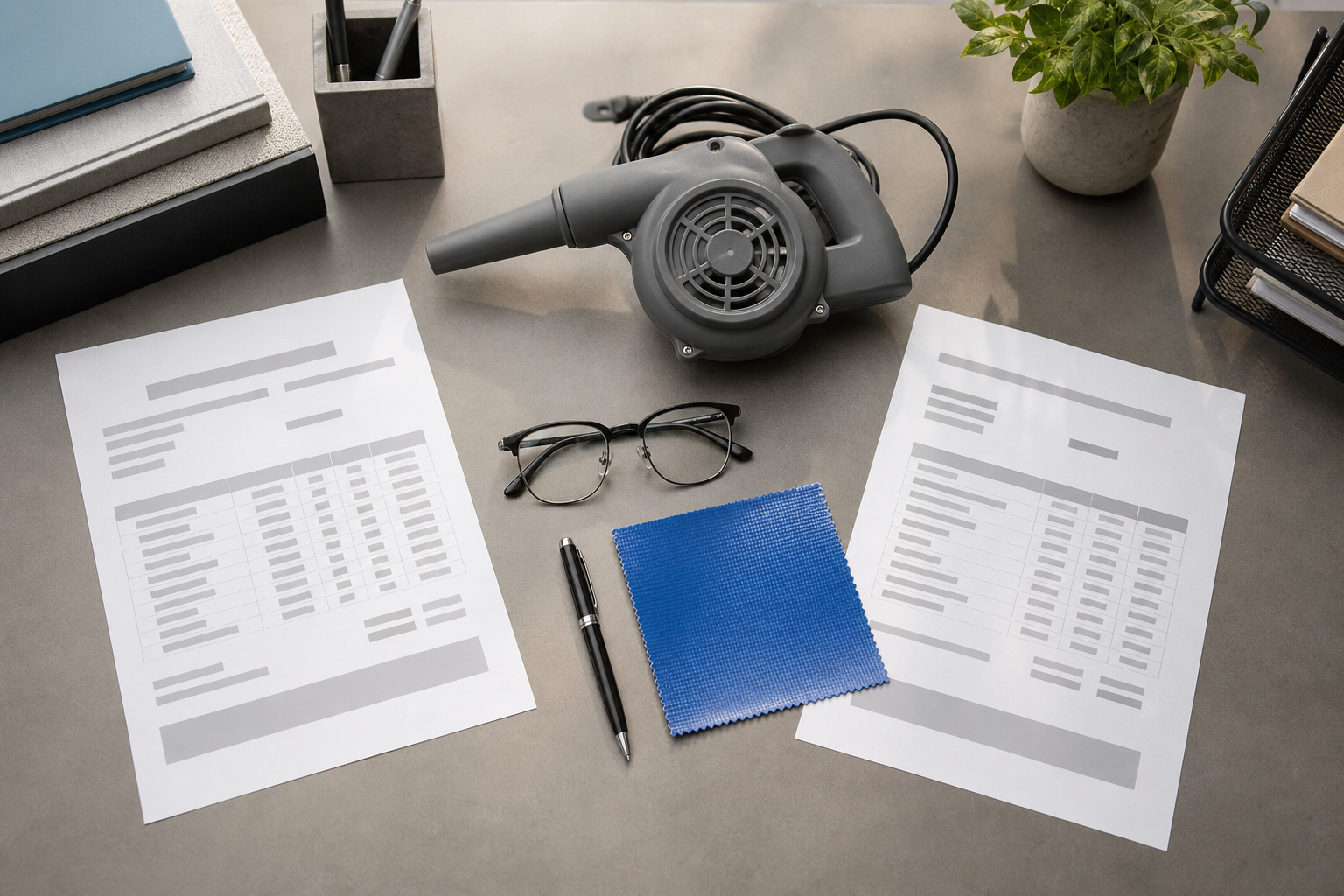
Material and construction
Ask each supplier to state the material and thickness, not just "PVC". Double-layer PVC is the general construction for custom advertising inflatables; 0.4 mm PVC appears on large-format projects; 0.5 / 0.6 / 0.7 mm PVC mesh is specified where the structure carries load, spans further or faces sustained exposure.
Also ask how seams are made and reinforced, and where reinforcement sits on this particular shape. Two quotes that both say "double-layer PVC" can still differ in how the stress points are built, which is what decides whether the piece survives a second season.
Air system and power
The air system should appear as a model with its power, airflow, pressure and voltage, not as "blower included". As a reference, a 650 W electric pump moves 1,600–2,000 L/min at 2.0 psi, and a 1600 W electric pump moves 4,800–5,200 L/min at 4.5 psi; both run on 110–240 V, 50–60 Hz.
Check the plug type for the destination and whether a spare pump is offered for a touring or unattended installation. Both pumps cover 110–240 V at 50–60 Hz, so the same air system suits 110 V and 220–240 V markets. Confirm the plug type for the destination country.
Accessories, spares and what is not included
List the accessories against each quote: carry bag, ground stakes or ballast points, ropes, repair material, spare valve caps, and any lighting. An item that is missing from one quote is the usual reason the totals differ.
Ask directly what is excluded. A short written list of exclusions is more useful than a long list of inclusions, and it is the fastest way to make two documents comparable.
Packed specification
Freight is charged on volume as much as weight, so the packed size and gross weight belong in the quotation. Ask for the packed dimensions, the number of cartons, the gross weight and whether the carry bag is inside the export carton.
Without those figures, a freight quotation is an estimate, and the difference between two suppliers' totals may simply be a different guess at the volume.
Lead time and when the clock starts
Lead time only means something with a starting point. Production is commonly 3–8 / 7–15 / 15–25 days (simple / standard / complex), counted from final design approval rather than from the order date; freight and import time come on top. Lead time is confirmed per project once artwork, size, quantity and destination are fixed; treat any figure quoted before that as indicative.
Ask each supplier what happens before the clock starts: how many drawing revisions are included, how quickly a mockup comes back, and what the approval deadline is for the event date you have given.
Freight terms, payment and validity
Confirm the incoterm on each quotation and what it leaves with you. EXW, FOB, CIF and a DDP option place customs clearance, duty and import tax in different hands, and a lower goods price under one term can end up higher landed. Freight ranges are indicative: express or air usually 4–15 working days, and sea, rail or truck usually 20–45 days, after dispatch and subject to route and customs
Then check the commercial lines: payment method and the deposit and balance split, and how long the price holds. A quotation is normally valid for a limited period, commonly around 15 days unless the supplier states otherwise, and freight is usually rechecked before payment because rates move.
MOQ is 1 piece for most custom projects, so ask what changes if you order one piece now and repeat the design later: pattern and print setup are paid once per design, and a repeat order on an approved design should reflect that.
Verified Specifications
Figures this guide is written against.
Material specifications
| Specification | Typical use | Notes |
|---|---|---|
| Double-layer PVC | General construction for custom advertising inflatables | The default build for most promotional structures. |
| 0.4 mm PVC | Large-format projects | Used on delivered large-format orders. |
| 0.5 / 0.6 / 0.7 mm PVC mesh | Engineered structures | Specified where the structure carries load, spans further, or faces sustained wind exposure. |
Air system specifications
| Pump | Airflow | Pressure | Suits |
|---|---|---|---|
| 650 W electric pump | 1,600–2,000 L/min | 2.0 psi | Smaller spheres, compact displays and short-duration indoor installations |
| 1600 W electric pump | 4,800–5,200 L/min | 4.5 psi | Large-format structures, arches and continuously inflated outdoor displays |
Both pumps cover 110–240 V at 50–60 Hz, so the same air system suits 110 V and 220–240 V markets. Confirm the plug type for the destination country.
Lead time
- Typical: Bulk production typically takes 3–8 days for simple items, 7–15 days for standard custom work and 15–25 days for complex or large pieces, counted from final design approval
- Can be shorter: Repeat orders on an approved design can run shorter
- Freight and import time come on top. Lead time is confirmed per project once artwork, size, quantity and destination are fixed; treat any figure quoted before that as indicative.
Product Buying Guides
More on choosing and ordering custom inflatables.
Reusable Custom Inflatables Checklist | InflatCraft
Planning to reuse a custom advertising inflatable across events? Use this buyer checklist for accessories, changeable artwork, storage, repair material, packing and RFQ details.
Air Dancer Replacement Tubes: Blower Fit | InflatCraft
Buying an air dancer replacement tube? Check the blower model, connection, tube dimensions and air requirements before ordering fabric-only replacements.
Inflatable Hanging Signs: Venue Checks | InflatCraft
Plan an inflatable hanging sign with the right venue approvals, dimensions, rigging review, documents and power arrangements before placing your order.
Inflatable Entrance Tunnels: Site Planning | InflatCraft
Specify a custom inflatable entrance tunnel around clear internal space, the full footprint, visitor routes, blower placement and event branding.
Compare sizes, materials and air systems on the custom advertising inflatable product range page before sending an RFQ.
Relevant Product Pages
Compare specifications before submitting an RFQ.
Buyer FAQ
Additional specification questions.
Where to order
Order direct from the manufacturer.
Published by InflatCraft, operated by Tianjin Mufeng Trading Co., Ltd., a custom inflatable manufacturer founded in 2005 and based in Tianjin, China. We export to the United States, United Kingdom, Canada, Australia, Germany, France, Spain and Italy.
Request a quote
Send the brief and get a specification-based quotation.
MOQ and lead time
What sets the minimum order and where the time goes.
Sourcing from China
Brief, approval, Incoterms, freight and import, in order.
Verified specifications
Materials, air systems and lead time this site quotes against.
Export planning by country: United States, United Kingdom, Canada, Australia, Germany, France, Spain, Italy.
