
Buyer Guide
From 3D File to Custom Inflatable: What a Factory Can Use and What Changes
A 3D file helps a manufacturer understand a shape, but it is not a production pattern. An inflatable is made from flat panels welded into a skin that takes its form from air pressure, so sharp corners soften, thin parts thicken and hollow details are simplified. Send the model together with the three or four dimensions that matter most, a note on which features are essential, print-ready vector artwork and the intended use, then approve a scaled production drawing before cutting starts. Ask the manufacturer which file formats they can open before sending anything large.
By InflatCraft Product Team • Last updated
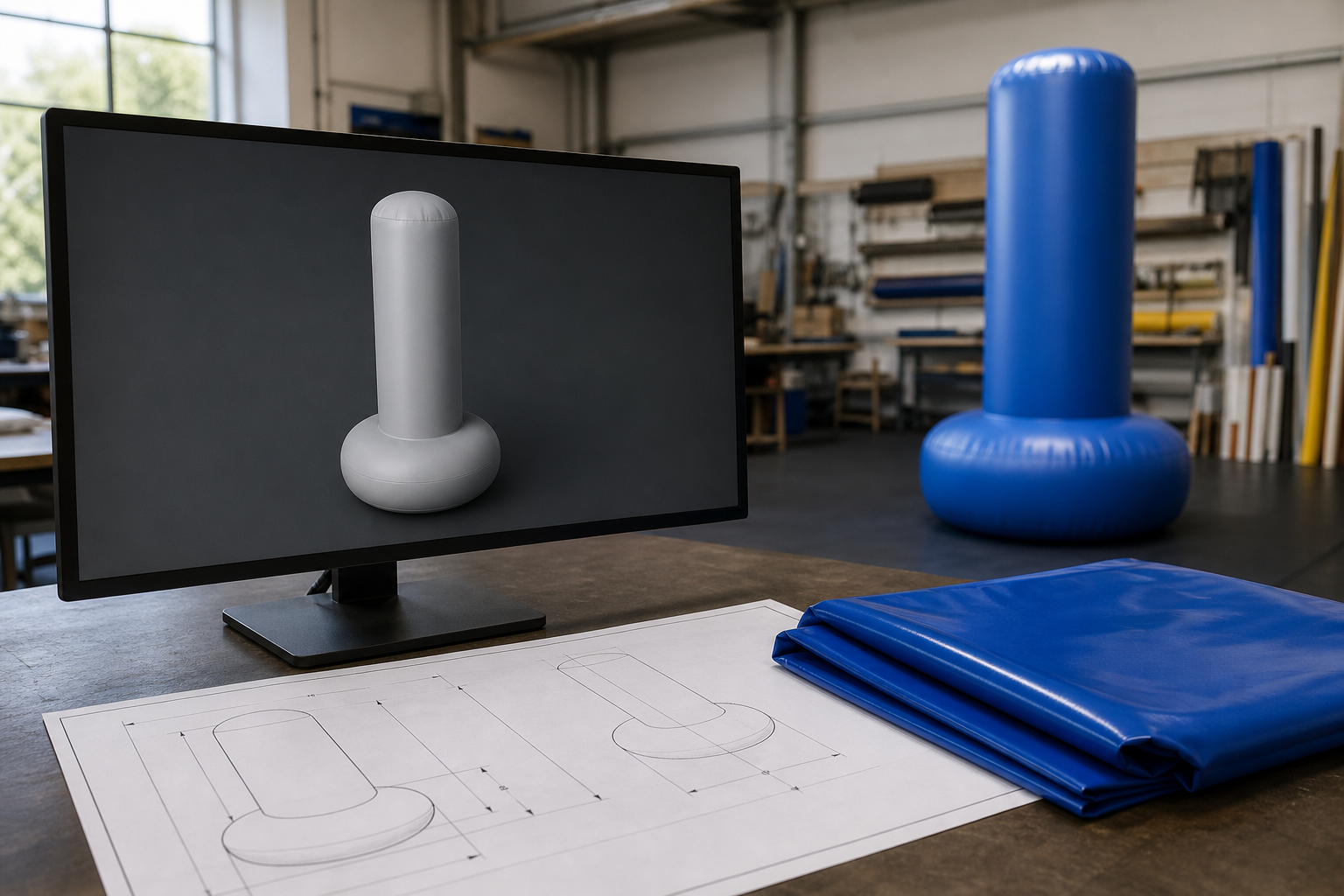
What a 3D file is good for
A 3D model, a product render or even a rough sculpt answers questions that photographs leave open: proportions from every side, how a shape sits on the ground, where a logo panel could go and how parts relate to each other. For an unusual product replica or a character shape, sending the model removes a whole round of "did you mean this?" questions.
It does not replace the brief. The model carries geometry but not intent, so the factory cannot tell from it which dimension is fixed by a venue door, which detail the brand cares about, or whether the piece stands on the floor, hangs from a truss or sits on a roof. Those decisions change the pattern, the material and the air system.
Ask which formats can be opened before sending files. Common exchange formats such as STEP, OBJ and STL are read by most modelling software, while a native file from one design package may not open at all. A short screen recording or a set of rendered views from six angles is often more useful than a file nobody can load.
Why an inflatable is not a one-to-one copy
An inflatable is a sealed skin cut from flat panels and welded together, then pushed into shape by air. Pressure pulls every surface towards a curve, so the geometry changes in predictable ways: sharp external corners become radii, flat faces bulge slightly, deep grooves shallow out and narrow slots close.
Thin, projecting parts are the most common adjustment. A slim handle, a thin tail or a narrow neck cannot hold its shape at display scale, so it is usually thickened, shortened or supported. Hollow features and undercuts are simplified into printed detail instead of built geometry. None of this is a compromise on quality; it is how the product works, and a good manufacturer shows each change on the drawing rather than making it silently.
The other change is scale. A shape that reads well as a 200 mm product may need different proportions at 3 m, because seams, print resolution and viewing distance all behave differently. It is normal for the factory to propose a small proportional change so the finished piece reads correctly from where the audience stands.
The dimensions that decide the quote
Every quotation starts from size, and a model without units or with a placeholder scale slows that down. State the overall height or width you need, the dimension that is fixed by the site, and what limits it: a doorway, a ceiling, a stand footprint, a truck or a loading bay.
Mark which features are essential and which are decoration. If the cap colour and the logo panel must be exact but the base plinth can change, say so. That single sentence usually saves a round of revisions.
Note how the piece is supported, because it changes the build: standing on the ground with ballast, anchored to a frame, suspended from a rigging point, or carried. Suspension in particular has to be designed into the seams, not added afterwards.
Artwork still has to come separately
Textures exported from a 3D model are rarely usable for printing. Send print-ready vector artwork for logos and text, with colour references, and say which face each element belongs on. If the artwork only exists as a raster image, send the largest original you have and expect the manufacturer to ask for a redraw of anything that has to stay sharp.
Fine print, legal copy and small icons usually get simplified at display scale. Decide in advance which two or three elements have to be readable from a distance, and let the rest be colour.
Material and air system follow the shape
Material is chosen from the shape and the use, not the other way round. Double-layer PVC is the general construction for custom advertising inflatables, 0.4 mm PVC is used on large-format projects, and 0.5 / 0.6 / 0.7 mm PVC mesh is specified where the structure carries load, spans further or faces sustained exposure.
The air system is sized the same way. The 650 W electric pump moves 1,600–2,000 L/min at 2.0 psi and suits smaller spheres, compact displays and short-duration indoor installations; the 1600 W electric pump moves 4,800–5,200 L/min at 4.5 psi for large-format structures, arches and continuously inflated outdoor displays. Both run on 110–240 V, 50–60 Hz, and the destination plug type is confirmed on the order.
From file to approved drawing
The sequence that works is short. Send the model, the key dimensions, the use and the artwork; receive a scaled production drawing and a colour mockup showing the adapted shape; raise every change at that stage; approve once. Cutting starts from the approved drawing, and the production clock starts with it.
MOQ is 1 piece for most custom projects, so a first piece can be made and reviewed before a larger run. Bulk production typically takes 3–8 days for simple items, 7–15 days for standard custom work and 15–25 days for complex or large pieces, counted from final design approval. Freight comes on top: express or air usually 4–15 working days, and sea, rail or truck usually 20–45 days, after dispatch and subject to route and customs
Verified Specifications
Figures this guide is written against.
Material specifications
| Specification | Typical use | Notes |
|---|---|---|
| Double-layer PVC | General construction for custom advertising inflatables | The default build for most promotional structures. |
| 0.4 mm PVC | Large-format projects | Used on delivered large-format orders. |
| 0.5 / 0.6 / 0.7 mm PVC mesh | Engineered structures | Specified where the structure carries load, spans further, or faces sustained wind exposure. |
Lead time
- Typical: Bulk production typically takes 3–8 days for simple items, 7–15 days for standard custom work and 15–25 days for complex or large pieces, counted from final design approval
- Can be shorter: Repeat orders on an approved design can run shorter
- Freight and import time come on top. Lead time is confirmed per project once artwork, size, quantity and destination are fixed; treat any figure quoted before that as indicative.
Product Buying Guides
More on choosing and ordering custom inflatables.
Inflatable Mirror Ball Finishes and Sizes
Which mirror ball finishes are available, the diameters that are practical, and what to confirm about hanging, air supply and packing before ordering.
How to Compare Two Custom Inflatable Quotes
The lines that make two custom inflatable quotes comparable: material, air system, accessories, packing, lead time, freight terms and payment.
Reusable Custom Inflatables Checklist | InflatCraft
Planning to reuse a custom advertising inflatable across events? Use this buyer checklist for accessories, changeable artwork, storage, repair material, packing and RFQ details.
Air Dancer Replacement Tubes: Blower Fit | InflatCraft
Buying an air dancer replacement tube? Check the blower model, connection, tube dimensions and air requirements before ordering fabric-only replacements.
Compare sizes, materials and air systems on the custom advertising inflatable product range page before sending an RFQ.
Relevant Product Pages
Compare specifications before submitting an RFQ.
Buyer FAQ
Additional specification questions.
Where to order
Order direct from the manufacturer.
Published by InflatCraft, operated by Tianjin Mufeng Trading Co., Ltd., a custom inflatable manufacturer founded in 2005 and based in Tianjin, China. We export to the United States, United Kingdom, Canada, Australia, Germany, France, Spain and Italy.
Request a quote
Send the brief and get a specification-based quotation.
MOQ and lead time
What sets the minimum order and where the time goes.
Sourcing from China
Brief, approval, Incoterms, freight and import, in order.
Verified specifications
Materials, air systems and lead time this site quotes against.
Export planning by country: United States, United Kingdom, Canada, Australia, Germany, France, Spain, Italy.
