
Buyer Guide
How to Repair Tears in a PVC Inflatable: Field Fix or Factory Repair
Small punctures and short tears in a flat PVC panel, away from seams and stress points, can usually be patched in the field with PVC patch material and an adhesive suitable for PVC, applied to a clean, dry surface and left to cure before the unit is inflated again. Damage at a seam, a tie point, a valve or a zip, long tears, and tears running through printed artwork should go back to the manufacturer, because a field patch there tends to fail under load or ruin the look of the unit.
By InflatCraft Product Team • Last updated September 2, 2026
Find the whole of the damage first
A tear that is visible is often not the only damage. The event that caused it — a snag on a fence, a drag across gravel, a gust pulling on a tie point — usually stresses the surrounding area too. Before repairing anything, inflate the unit in a sheltered space and walk around it slowly.
On a continuous-air inflatable, leaks are easiest to find by sound and by holding a hand close to the surface. Mark every hole, split and lifting seam with something that can be removed later without damaging the print. Then deflate the unit and look at the same areas from the inside where access allows, because seam damage often shows more clearly from within.
Only once every point is marked is it possible to decide whether this is a field repair, a factory repair, or a unit that has reached the end of its life.
What can be repaired in the field
Field repairs work best on small punctures and short, clean tears in a flat area of fabric, away from seams, tie points, valves and zips. In those places the fabric is not carrying concentrated load, and a well-bonded patch spreads what load there is across a wider area.
A field repair also makes sense where the unit is needed again soon and the damage is minor, even if it will be looked at properly later. The goal is a repair that holds through normal use without making the damage worse.
What a field repair should not attempt is to restore structure. If the damage has changed how the unit holds its shape, or sits exactly where the unit is tied down, a patch on the surface will not put the strength back where it is needed.
What should go back to the factory
Seams are the first category. A seam holds two panels together under the full pressure of the structure, and a surface patch across a failed seam rarely holds for long. Repairing a seam properly means re-joining the panels, which needs the right equipment and material.
Tie points and the fabric around them are the second. They take the load every time the unit is secured, so a weak repair there fails at the worst possible moment. Valves, zips and access openings are the third, because they are components rather than fabric and usually need replacing rather than patching.
Long tears, tears across several panels, and tears running through a large printed area also belong at the factory. A field patch there may hold, but it will be visible in every photograph of the unit, and for an advertising inflatable that is part of the damage.
How to make a field patch that lasts
Most failed patches fail because of the surface, not the patch. Clean the area around the damage thoroughly to remove dirt, grease and any residue, and let it dry completely. A patch applied over moisture or grime bonds to that layer instead of the fabric.
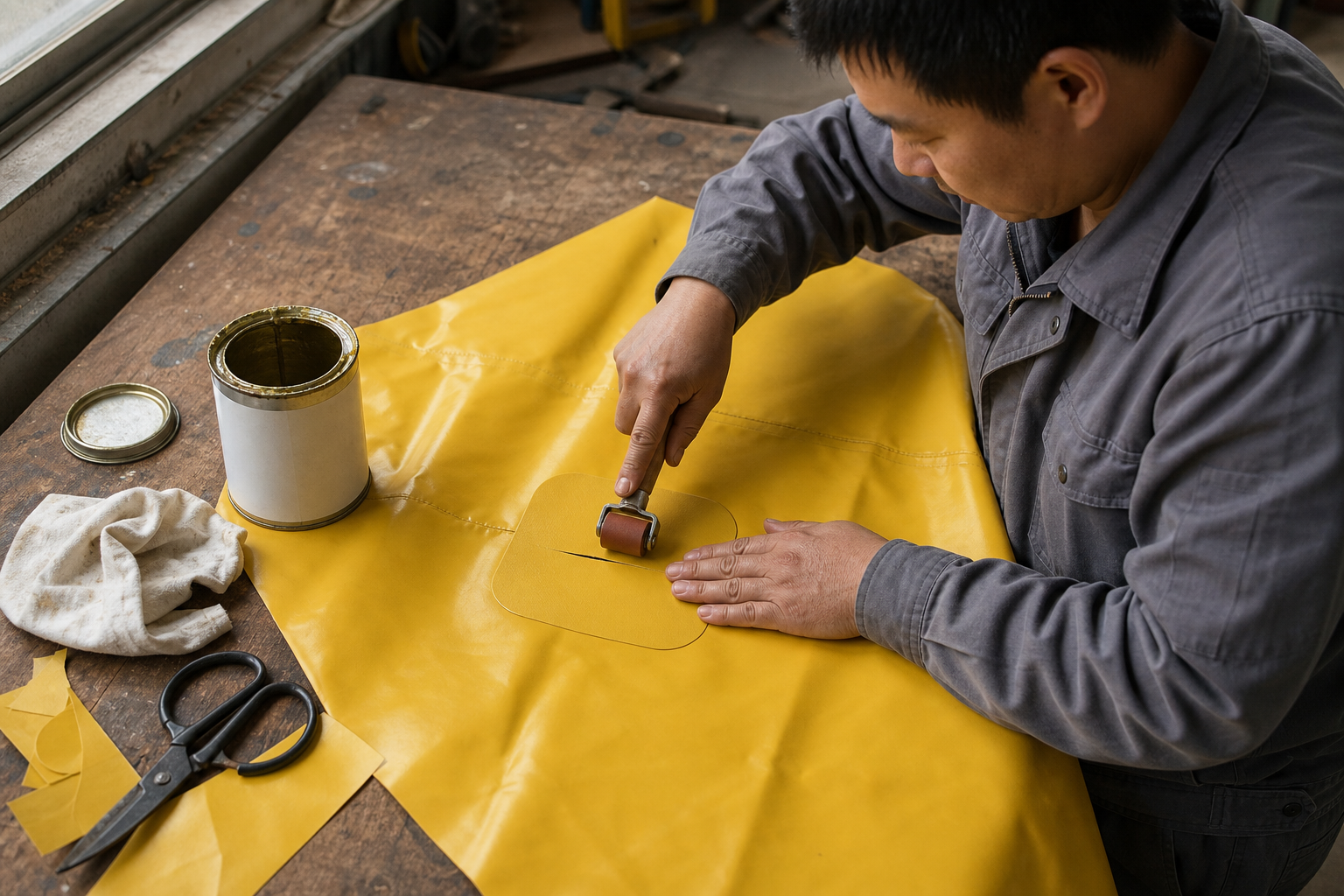
Cut the patch from PVC material compatible with the unit, large enough to overlap well beyond the damage in every direction, with rounded corners — square corners are where patches start to lift. Use an adhesive intended for PVC, follow its instructions for application and working time, and press the patch firmly from the centre outwards to remove trapped air.
Then wait. The adhesive needs time to cure before the fabric is put under pressure, and inflating too early is the most common reason a good patch peels. The adhesive's own instructions set that time; follow them, and allow longer in cold or damp conditions.
Why tape repairs fail
Tape is tempting because it is fast and it works for an hour. It fails because it is not designed to bond to PVC under repeated flexing, temperature change and moisture. The edge lifts as the fabric moves, dirt gets under it, and the tear continues underneath where nobody can see it.
Tape also leaves residue that has to be removed completely before a proper patch can be applied, which makes the eventual repair harder. Use tape only to finish a job on the day, and replace it with a real repair before the unit goes out again.
Sending a unit back for repair
Before shipping a unit back, send the manufacturer clear photographs of each marked area, a note of what caused the damage if known, and the order reference. Close-up and wide photographs together show both the damage and where it sits on the structure.
Clean and dry the unit completely before packing it, so the repair can start straight away and no mould develops in transit. Ask for a repair quotation and weigh it, plus freight in both directions and the time the unit is out of service, against the cost of a replacement. For an older unit with damage in several places, replacement is sometimes the better decision.
Verified Specifications
Figures this guide is written against.
Material specifications
| Specification | Typical use | Notes |
|---|---|---|
| Double-layer PVC | General construction for custom advertising inflatables | The default build for most promotional structures. |
| 0.4 mm PVC | Large-format projects | Used on delivered large-format orders. |
| 0.5 / 0.6 / 0.7 mm PVC mesh | Engineered structures | Specified where the structure carries load, spans further, or faces sustained wind exposure. |
Care and Repair Guides
More on repairing, cleaning and storing inflatables.
Long-Term Storage for Commercial Inflatables
Why storage damages more commercial inflatables than use does, and how to dry, clean, fold and store a unit so it survives the off-season.
Cleaning and Mold Prevention for Inflatables
How to clean PVC and coated-fabric inflatables without damaging print or coating, dry them properly, deal with early mold spots, and which cleaning products to keep away.
How Many Seasons Can a Commercial Inflatable Last?
Why no honest supplier gives one lifespan figure for a commercial inflatable, what shortens and extends service life, the signs a unit is near the end, and what to ask a manufacturer instead.
Compare sizes, materials and air systems on the verified material specifications page before sending an RFQ.
Relevant Product Pages
Compare specifications before submitting an RFQ.
Buyer FAQ
Additional specification questions.
Where to order
Order direct from the manufacturer.
Published by InflatCraft, operated by Tianjin Mufeng Trading Co., Ltd., a custom inflatable manufacturer founded in 2005 and based in Tianjin, China. We export to the United States, United Kingdom, Canada, Australia, Germany, France, Spain and Italy.
Request a quote
Send the brief and get a specification-based quotation.
MOQ and lead time
What sets the minimum order and where the time goes.
Sourcing from China
Brief, approval, Incoterms, freight and import, in order.
Verified specifications
Materials, air systems and lead time this site quotes against.
Export planning by country: United States, United Kingdom, Canada, Australia, Germany, France, Spain, Italy.