
Buyer Guide
Cleaning and Mold Prevention for Inflatable Fabric
Clean an inflatable with mild soap, water and a soft brush or cloth, rinse, and dry it completely while inflated before folding it away. Mold grows where moisture and dirt are folded into a unit and left in the dark, so thorough drying prevents far more of it than any cleaning product removes. Keep solvents, bleach, strong alcohol and abrasive pads away from the fabric and print, and treat any early mold spots straight away.
By InflatCraft Product Team • Last updated September 2, 2026
What mold needs, and why folded inflatables supply it
Mold needs moisture, something to feed on and time without air or light. A commercial inflatable packed away after an event can supply all of them at once: water from rain, grass or cleaning trapped in its folds, dirt and organic residue on the surface, and weeks in a closed bag.
The fabric itself is not usually what feeds the mold. The surface film of dirt, grass and residue is. That is why cleaning and drying work together: cleaning removes what mold grows on, and drying removes what it needs to grow.
Cleaning after each use
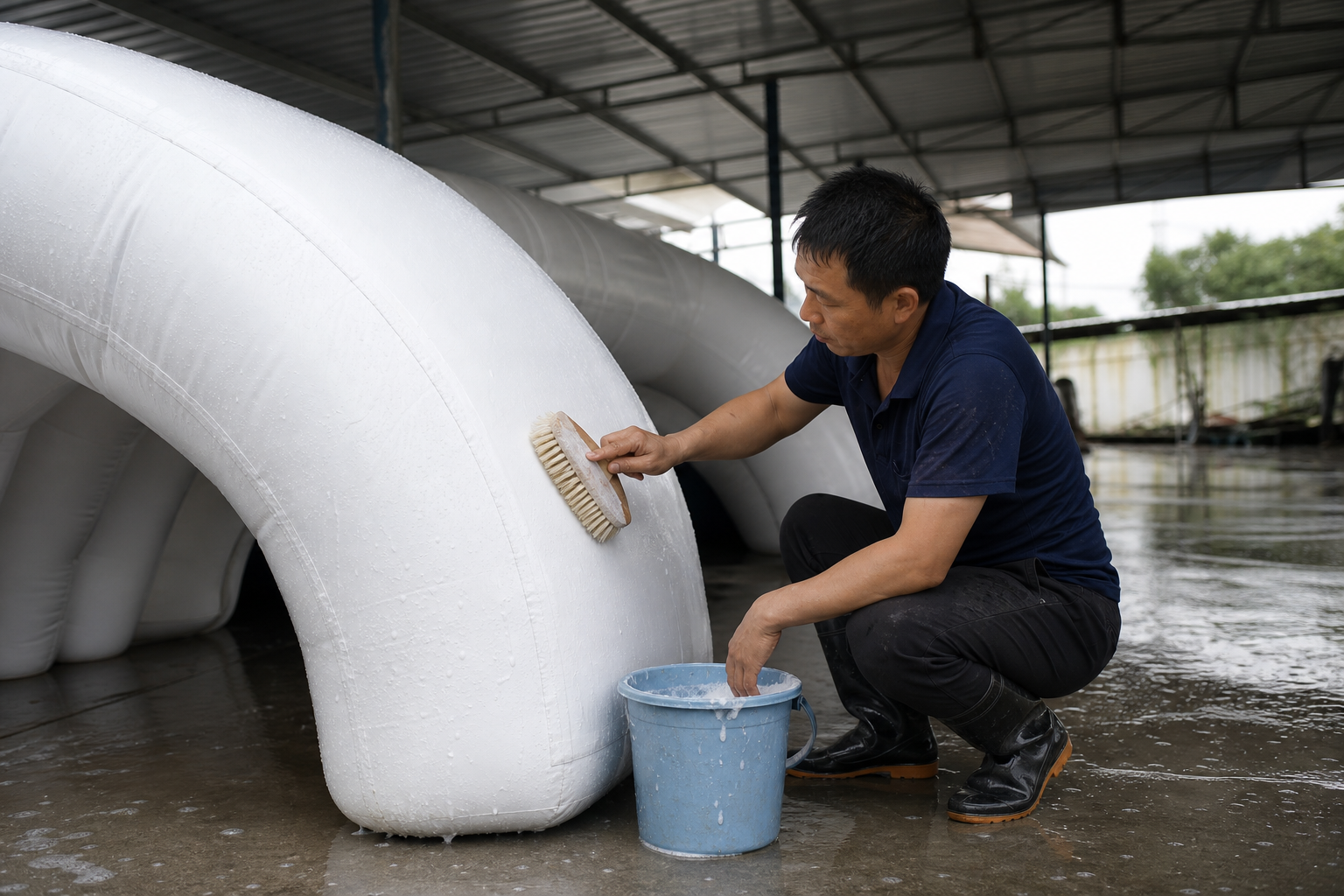
Clean the unit while it is inflated, where possible, so the surface is taut and every area can be reached. Use mild soap in water and a soft brush or cloth, working from the top down so dirty water does not run over panels already cleaned.
Pay attention to the base and lower panels, which collect the most dirt, and to seams and folds where residue gathers. Rinse with clean water so no soap film is left behind, because residue left on the surface attracts dirt again.
Avoid pressure washers close to the fabric. A concentrated jet can force water into seams, lift print edges and damage the coating, and it drives dirt into the places that are hardest to dry.
Drying properly
Dry the unit inflated, in a sheltered space with air moving across it. Sunlight dries quickly but prolonged exposure fades print, so use shade and airflow rather than leaving a unit in full sun for hours.
Check the underside, the seams and the folds before deflating. In a continuous-air unit, moisture can also collect inside the structure, so keep the blower running long enough to dry the interior. A unit is ready to pack only when every surface, inside and out, is dry to the touch.
Dealing with early mold spots
Small spots caught early are usually a surface problem and can often be cleaned off. Left for a season, mold stains the coating and print and can become permanent. So treat spots as soon as they are found, rather than waiting for the next full clean.
Start with the gentlest method — mild soap, water and a soft brush — and work on a small area. If a stronger cleaner is needed, choose one suitable for PVC or coated fabrics, and test it first on a hidden area to check it does not affect the print or finish. After treatment, rinse, dry completely and find out why moisture was trapped in that area, so it does not happen again.
Cleaning products that damage inflatables
Solvents and solvent-based cleaners can soften or strip the PVC coating and remove print. Bleach can discolour fabric and print. Strong alcohol and aggressive degreasers can dry out the coating over repeated use. Abrasive pads and stiff brushes scratch the surface and wear print away at the edges.
Household products are not all safe simply because they are common. If in doubt, ask the manufacturer what is suitable for the specific material used on your unit, and test anything new on a hidden area first.
Building cleaning into the turnaround
For rental companies and repeat users, cleaning and drying are part of the job, not an optional extra. Plan space and time for them after every event, and include them in the crew routine alongside packing.
A unit that goes out clean looks better in clients' photographs, lasts longer and is far less likely to come out of storage stained. The same routine carries straight into preparing units for the off-season, covered in the long-term storage guide.
Cleaning around print, seams, valves and attachments
Some parts of an inflatable need more attention than open panels. Printed areas should be cleaned gently, with a soft cloth rather than a brush where the print is detailed, because repeated scrubbing wears the edges of the artwork first. Clean across printed areas rather than rubbing hard along one edge.
Seams collect dirt along their edges and hold water in the overlap, so they are one of the most common places for mold to start. Clean along them carefully, rinse the soap out of the overlap, and give seams extra drying time. Tie points and reinforced areas have layered fabric that dries more slowly than the panels around them.
Valves, zips and access openings need to be rinsed clear of grit, which otherwise wears the closure every time it is used, and then left open to dry. Hook-and-loop attachment strips for banner panels trap grass and dirt; clear them before packing, because debris stops them gripping properly on the next setup.
Where a unit carries removable branding panels, remove and clean them separately. Moisture trapped between a panel and the structure is invisible during drying and is exactly the kind of hidden damp that produces mold in storage.
Finish with the bag. Storage bags pick up the same dirt and moisture as the units they carry, and a clean, dry inflatable packed into a damp, dirty bag is back where it started. Shake bags out, wipe them down, let them dry fully and store them open. A bag that smells of mildew should be cleaned before it is used again, or replaced.
Care and Repair Guides
More on repairing, cleaning and storing inflatables.
Repairing PVC Inflatable Tears: Field vs Factory
Which tears in a PVC advertising inflatable can be patched on site, which should go back to the factory, how to make a field patch that lasts, and why tape repairs fail.
Long-Term Storage for Commercial Inflatables
Why storage damages more commercial inflatables than use does, and how to dry, clean, fold and store a unit so it survives the off-season.
How Many Seasons Can a Commercial Inflatable Last?
Why no honest supplier gives one lifespan figure for a commercial inflatable, what shortens and extends service life, the signs a unit is near the end, and what to ask a manufacturer instead.
Compare sizes, materials and air systems on the verified material specifications page before sending an RFQ.
Relevant Product Pages
Compare specifications before submitting an RFQ.
Buyer FAQ
Additional specification questions.
Where to order
Order direct from the manufacturer.
Published by InflatCraft, operated by Tianjin Mufeng Trading Co., Ltd., a custom inflatable manufacturer founded in 2005 and based in Tianjin, China. We export to the United States, United Kingdom, Canada, Australia, Germany, France, Spain and Italy.
Request a quote
Send the brief and get a specification-based quotation.
MOQ and lead time
What sets the minimum order and where the time goes.
Sourcing from China
Brief, approval, Incoterms, freight and import, in order.
Verified specifications
Materials, air systems and lead time this site quotes against.
Export planning by country: United States, United Kingdom, Canada, Australia, Germany, France, Spain, Italy.