
Buyer Guide
How Many Seasons Can a Commercial Inflatable Last?
There is no single honest number for how many seasons a commercial inflatable lasts. Service life depends on the material specified, how often and where the unit is set up, how it is handled, cleaned, dried and stored, and how damage is repaired. A well-specified unit that is dried and stored properly can stay in service far longer than an identical unit packed away wet. Ask a manufacturer which material suits your specific pattern of use, rather than asking for a lifespan.
By InflatCraft Product Team • Last updated September 2, 2026
Why there is no single honest number
The same inflatable can be used indoors at a few trade shows a year or outdoors every weekend on concrete. It can be dried and rolled into a bag in a dry warehouse, or folded wet and left in a van. It can be set up by a trained crew or dragged into position by whoever is available. Those two lives have almost nothing in common, and a lifespan figure that ignores the difference cannot be accurate for either.
That is why a careful manufacturer answers the question with questions. Where will it be used, how often, on what surfaces, by whom, and how will it be stored? The answers decide what should be specified, and the specification — together with how the unit is treated — decides how long it lasts.
What shortens service life
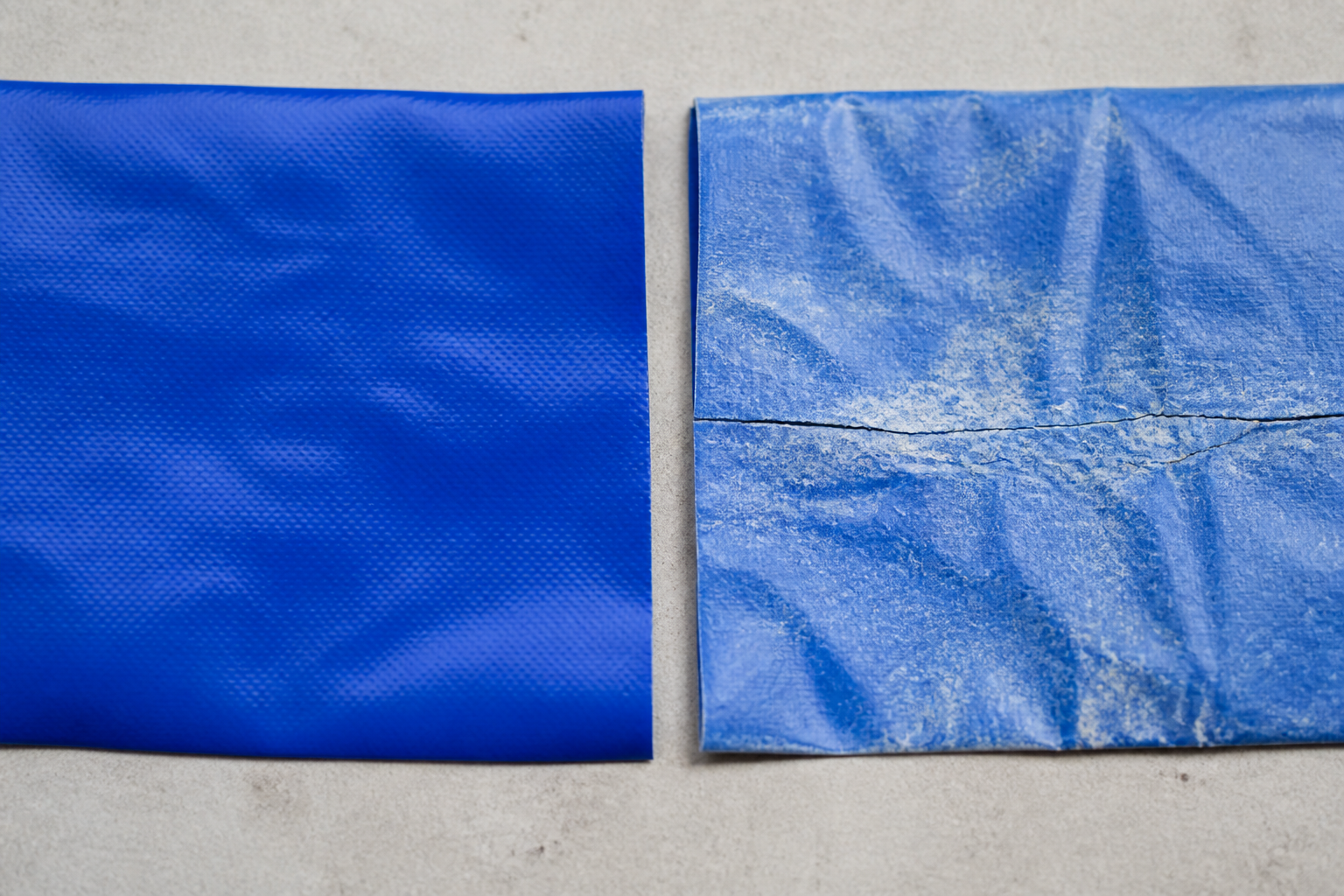
Prolonged sunlight is the first factor for outdoor units. Over time it fades print and ages the coating, which becomes less flexible and more prone to cracking at folds. Abrasion is the second: bases dragged across concrete, gravel or asphalt wear through much faster than those lifted into position.
Moisture is the third, and it does its damage off site. A unit packed away damp develops mold and staining in storage, and repeated damp storage shortens its useful life faster than most outdoor use. Rough handling completes the list: over-tightened tie points, units pulled by their seams, sharp objects in vans, and folds forced into bags that are too small.
What extends service life
Specification comes first. A material chosen for the actual use — outdoor repeated setup, indoor display, a large-format structure — holds up better than one chosen on price alone. The verified materials on this site, and what each suits, are shown below this article.
After that, most of the difference is routine. Cleaning after use, drying completely before packing, rolling rather than creasing, storing dry and off the floor, lifting rather than dragging, tying down at the designed points, and repairing small damage before it spreads. None of these is expensive; all of them compound over seasons.
Design details matter too. Reinforcement at tie points and the base, parts that can be replaced on their own, and a bag that is not a tight fit when new all remove common causes of early wear.
Signs a unit is nearing the end of its life
A single repair is normal. Repairs that keep recurring at the same seams or tie points are a sign that the fabric there is no longer holding a repair well. Fabric that has become stiff, rough or chalky, or that cracks along folds, has aged beyond what cleaning can restore.
For an advertising inflatable, appearance is part of its function. Print that has faded or discoloured noticeably may leave a unit structurally sound but commercially finished, because clients and their audiences judge the brand by what they see. A unit that no longer holds its shape reliably, or needs constant attention to stay inflated, has reached the same point by a different route.
Matching material to expected use
The question that actually decides service life is which material suits the use. An indoor display that goes up a few times a year does not need the same specification as an outdoor unit set up every weekend, and a large structure carrying load needs something different again.
The verified material specifications listed below show the options offered on this site and what each is used for. Whoever manufactures your unit, ask for the material specification in writing, and ask why it suits your use.
Ask the manufacturer the right question
Instead of asking "how long will it last", describe how it will be used: indoor or outdoor, how often, on what surfaces, by what kind of crew, in what climate, and how it will be stored. Then ask which material and construction suit that use, which points will wear first, and what can be replaced or repaired when they do.
Those answers are more useful than any lifespan figure, because they tell you what to specify, what to watch and what to budget for. They also show quickly whether a supplier understands commercial use or is quoting a number to close a sale.
Keeping a service record for each unit
The most reliable way to know how long your inflatables last is to record it. Give each unit a permanent identifier, and note every use, every repair and every problem against it: where it was set up, on what surface, how it was stored afterwards, and what needed fixing. Over time the record shows how long units actually last under your conditions, which is the only lifespan figure that means anything for your business.
A service record also shows why some units age faster than others. Two identical units with very different histories usually differ in how they were handled or stored, not in how they were made. That points directly at a routine to change, rather than at a material to replace.
When the time comes to order again, the record is the most useful thing you can give a manufacturer. It replaces a general request for something more durable with specific information about which points wore, under what use, and after how long.
Verified Specifications
Figures this guide is written against.
Material specifications
| Specification | Typical use | Notes |
|---|---|---|
| Double-layer PVC | General construction for custom advertising inflatables | The default build for most promotional structures. |
| 0.4 mm PVC | Large-format projects | Used on delivered large-format orders. |
| 0.5 / 0.6 / 0.7 mm PVC mesh | Engineered structures | Specified where the structure carries load, spans further, or faces sustained wind exposure. |
Care and Repair Guides
More on repairing, cleaning and storing inflatables.
Repairing PVC Inflatable Tears: Field vs Factory
Which tears in a PVC advertising inflatable can be patched on site, which should go back to the factory, how to make a field patch that lasts, and why tape repairs fail.
Long-Term Storage for Commercial Inflatables
Why storage damages more commercial inflatables than use does, and how to dry, clean, fold and store a unit so it survives the off-season.
Cleaning and Mold Prevention for Inflatables
How to clean PVC and coated-fabric inflatables without damaging print or coating, dry them properly, deal with early mold spots, and which cleaning products to keep away.
Compare sizes, materials and air systems on the verified material specifications page before sending an RFQ.
Relevant Product Pages
Compare specifications before submitting an RFQ.
Buyer FAQ
Additional specification questions.
Where to order
Order direct from the manufacturer.
Published by InflatCraft, operated by Tianjin Mufeng Trading Co., Ltd., a custom inflatable manufacturer founded in 2005 and based in Tianjin, China. We export to the United States, United Kingdom, Canada, Australia, Germany, France, Spain and Italy.
Request a quote
Send the brief and get a specification-based quotation.
MOQ and lead time
What sets the minimum order and where the time goes.
Sourcing from China
Brief, approval, Incoterms, freight and import, in order.
Verified specifications
Materials, air systems and lead time this site quotes against.
Export planning by country: United States, United Kingdom, Canada, Australia, Germany, France, Spain, Italy.