
Buyer Guide
How Rental Companies Source Commercial Inflatables From a Manufacturer
A rental company should source commercial inflatables as fleet equipment rather than as event props. That means deciding the mix of formats before contacting suppliers, specifying reinforcement for the points that wear with every hire, standardising tie points, air connections and bags across units, and ordering a single unit to test in real hire conditions before committing to a batch. The purchase price matters less than how each unit survives being set up, taken down, cleaned and stored dozens of times.
By InflatCraft Product Team • Last updated September 2, 2026
Why rental sourcing is different from buying for one event
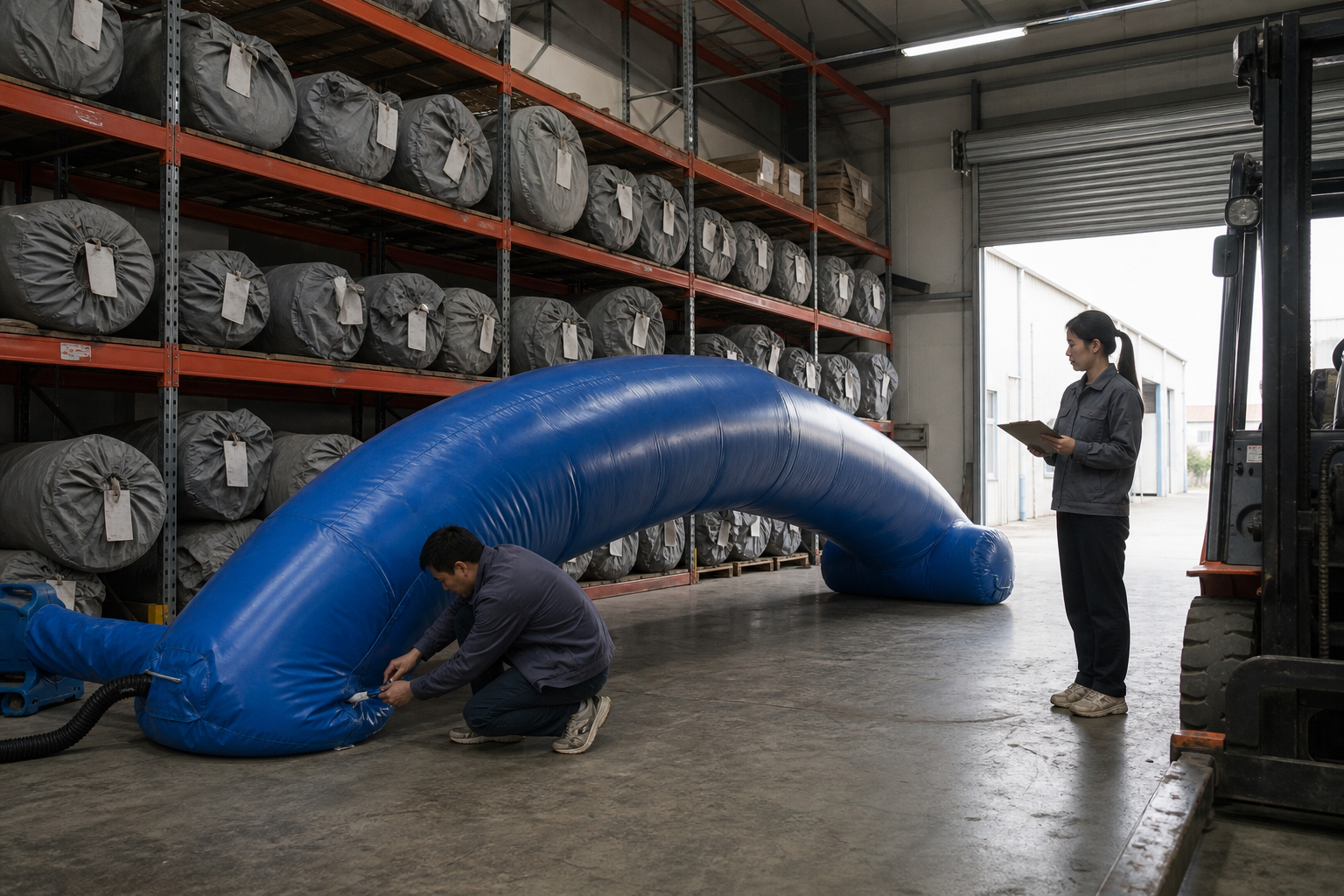
An event buyer orders an inflatable to look right on one day. A rental company orders it to earn money across hundreds of days, handled by crews who did not choose it, set up on surfaces nobody surveyed, and packed away wet at the end of a long shift. The same product specification can suit the first buyer perfectly and fail the second within a season.
From the manufacturing side, the difference shows up in where the effort goes. A one-event piece gets its attention in the print and the shape. A rental piece needs the same care in places the client never looks: the base that drags across tarmac, the tie points that take the load every time, the zips and valves that are opened and closed by a different person each week.
That is the frame for every decision below. When a supplier asks what the inflatable is for, "rental" is not a detail. It changes what should be reinforced, what should be replaceable, and what should be identical from one unit to the next.
Decide the fleet mix before contacting suppliers
Start from what your clients book, not from a supplier's catalogue. A company hiring mainly to sports clubs and running events needs arches in several widths before it needs mascots. A company serving car dealerships and retail parks needs air dancers in quantity. A company serving corporate events and product launches may earn most from a small number of distinctive custom pieces.
Look at the last season's enquiries, including the ones you turned down. The requests you could not fill are the clearest guide to where the next purchase should go. Then decide how many units of each format the business needs to cover its busiest weekend, because peak weekends, not averages, decide fleet size.
Only once the mix is clear is it worth asking for quotes. A supplier can quote one arch accurately. A supplier asked to "quote a rental fleet" with no mix will quote something generic, and comparing those quotes tells you very little.
What to put in a rental RFQ
A rental RFQ needs everything an event RFQ needs — product type, dimensions, quantity, artwork, destination — plus the information that describes how the unit will be used. Say that it is for hire. Say how often it will be set up, on which surfaces, by what kind of crew, and whether it will be cleaned and stored between hires.
Then ask specific questions. Which points on this design take the most stress, and how are they reinforced? Which parts can be replaced on their own — valves, zips, tie points, banner panels — without returning the whole unit? What repair material and spare parts come with each unit? What does the bag look like, and will it survive being thrown into a van?
Ask for the material specification in writing, not just "commercial-grade". The verified materials and air systems for this site are listed on the specifications page; whichever supplier you use, get the equivalent detail for your order in the quotation itself.
Standardise what you can across the fleet
Every difference between units costs the business something later. If each arch has a different tie-point layout, crews have to learn each one. If blowers connect differently, the spare blower in the van may not fit the unit that just lost its own. If bags are all different sizes, storage shelves and van loading plans never settle.
When ordering several formats, ask the supplier to keep the parts crews touch consistent: the same style of tie point, the same air connection, the same type of zip or valve, bags in a small set of sizes, and labels that identify the unit and its accessories. Consistency is cheap to specify at order time and expensive to add afterwards.
Standardisation also makes damage easier to manage. A business that stocks one kind of repair patch, one kind of replacement zip and one blower connection can fix most problems the same day. A business with a fleet of one-offs waits for parts.
Branded, unbranded and changeable branding
A fully printed unit carrying one client's brand can only be hired to that client. A neutral unit in plain colours can be hired to anyone, but gives a client less reason to choose it. The option most rental companies end up favouring sits between the two: a neutral structure with branding that changes between hires.
Changeable branding usually means printed panels that attach to the structure — along an arch crossbar, on the front of a logo sign, around the base of a custom shape. The structure stays in the fleet for years; the panels are ordered per client and kept or discarded afterwards. Ask the supplier how panels attach, how the attachment wears with repeated changes, and whether new panels can be ordered for an existing unit later.
Keep a small number of fully branded pieces only where a single client books often enough to justify it, or where the piece is the booking — a signature custom shape that clients ask for by name.
How to judge a first order
Order one unit of each new format first, and put it through real hires before ordering the batch. A test in the warehouse does not show what happens after the tenth setup on wet grass by a crew in a hurry.
Watch the places that wear: the base, the tie points, the seams near them, the valves and zips, the edges of printed areas. Fold it the way your crew will, not the way the supplier folded it for shipping. Check whether it still fits the bag after a few uses, because bags that were a tight fit when new often become impossible to close.
Keep a short record of each hire and anything that went wrong. That record is the most useful document you can send back to the supplier before the batch order, because it turns general requests into specific changes.
Rental Fleet Guides
More for rental and hire companies.
Inflatable Rental Fleet ROI and Replacement Cycle
What decides the return on a rental inflatable, why it has to be tracked unit by unit, the costs that never show in the purchase price, and how to decide between repair and replacement.
What to Check Before Bulk Ordering Inflatables
Before ordering a batch of commercial inflatables: pilot one unit in real hires, handle it the way crews will, inspect the wear points, fix the specification in writing and check consistency across the batch.
Custom vs Stock Inflatables for Rental Fleets
When stock designs earn more for a hire company, when custom pieces do, why most fleets combine neutral structures with changeable branding, and how cost and lead time differ.
Compare sizes, materials and air systems on the custom advertising inflatable product range page before sending an RFQ.
Relevant Product Pages
Compare specifications before submitting an RFQ.
Buyer FAQ
Additional specification questions.
Where to order
Order direct from the manufacturer.
Published by InflatCraft, operated by Tianjin Mufeng Trading Co., Ltd., a custom inflatable manufacturer founded in 2005 and based in Tianjin, China. We export to the United States, United Kingdom, Canada, Australia, Germany, France, Spain and Italy.
Request a quote
Send the brief and get a specification-based quotation.
MOQ and lead time
What sets the minimum order and where the time goes.
Sourcing from China
Brief, approval, Incoterms, freight and import, in order.
Verified specifications
Materials, air systems and lead time this site quotes against.
Export planning by country: United States, United Kingdom, Canada, Australia, Germany, France, Spain, Italy.