
Buyer Guide
Custom vs Stock Inflatables: Building a Rental Fleet That Earns
Stock designs earn more for a rental fleet when demand is broad and bookings come from many kinds of client; custom pieces earn more when a design is the reason clients book, or when a few corporate clients hire repeatedly. Most successful fleets combine the two: neutral, general-purpose structures with branding that changes per client, plus a small number of signature custom pieces. Custom designs carry pattern setup and longer lead times on the first order, so repeat demand has to justify them.
By InflatCraft Product Team • Last updated September 2, 2026
What stock and custom mean from the manufacturer's side
For a manufacturer, a stock design is one whose pattern already exists: the shape has been developed, the panels are cut from templates that are already proven, and producing another unit mainly means printing and assembling. A custom design starts earlier. The shape has to be resolved into panels that hold air and stand correctly, and that pattern work is done once, before the first unit is made.
Most "stock" inflatables offered to rental companies are still printed to order, so the line between the two is not about print. It is about whether the structure is new. That distinction is what drives the differences in cost, minimum quantity and lead time described below.
When stock designs earn more
Stock structures earn more when the business hires to many different kinds of client and needs units that suit all of them. A standard arch in a common width serves a charity run one weekend and a car showroom the next. A standard air dancer serves any roadside retailer. Because the pattern exists, replacement units can match the fleet and arrive sooner.
Stock also suits businesses still learning their market. Until booking records show which formats and sizes clients actually want, general-purpose units carry less risk than distinctive pieces that suit only a narrow set of events.
When custom pieces earn more
Custom pieces earn more when the design itself is the booking. A distinctive shape that clients ask for by name, a character that has become associated with your business, or a piece built for a type of event that nobody else in your region serves can command bookings that a standard arch never will.
Custom also makes sense when a small number of corporate clients hire repeatedly and want something that looks like theirs. In that case the client's repeat bookings carry the setup cost, and the piece can be designed so its branding changes if the relationship ends.
The risk with custom pieces is building one for a single enthusiastic enquiry. A custom unit that is booked twice a year ties up the setup cost and storage space for years.
The hybrid most fleets end up with
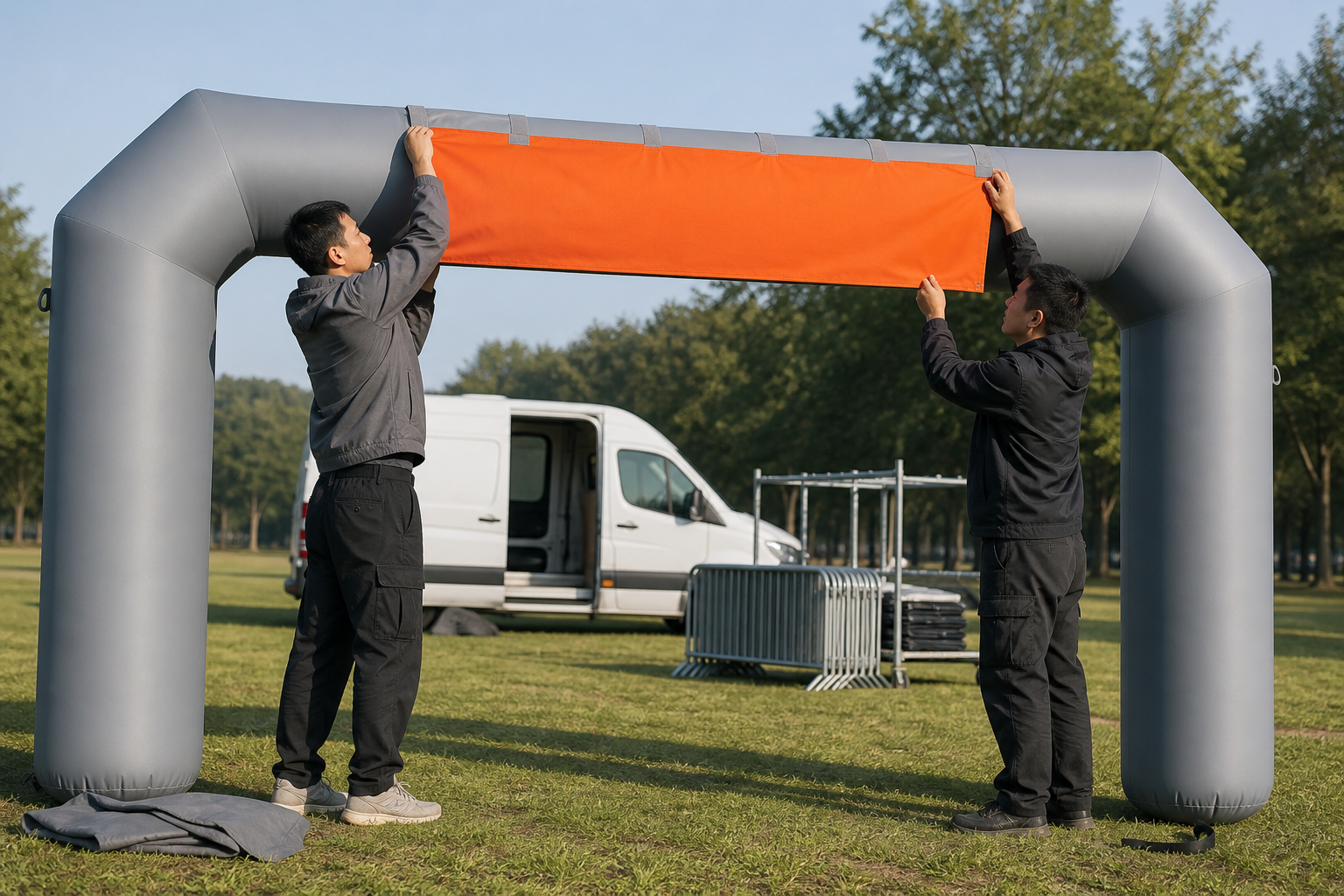
The arrangement that works for most rental companies is a neutral structure with changeable branding. The structure is a general-purpose shape in colours that suit most clients. The branding lives on printed panels that attach along an arch crossbar, across the front of a sign or around the base of a shape, and is ordered per client.
This keeps the expensive part — the structure — earning across every client, while the cheap part carries each client's identity. Ask the manufacturer how panels attach, how the attachment wears after many changes, and whether panels for an existing structure can be ordered on their own later. Those answers decide whether the hybrid actually works in your fleet.
How cost and lead time differ
The first unit of a custom design carries the pattern development and approval that a stock design has already been through. That usually means a higher cost on the first order, a minimum quantity that reflects the setup, and a longer lead time while the design is resolved and approved. Once the pattern exists, reorders of that design behave much more like stock.
For a rental company that means custom pieces are best introduced out of season, when there is time for design approval, and re-ordered in quantity only once they have proved themselves in bookings. How minimum quantities and lead times work for new and repeat designs is set out on the MOQ and lead time page.
Deciding the mix for your market
Use the booking record. Formats that are booked often and by many kinds of client belong in the stock part of the fleet, in enough units to cover the busiest weekend. Enquiries that were turned down because nothing suitable existed are candidates for custom pieces — but only if they recur.
Review the mix every season. A custom piece that has become a regular booking may be worth a second unit. A stock format that sits unused may be worth retiring rather than repairing. The fleet should follow demand, not the other way round.
What to ask a manufacturer before choosing
Before committing to stock or custom, ask the manufacturer a short set of questions. Does a proven pattern already exist in the size and proportions you need, or would a stock design have to be adapted? Which changes turn a stock design into a custom one — a different opening, a new silhouette, a changed base — and which are simply artwork?
For custom pieces, ask whether the pattern is kept for reorders, so a second or third unit matches the first, and whether branding panels for an existing structure can be ordered on their own later. For stock designs, ask how long the design is expected to remain available, because a fleet built around a design that is later discontinued cannot be extended to match.
Finally, ask how artwork changes affect the schedule. For a rental company ordering branding per client, the time from receiving a client's artwork to having a finished panel is often the number that decides whether a booking can be accepted. Knowing it in advance turns a vague promise to clients into a firm booking policy.
Rental Fleet Guides
More for rental and hire companies.
How Rental Companies Source Commercial Inflatables
A rental fleet is bought for repeated handling, not one event. How hire companies decide the fleet mix, write an RFQ for wear, standardise parts across units and judge a first order.
Inflatable Rental Fleet ROI and Replacement Cycle
What decides the return on a rental inflatable, why it has to be tracked unit by unit, the costs that never show in the purchase price, and how to decide between repair and replacement.
What to Check Before Bulk Ordering Inflatables
Before ordering a batch of commercial inflatables: pilot one unit in real hires, handle it the way crews will, inspect the wear points, fix the specification in writing and check consistency across the batch.
Compare sizes, materials and air systems on the custom advertising inflatable product range page before sending an RFQ.
Relevant Product Pages
Compare specifications before submitting an RFQ.
Buyer FAQ
Additional specification questions.
Where to order
Order direct from the manufacturer.
Published by InflatCraft, operated by Tianjin Mufeng Trading Co., Ltd., a custom inflatable manufacturer founded in 2005 and based in Tianjin, China. We export to the United States, United Kingdom, Canada, Australia, Germany, France, Spain and Italy.
Request a quote
Send the brief and get a specification-based quotation.
MOQ and lead time
What sets the minimum order and where the time goes.
Sourcing from China
Brief, approval, Incoterms, freight and import, in order.
Verified specifications
Materials, air systems and lead time this site quotes against.
Export planning by country: United States, United Kingdom, Canada, Australia, Germany, France, Spain, Italy.