Buyer Guide
Basketball-Themed Custom Inflatables: What Teams, Arenas and Sponsors Actually Order
Most basketball projects are built around four formats: a player entry tunnel, a team mascot, an entrance arch carrying sponsor artwork, and custom shapes for the concourse or fan zone. Sizes follow the arena, not the sport: tunnels for team entries are commonly 5–15 m long × 3–6 m wide × 3–5 m internal height, mascots 1.5–3 m high and arches 4–8 m wide × 3–5 m high. Work back from the first home game, because a season opener fixes the date long before artwork is usually ready.
By InflatCraft Product Team • Last updated
The player entry tunnel
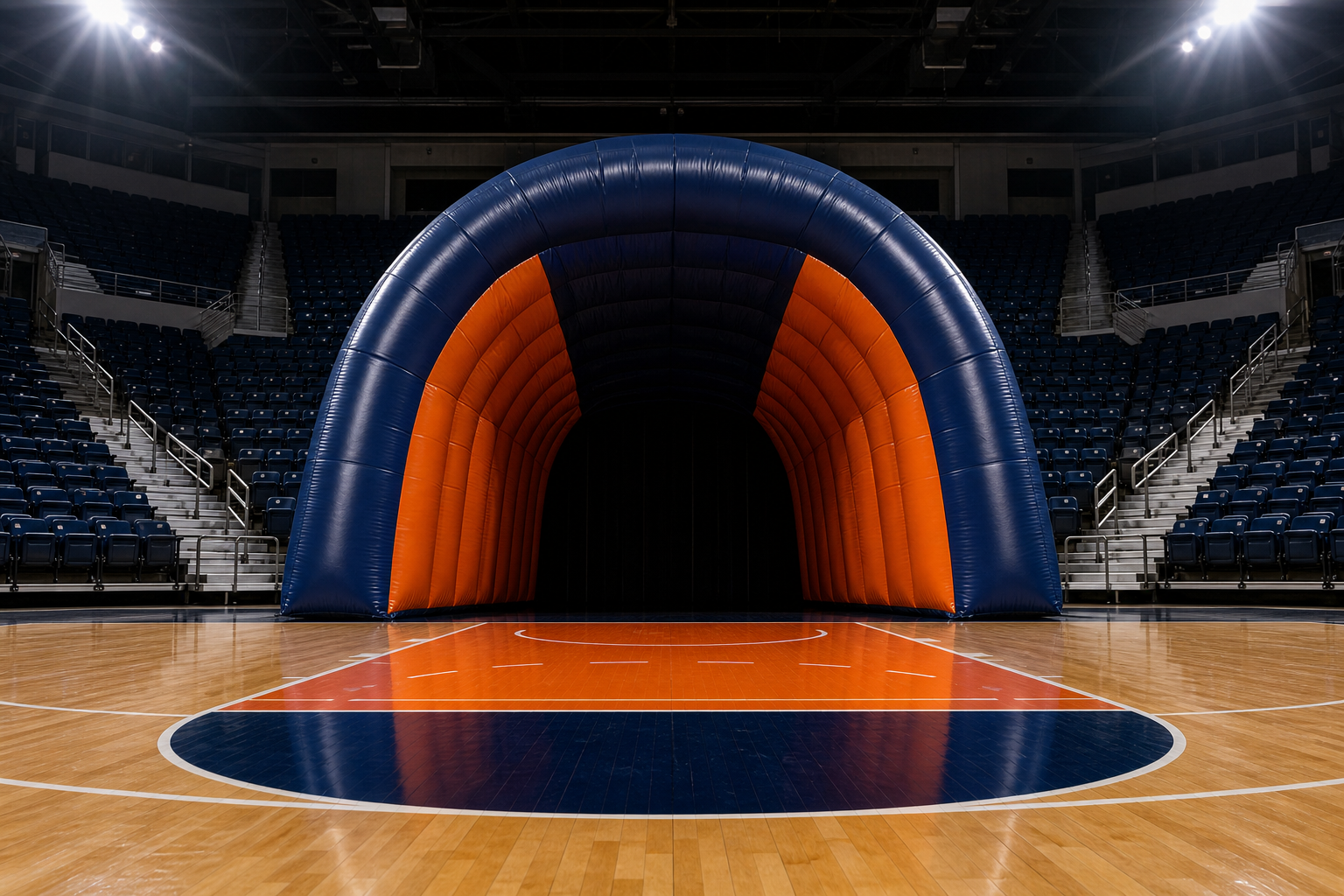
The tunnel is the piece that appears in every broadcast cut and most highlight clips, so it carries the team identity and usually the main sponsor. Tunnels for team entries are commonly 5–15 m long × 3–6 m wide × 3–5 m internal height, and the internal height matters as much as the length: players, staff and camera operators pass through it at speed.
Measure the real route from the locker-room door to the court, including any doorway the tunnel has to sit behind, the floor protection the arena requires and where the air supply can stand without blocking that route. Ask about the emergency removal plan too: arena staff will want to know how quickly the tunnel can be cleared.
4–6 people and about 45–90 minutes are typical for this kind of installation, which has to fit inside the arena's pre-game schedule rather than the other way round.
Team mascots and character shapes
An inflatable mascot for a basketball team is normally 1.5–3 m high for court-side and concourse use, where it has to read from the stands without blocking sight lines. A larger version for the plaza outside is a different piece, sized against the entrance rather than the seating bowl.
Send the mascot artwork as vector files with colour references, and say which features are non-negotiable: the face, the jersey number, the team colours. Character proportions usually need a small adjustment at inflatable scale, and that adjustment should appear on the production drawing before cutting starts.
Entrance arches and sponsor space
Arches at 4–8 m wide × 3–5 m high work for fan-zone entries, community events and youth tournaments run by the club. The flat faces carry sponsor logos with the least distortion, so fix the clear opening first, then lay out the artwork against it.
Sponsorship usually changes between seasons. Ask whether sponsor artwork can be carried on changeable panels rather than printed into the arch, because that decision is what lets one structure serve three seasons instead of one.
Concourse, fan zone and court-side shapes
Beyond the four main formats, clubs order custom shapes for photo moments, ticket entrances, sponsor activations and roadshows. These are sized against the space they occupy and the ceiling above them, and indoor pieces need a clear plan for cable routing and where the pump sits relative to seating.
A note on ball shapes: stand-alone inflatable basketballs are asked about often, and the answer depends on the size and construction you need, so confirm availability with the manufacturer before a concept depends on one. Basketball-themed projects are usually built from the formats above, with the ball treated as printed detail or a design element rather than a separate structure.
Material, air system and indoor use
Double-layer PVC is the general construction for these pieces; 0.5 / 0.6 / 0.7 mm PVC mesh is specified where the structure carries load or spans further, which is the usual question on a long tunnel.
Indoors, the air system is chosen for noise and cable routing as much as volume. The 650 W electric pump moves 1,600–2,000 L/min at 2.0 psi and suits smaller spheres, compact displays and short-duration indoor installations; the 1600 W electric pump moves 4,800–5,200 L/min at 4.5 psi for large-format structures, arches and continuously inflated outdoor displays. Both run on 110–240 V, 50–60 Hz. Confirm with the arena where a pump may stand and how the cable must be covered.
Ordering against the season
A season opener does not move. Work back from it: freight, then production, then artwork approval, then design. Bulk production typically takes 3–8 days for simple items, 7–15 days for standard custom work and 15–25 days for complex or large pieces, counted from final design approval. Freight comes on top: express or air usually 4–15 working days, and sea, rail or truck usually 20–45 days, after dispatch and subject to route and customs
MOQ is 1 piece for most custom projects, so a single tunnel or mascot can be approved first and repeated later. Pattern and print setup are paid once per design, so a second unit for a road show, or a copy for an affiliate team, costs less per piece once the design is approved.
What to send for a quote
Send the format you need, the route or floor space it has to fit, the internal height for a tunnel, the ceiling clearance, indoor or outdoor use, team and sponsor artwork as vector files, the number of units, the first game date and the destination city. If the arena has rules on floor protection, rigging or set-up windows, send those too: they change the design more often than the artwork does.
Verified Specifications
Figures this guide is written against.
Material specifications
| Specification | Typical use | Notes |
|---|---|---|
| Double-layer PVC | General construction for custom advertising inflatables | The default build for most promotional structures. |
| 0.4 mm PVC | Large-format projects | Used on delivered large-format orders. |
| 0.5 / 0.6 / 0.7 mm PVC mesh | Engineered structures | Specified where the structure carries load, spans further, or faces sustained wind exposure. |
Air system specifications
| Pump | Airflow | Pressure | Suits |
|---|---|---|---|
| 650 W electric pump | 1,600–2,000 L/min | 2.0 psi | Smaller spheres, compact displays and short-duration indoor installations |
| 1600 W electric pump | 4,800–5,200 L/min | 4.5 psi | Large-format structures, arches and continuously inflated outdoor displays |
Both pumps cover 110–240 V at 50–60 Hz, so the same air system suits 110 V and 220–240 V markets. Confirm the plug type for the destination country.
Lead time
- Typical: Bulk production typically takes 3–8 days for simple items, 7–15 days for standard custom work and 15–25 days for complex or large pieces, counted from final design approval
- Can be shorter: Repeat orders on an approved design can run shorter
- Freight and import time come on top. Lead time is confirmed per project once artwork, size, quantity and destination are fixed; treat any figure quoted before that as indicative.
Product Buying Guides
More on choosing and ordering custom inflatables.
Air Dancer Replacement Tubes: Blower Fit | InflatCraft
Buying an air dancer replacement tube? Check the blower model, connection, tube dimensions and air requirements before ordering fabric-only replacements.
Custom Inflatable Hanging Signs: Venue Checks | InflatCraft
Plan a custom inflatable hanging sign with the right venue approvals, dimensions, rigging review, documents and power arrangements before placing your order.
Custom Inflatable Tunnel Site Planning | InflatCraft
Specify a custom inflatable entrance tunnel around clear internal space, the full footprint, visitor routes, blower placement and event branding.
Custom Inflatable Mascot Production Checklist
Approve a custom inflatable mascot for retail or events: review 3D shape, facial details, site limits, inspection proof, accessories and RFQ scope.
Compare sizes, materials and air systems on the custom advertising inflatable product range page before sending an RFQ.
Relevant Product Pages
Compare specifications before submitting an RFQ.
Buyer FAQ
Additional specification questions.
Where to order
Order direct from the manufacturer.
Published by InflatCraft, operated by Tianjin Mufeng Trading Co., Ltd., a custom inflatable manufacturer founded in 2005 and based in Tianjin, China. We export to the United States, United Kingdom, Canada, Australia, Germany, France, Spain and Italy.
Request a quote
Send the brief and get a specification-based quotation.
MOQ and lead time
What sets the minimum order and where the time goes.
Sourcing from China
Brief, approval, Incoterms, freight and import, in order.
Verified specifications
Materials, air systems and lead time this site quotes against.
Export planning by country: United States, United Kingdom, Canada, Australia, Germany, France, Spain, Italy.
