Buyer Guide
Custom Inflatable Jar & Tub Replicas: Multi-SKU Label Proof and Retail Rollout RFQ
For a multi-SKU inflatable jar or tub campaign, approve the container silhouette and lid as one master design, then approve every label artwork version separately. Give the supplier original package measurements, installed footprint, viewing angles, quantity by SKU, location rules and a destination schedule. A wide jar body does not prove stability, and a render does not confirm the air system or venue approval.
By InflatCraft Product Team • Last updated
Who needs a multi-SKU jar display—and what this guide decides
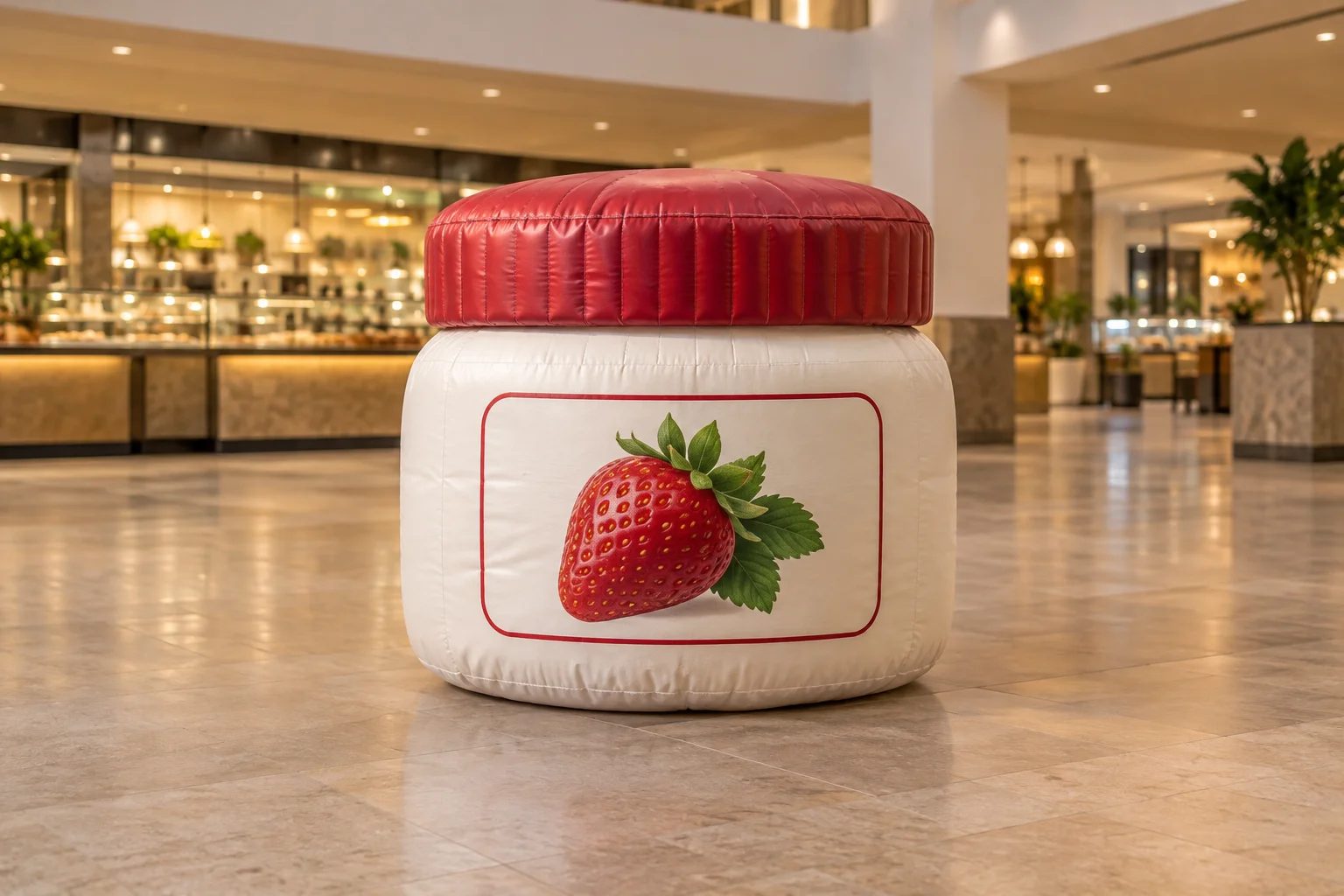
A food, skincare or supplements brand may have several jars or tubs with nearly identical proportions but different flavor, color, size or market labels. A procurement team may want one inflatable display at a launch and several units across a retail network. The risk is approving one attractive front view while the purchasing order actually contains several silhouettes, print versions and store requirements. This guide provides a method for separating those decisions before the RFQ, not a generic claim that every jar can be copied at any size.
Start with the existing custom inflatable jar and tub product format. It covers the container-shaped product family; the wider product replica category can help when a campaign also needs a can, pouch or bottle. This article concentrates on *multi-SKU proof control and rollout scope* rather than a single cosmetic tube's cap and crimp. A proposal drawing is a design reference until construction and the site plan have been checked.
US, UK and Australian brand teams should identify both a brand artwork approver and an event or retail facilities approver. Those people answer different questions. A marketing manager may approve a label visually without being qualified to accept an anchoring plan or an electrical installation at a particular venue.
Separate the real package dimensions from the display envelope
Ask the brand to photograph the original jar straight on from the front, rear, above and side, ideally with a dimensional sketch. Record external height, widest body diameter or width and depth, shoulder taper, lid overhang, lid height, base curvature and the position of the label band. If a tub is oval rather than round, a single diameter is not enough. The source drawing should also flag measurements that were estimated rather than physically measured.
| Reference item | Buyer-owned input | Decision recorded on approval drawing |
|---|---|---|
| Body and base | Height, maximum width/depth, taper and standing orientation | Shape outline, seam or panel plan and intended floor-contact arrangement |
| Lid and rim | Lid height, overhang, edge treatment and top-view photograph | Whether details are shaped, printed or intentionally simplified |
| Label artwork | Authorized front, side, back and lid files; edition/date | Print panels, wrap join, readable face and approved omitted text |
| Installed site | Maximum height, usable floor area, access route and power position | Overall installed envelope and clearance for equipment and visitors |
| Order matrix | Quantity by jar body, size, artwork and destination | Distinct design/print versions, carton labels and dispatch groups |
Scale the *approved display envelope*, not just the height of a jar on a phone photograph. An enlarged lid can project into a public route; a strongly tapered body may need a different support proposal. Ask the designer to show front and side views at the proposed installed dimensions and to mark the inflation equipment location. Do not infer material grade, allowable loading or stability from a render.
Approve the lid and label band independently
A wide cosmetic cream tub, food spread jar and supplement container may share a cylindrical outline while having different lid geometry. The lid might be flush, domed, stepped, ribbed or unusually deep. Ask which of those features are essential to product recognition. A printed line may visually suggest a shallow ridge, while a pronounced overhang may require additional shaped construction. These are feasibility options, not fixed manufacturing methods for every order.
The label band introduces a second approval problem. A continuous piece of flat artwork does not always align on a curved, inflated surface. Request a proof with the proposed seam positions and print-panel boundaries marked. Show at least a principal customer-facing view, an oblique side view and a rear view. Mark which product name, logo, color block and promotional claim must be legible from the expected approach direction. If small ingredient or regulatory text is to be simplified, that decision requires explicit brand review and must not be presented as a compliant replica of consumer packaging.
Keep lid-top artwork separate from the side label and identify the junction where one printed face meets another. Before printing, the approval version should state whether a logo crosses a seam, whether a wrap join lands near the main viewing face, and whether the lid and body color references are measured or visual approximations. The artwork and print file guide gives general file-preparation steps; this jar checklist defines where the artwork must land on the three-dimensional object.
Control artwork versions without multiplying geometry by accident
A buyer ordering strawberry, cocoa and unflavored product versions should not treat three print files as one product code. Nor should a supplier assume that three labels use identical body geometry when one comes from a different pack family. Establish a master shape revision only after checking that body, lid and display dimensions really are shared. Then give every approved print layout its own version number, language, market and filename. Do not allow a final PDF named simply 'approved-final' to conceal successive edits.
| Version field | Example notation—not an actual customer project | Why it matters |
|---|---|---|
| Master shape | JAR-BODY-A / revision 02 | Prevents an unapproved taper or lid change between SKUs |
| Label artwork | ART-SKU-01 / revision 04 | Distinguishes signed artwork from earlier creative versions |
| Market or language | US / UK / AU as applicable | Identifies copy variants for separate brand review |
| Quantity | Units per geometry and artwork code | Avoids incorrect volume pricing or packing quantities |
| Destination group | Store group or warehouse delivery code | Supports freight, cartons and receiving checks |
| Approver/date | Named owner, approval date and document link | Creates a traceable stop point before production |
The example codes are a method, not evidence that InflatCraft has manufactured these SKUs. If one market needs different claims or logos, request the legally reviewed files from the rights holder. The supplier should not decide which market wording is lawful. A revision to the label after approval may require new proofs or production work; ask how such changes are priced and scheduled.
When an agency orders for a brand, specify whether agency or brand is the final print approver. Without that decision, the supplier can receive contradictory instructions from a local distributor, the marketing team and the rollout installer.
Site fit is not proven by the container's wide shape
An inflatable jar may look low and broad in a product illustration, but width alone does not make it freestanding or suitable for public circulation. Its actual dimensions, center of mass, inflation system, base arrangement and visitor exposure are design questions. Indoor hard floors, mall atriums, exhibition aisles and temporary outdoor entrances impose different restrictions. Ask the venue who is authorized to approve fixation, ballast, barriers, fire access and electrical equipment.
For each venue, request a dimensioned placement plan with the maximum installed footprint, nearby doors and exits, pedestrian traffic, available outlet location and route for cables and staff. State whether the inflatable is accessible to the public, used only under supervision, or behind a managed barrier. If the installation is outdoors, record the ground surface, weather monitoring responsibility and stop/deflation procedure. Do not accept a universal safe-wind claim or an assumed ballast mass without a design-specific review.
Consult the retail promotions application guide for store positioning and the exhibitions and trade shows application guide for stand planning. The supplier's quotation should name the accessories it will provide; the venue or installer must independently accept the proposed setup and any required local documentation. A quotation for a fabric object is not, by itself, a permit or an installation engineering certificate.
Choose the air-system and repeat-use scope after reviewing the site
The correct air approach depends on the proposed size, shape, duration, access and power conditions. Ask whether the quotation assumes an approved sealed-air construction or continuous-air configuration, and what equipment and operating instructions are included. An image of a jar cannot determine the air system. Where a blower is proposed, confirm its specific model, voltage, frequency, plug, noise and access requirements for the destination; do not treat a generic power figure as proof of a specific order's electrical compliance.
Repeated activations require operational planning as well as procurement. Identify who inflates, supervises, deflates, dries, cleans, packs and stores the display. Request instructions for fabric protection and inspection before reuse, and ask the supplier which spares are offered for the approved design. A storage bag, spare fan, repair kit or replacement printed sleeve is not automatically included; include or exclude each item explicitly in the purchase order.
For a network rollout, determine whether all cartons should go to one distribution center or to several stores. Each destination needs a named receiving contact, delivery window and identification on the packing list. If installation will be arranged locally, make this exclusion explicit to avoid comparing a supply-only quote with an installed-event proposal.
Build one RFQ matrix that suppliers can price consistently
Before requesting a total price, consolidate the design and logistics fields into one working document shared by marketing, procurement and operations. At minimum it should include master geometry code, final artwork code, target display dimensions, installation classification, site constraints, quantity per version, destination, intended on-site date and approval owner. Unknown items should be marked 'to confirm' rather than silently filled from a reference photograph.
- Product: jar/tub format, original measured package references, body profile, lid feature and target installed size.
- Artwork: rights holder, editable and review PDFs, lid and side graphics, version codes, required printed claims and change cutoff.
- Site: indoor/outdoor, allowable height and footprint, access, visitor exposure, power, anchoring limitations, installer and operating dates.
- Order: quantity by geometry/artwork, sample or approval stage, packaging labels, spares, delivery groups, import destination and contact.
- Quote: proposed construction and equipment, material description where documented, drawing and proof stages, packaging, named trade term, freight scope and payment milestones.
Request prices against the same bill of supply, not a headline per-piece figure. Break out any approved sample, pre-production proof, artwork revisions, main goods, equipment, packing, spare items and transportation. For cross-border projects, use a named delivery term *and named place* and confirm the applicable responsibilities with the supplier and forwarder. The ICC's Incoterms 2020 rules concern delivery, cost and risk allocations; they do not establish installation duties or consumer-packaging label legality.
No MOQ, lead time, price, material rating or certification is promised here. The manufacturer should confirm each against the approved configuration and a dated quotation. For a complex rollout, ask how price and schedule change if one artwork version is delayed while another is approved.
A practical approval sequence for retail project buyers
Use four decision gates. First, the brand owner approves a reference pack and rights to the artwork. Second, the buyer reviews the geometry and lid drawing at installed dimensions. Third, the brand and agency approve every wrap and lid print version with a documented revision history. Fourth, the venue/operator and supplier align on site constraints, air equipment, accessories and shipment plan. Do not assume that brand approval also certifies mechanical safety.
If time is limited, tell the supplier which approvals are final and which are provisional. A visually approved concept may still need alterations because the venue forbids a fixation method or because a distribution warehouse has a maximum receiving size. Keep revision changes visible; do not silently substitute another lid or label band after the purchase order has been issued.
For US, UK and Australian imports, the US market guide, UK market guide and Australia market guide can frame destination questions. These guides are not substitutes for local venue authorities, import advisers or electrical checks. A procurement team should obtain the relevant approvals from the responsible parties before commercial commitments become irreversible.
Send a version-controlled jar display RFQ
A useful first message might say: 'We need a made-to-order inflatable jar display for a retail campaign. The container outline and lid drawing are attached; the installed height and floor area are specified separately. Please review whether one master shape can support the attached label versions. Quantity is listed per approved artwork revision and destination. Please identify your proposed construction, air equipment, fixing accessories, proof stages, packing and shipping scope, and any unresolved design or site questions before pricing.' This is a briefing example, not a statement of InflatCraft's stock or production capability.
Check the custom inflatable jar and tub product page against the finished brief, then request a project-based quote or send the files to sales@inflatcraft.com. If a jar is not the correct packaging form, choose another format from the product replica range before commissioning artwork. An itemized review is more reliable than a fixed quote based only on an illustration.
Product Buying Guides
More on choosing and ordering custom inflatables.
Air Dancer Replacement Tubes: Blower Fit | InflatCraft
Buying an air dancer replacement tube? Check the blower model, connection, tube dimensions and air requirements before ordering fabric-only replacements.
Custom Inflatable Hanging Signs: Venue Checks | InflatCraft
Plan a custom inflatable hanging sign with the right venue approvals, dimensions, rigging review, documents and power arrangements before placing your order.
Custom Inflatable Tunnel Site Planning | InflatCraft
Specify a custom inflatable entrance tunnel around clear internal space, the full footprint, visitor routes, blower placement and event branding.
Custom Inflatable Mascot Production Checklist
Approve a custom inflatable mascot for retail or events: review 3D shape, facial details, site limits, inspection proof, accessories and RFQ scope.
Compare sizes, materials and air systems on the custom advertising inflatable product range page before sending an RFQ.
Relevant Product Pages
Compare specifications before submitting an RFQ.
Retail Planning, Artwork and Destination RFQ
Buyer FAQ
Additional specification questions.
Possibly, if geometry, display dimensions and construction are genuinely identical. Approve one master body drawing and a separate printed panel proof, revision and quantity for each SKU.
Not by assumption. Fixing, ballast and supervision depend on the approved design, installation site and visitor exposure. Obtain a site-specific plan and venue approval.
Not necessarily. Some details may be represented with printing; others may need shaped panels or simplification. Approve front, side and top views before production.
Use separate approved artwork revisions whenever language, claims, trademarks or other print content differ. The brand and local advisers are responsible for approving their wording.
No. Request an itemized scope listing construction, air equipment, fixing accessories, packing, spare items, destination and a named trade term and place.
Final design and print approvals, quantities by version, manufacturing feasibility, packing and shipping routes. Confirm a project-specific schedule rather than relying on a general lead-time estimate.