Buyer Guide
Custom Inflatable Cosmetic Tube Replicas: Cap, Crimp and Artwork Approval Guide
To order a custom inflatable cosmetic tube display, supply measured packaging dimensions, approved front and back artwork, a cap and crimp reference, target installed size, site limits, quantity and destination. Request a shape drawing, print-panel proof, construction and equipment scope, and written approval checkpoints before production. A reference rendering does not verify inflation behavior or venue suitability.
By InflatCraft Product Team • Last updated
Why a cosmetic tube is not just a printed inflatable cylinder
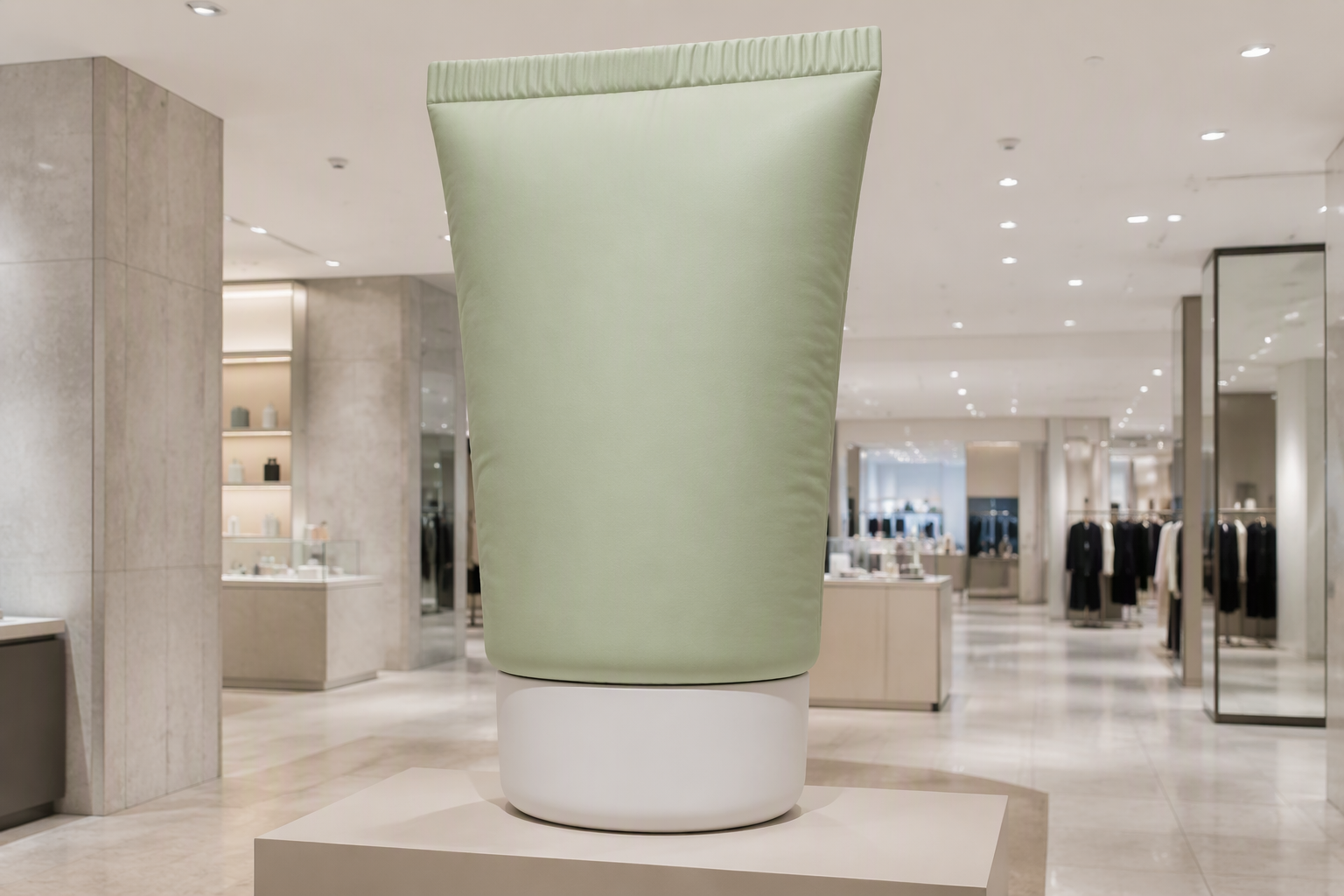
A skincare or cosmetics campaign often relies on a distinctive package rather than on a large wordmark alone. The tube's flattened body, sealed crimp, cap, shoulders and front-panel proportions distinguish it from a bottle or generic advertising column. Inflating those elements changes how they look. A tube face may bulge; the crimp can soften; an ordinary cap detail may disappear at the chosen scale.
Begin with the custom inflatable cosmetic tube product format. Treat its product illustration as a format reference, not proof of a tested construction. A buyer commissioning a launch display should ask which package characteristics must survive enlargement and which details may be simplified without changing brand recognition. If the original product has a rigid closure or an asymmetric profile, the supplier needs more than a single catalogue photograph.
This guide concentrates on the *approval sequence* for a cosmetic-tube-shaped advertising display. The broader product replica category covers bottles, cans, cartons and related structures, which have different shaping and surface requirements.
Build a reference pack that cannot be misread
Send the actual package height, maximum body width, body thickness or depth, cap width and depth, and the location of the crimp. If the base is curved or the closure is offset, show it in a front, back and side reference. A scaled photograph without dimensions cannot establish accurate proportions. Include the requested display height, but keep the original package measurements separate from the proposed enlargement.
| Reference item | What the buyer supplies | What the approval must show |
|---|---|---|
| Front and back photos | Straight-on, unfiltered images of the actual pack | Which artwork face and viewing side each image represents |
| Side profile and cap | Measured cap, shoulder, depth and closure reference | Cap shape, projection and base/ground contact assumptions |
| Original package dimensions | Height, body width and depth, cap measures, crimp position | Ratios used to derive the proposed display size |
| Brand artwork | Authorized vector or high-resolution files plus color guidance | Approved print hierarchy, placement and any simplification |
| Venue plan | Floor dimensions, access route, ceiling clearance, power and restrictions | Installed footprint, servicing space and proposed fixation method |
If you cannot measure the original packaging, state what is estimated. The next supplier drawing should distinguish measured information from assumed information; otherwise two approval rounds can appear to agree while using different proportions.
Approve the cap and crimp as constructed features
The crimp is a defining visual cue of a tube, but it is not merely a line printed across the top. Ask for a front and side drawing showing how the crimp shape will be formed and where the panel boundaries sit. A visually sharp crimp may be less practical when the envelope has to retain its intended shape and air system. Do not approve a front rendering alone if the display must read correctly from an aisle or diagonal approach.
The cap deserves a separate review. A simple flat graphic can imply a cap in a concept image while the actual object may need a shaped extension, printed panels, an attached feature or a different base arrangement. Ask for the construction proposal, whether a removable or separately built detail is contemplated, and how that choice affects assembly, packing and maintenance. None of these solutions should be assumed to be available without project review.
- Mark the cap-to-body joint and crimp geometry on two-view approval drawings.
- Record the intended primary viewing side and whether the cap faces the floor or the ceiling in the installation.
- Identify any projecting feature that could conflict with visitor movement, access doors or event furniture.
- Ask whether the proposed base orientation requires ballast, attachment points, support or a different display plan.
Evaluate the printed face after inflation, not only on a flat dieline
Cosmetic packaging frequently uses small typography, ingredient panels, fine metallic-looking details and subtle gradients. A large soft textile surface will not behave like rigid printed packaging. Panel seams, curved surfaces and changes in inflation shape may distort straight lines or place text around a corner. The supplier should show how the artwork maps onto the proposed panels and which portions of the reference pack cannot be faithfully reproduced.
Provide a hierarchy: primary brand mark, product name, campaign claim, decorative pattern and microtext. Tell the supplier which wording must remain exactly as approved and which small details can be omitted from a *promotional display*, subject to brand-team approval. Do not reproduce ingredient or regulatory claims from a market-specific pack without the brand owner's review. An inflatable display is advertising, not necessarily a faithful legal representation of a retail label.
| Artwork element | Specific proof question | Approval owner |
|---|---|---|
| Primary logo | Is it visible on the bulging face from the main approach? | Brand/creative team |
| Product name or campaign phrase | Is the approved wording intact and outside high-distortion seam zones? | Brand and local campaign owner |
| Color and finish | What digital reference and output expectations are agreed? | Brand production lead |
| Small packaging claims | Are omissions or enlargements documented and authorized? | Brand/legal reviewer where applicable |
| Back-panel graphics | Is a separate back-view proof required at this site? | Event or retail deployment lead |
Make site constraints part of design approval
At an indoor exhibition, the installer may have a fixed stand boundary, ceiling height, electrical supply allocation and specific move-in arrangements. At a retail entrance, customer circulation, building management rules and access to doors take priority. For an outdoor campaign, the event operator must review weather exposure, the ground surface, the anchoring method and the operation or shutdown plan. A design that looks right in a showroom may still be unsuitable for the intended site.
Ask the venue or event contractor to provide a plan showing the inflatable's proposed dimensions, safe visitor routes, nearby objects, service access and available power. Confirm whether public access to the object is restricted. Do not claim a universal wind tolerance, anchoring quantity, material rating or electrical compliance on the basis of a supplier catalogue; these require the actual design, documentation and site assessment.
Use the retail promotions application guide for store-level questions, or the exhibitions and trade shows guide for stand restrictions. Venue approval and product supply are separate responsibilities and should be recorded separately.
Separate air-system approval from visual approval
A rendering showing a finished tube does not reveal whether the proposed structure uses continuous-air equipment, a sealed-air system or another approved construction. Ask the supplier to identify the intended approach and why it suits the geometry and use period. For equipment that uses mains power, specify the destination country and available supply. The actual model, voltage, frequency, plug and any required protection should appear in the approved equipment schedule.
Confirm where the blower or inflation point is located, how noise and cable routing affect the installation, how the display will be secured, and who can access it during operation. A tube that is attractive from the front but blocks the service opening is a poor choice for a repeated exhibition schedule. Similarly, the ability to pack an object into a bag does not prove that a particular site can deploy it safely.
- Written confirmation of the proposed inflation method and equipment scope.
- Site power, plug, cable routing and operator access requirements where applicable.
- Approved anchoring or support concept appropriate to the confirmed design and surface.
- Practical setup, deflation, inspection and storage instructions for the supplied configuration.
Record the correct approval order before production
Use separate approvals for shape, artwork and technical scope. First, sign off the display dimensions and tube geometry. Next, approve the print panels and any visual compromises that affect the campaign. Then approve the material and equipment proposal, safety and installation inputs, included accessories, sample arrangements and the supply schedule. If the artwork changes after the print-panel proof or the cap changes after structural detailing, request a written revision with the impact on cost and timing.
Assign a named buyer-side approver for each checkpoint. A retail brand manager may approve the visual while a venue contractor approves installation drawings; neither approval automatically substitutes for the other. Keep filenames and dates in the approval record rather than relying on a message that simply says 'looks good.'
| Checkpoint | Evidence to retain | What it does not prove |
|---|---|---|
| Shape drawing | Dated front, back, side and footprint dimensions | Installed safety or print color accuracy |
| Artwork proof | Panel placement, color reference and final brand copy | Physical inflation or weather suitability |
| Technical scope | Material proposal, inflation method, accessories and use assumptions | Certification without matching documents |
| Pre-shipment confirmation | Agreed inspection evidence and packing/accessory list | Acceptance by the receiving venue |
Budget and quote the complete display, not an image
Supplier quotes can refer to very different scopes. One may include a tube-shaped inflatable body alone; another may include a blower, cable, fixing accessories, storage bag, sample or revised graphics. Do not compare the grand totals until the supply content is normalized. Specify quantity *per design and artwork version*, rather than a combined number that hides variation between products in a campaign.
For international buyers, distinguish manufacturing cost, packing, freight and any on-site installation services. State a named delivery term and place in the purchase document, and confirm it with the supplier and forwarder. The ICC's Incoterms 2020 rules allocate responsibilities for delivery, costs and risk under defined trade terms; they do not replace an installation contract or clarify an unspecified production drawing.
Ask how any revision affects the quotation. A different cap, a deeper tube body or multiple country-specific print versions can change the required proof, construction, packing and shipment plan. Avoid accepting universal unit prices, guaranteed lead times or material test claims for an unapproved design.
Use one RFQ worksheet across your team
A beauty-brand buyer, advertising agency or distributor can circulate the following short brief to the brand, supplier and venue before asking for a final number. If a field is unknown, say 'to be confirmed' and identify who will provide it. That is more reliable than assuming it has been decided.
- Project: campaign name or neutral project code; intended use (retail, exhibition, launch); operating dates.
- Original pack: measured tube height/width/depth, cap and crimp references, front/back photos.
- Installed display: target height, width/depth limit, floor area, primary viewing angle and access route.
- Artwork: authorized logos, front/back variants, exact promotional wording, market-specific approvals and color references.
- Scope: quantity by version, inflation method for review, included accessories, packing labels and any spare components.
- Venue: city/country, indoor/outdoor, available power, anchoring or rigging restrictions, handling and storage arrangements.
- Approval: who signs shape, print, equipment and installation documents, and when each sign-off is required.
- Commercial: target arrival date, requested named trade term and place, freight assumptions and payment milestones for quotation.
The United States market guide, United Kingdom market guide and Australia market guide help buyers identify destination-specific planning questions. They do not replace an importer, venue or electrical professional's verification.
From approved proof to a useful quotation
After consolidating the drawing, artwork and site inputs, send a specification-based request instead of asking for a generic 'giant cosmetic tube' price. Include the current artwork revision, authorized brand content, required dimensions, quantity by version, venue restrictions and shipment destination. Ask the supplier to flag anything it cannot confirm yet. A responsible quote may depend on a feasibility review; that is preferable to an unqualified promise.
For a different packaging form, compare the inflatable bottle replica and custom packaging replica formats before approving the geometry. For a cosmetic tube, continue from the product-specific page to request a custom quote. You can also email the approved brief to sales@inflatcraft.com. Request a drawing and itemized scope, not a guaranteed certification, delivery date or fixed price based only on a render.
Product Buying Guides
More on choosing and ordering custom inflatables.
Air Dancer Replacement Tubes: Blower Fit | InflatCraft
Buying an air dancer replacement tube? Check the blower model, connection, tube dimensions and air requirements before ordering fabric-only replacements.
Custom Inflatable Hanging Signs: Venue Checks | InflatCraft
Plan a custom inflatable hanging sign with the right venue approvals, dimensions, rigging review, documents and power arrangements before placing your order.
Custom Inflatable Tunnel Site Planning | InflatCraft
Specify a custom inflatable entrance tunnel around clear internal space, the full footprint, visitor routes, blower placement and event branding.
Custom Inflatable Mascot Production Checklist
Approve a custom inflatable mascot for retail or events: review 3D shape, facial details, site limits, inspection proof, accessories and RFQ scope.
Compare sizes, materials and air systems on the custom advertising inflatable product range page before sending an RFQ.
Relevant Product Pages
Compare specifications before submitting an RFQ.
Retail, Exhibition and Destination RFQ Planning
Buyer FAQ
Additional specification questions.
Send the original tube measurements, cap/crimp photos, approved artwork, target display size, quantity by version, installation site, destination and required date. Note unknown specifications for review.
Not always. Flexible inflatable construction may soften rigid edges or change proportions. Approve separate cap, crimp and side-view drawings before accepting the final shape.
Do not assume so. Request a panel-layout proof and mark which text must remain exact, enlarged, omitted or locally approved. Brand and regulatory review remain the buyer's responsibility.
No. Inflation equipment, anchoring, materials, site power, operating limitations and any required documentation must be checked for the actual configuration and venue.
Only if the buyer explicitly approves the common geometry and each artwork version. Assign a revision code and quantity to every distinct variant, including language and market differences.
Only when these items are listed. Request an itemized supply and packing scope and a named delivery term and place; do not compare prices that assume different accessories or transport.