Buyer Guide
How to Print Letters and Logos on a Custom Air Dancer: A Buyer’s Proof Checklist
To print letters or a logo on a custom air dancer, approve the brand message and artwork files, then review panel layout, seams, movement, reading direction and sleeve-to-blower fit. A static rendering verifies intended graphics, not continuous readability, equipment compatibility or venue suitability.
By InflatCraft Product Team • Last updated
Start with the viewing job, not the artwork file
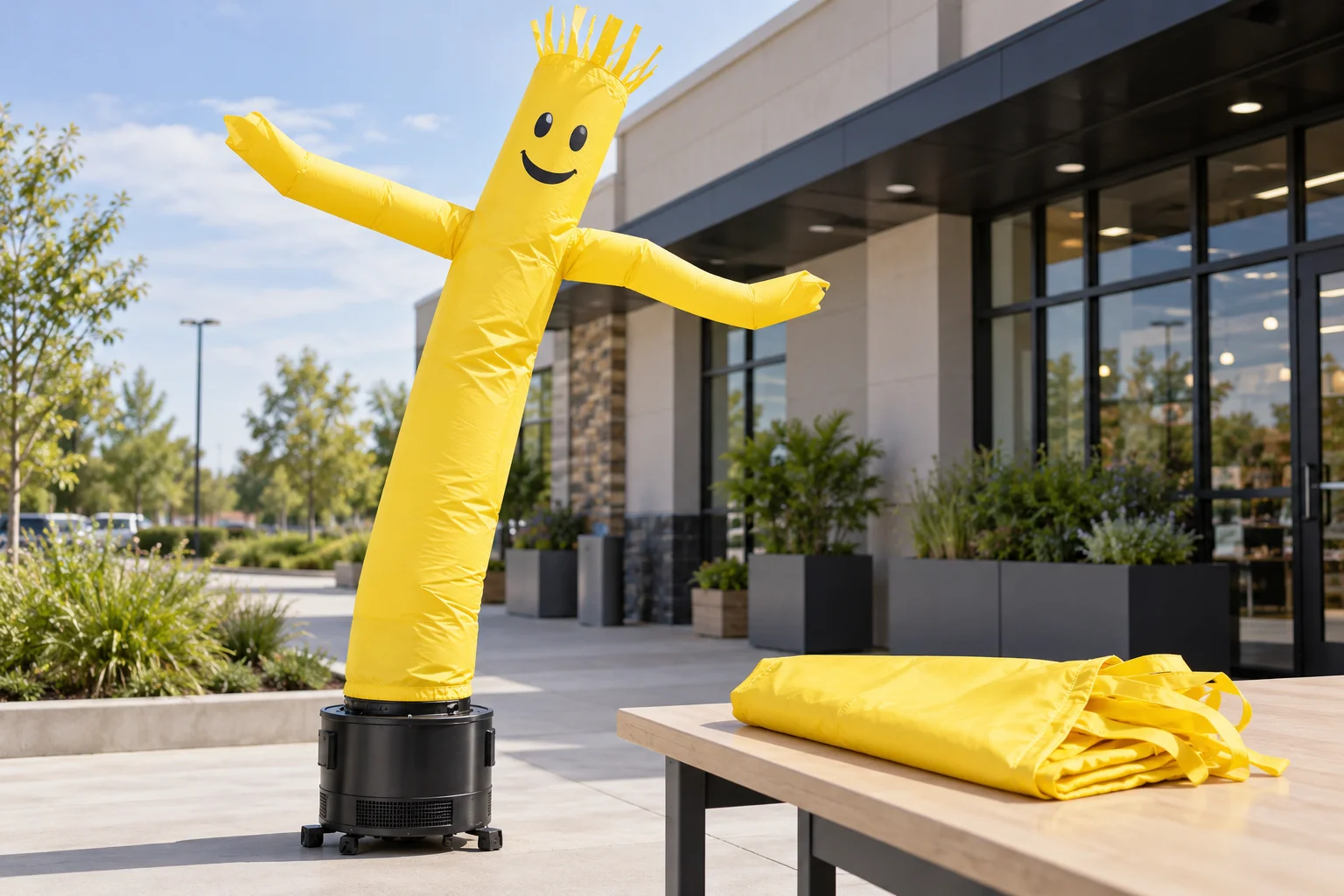
An air dancer is a moving fabric sleeve, not a rigid printed sign. The artwork rotates, folds and changes its apparent width as the blower moves air through the body. The purchasing question is therefore not simply whether a full-color image can be printed: it is whether the brand mark or short message can be recognized during the movements expected at the actual site. A front-facing studio mockup cannot demonstrate continuous readability.
Write down the primary job before commissioning artwork. For a roadside promotion, a recognizable silhouette and strong brand color may matter more than a sentence. At a pedestrian-facing store entrance, a short offer or store name may be useful if visitors can safely approach and read it. Ask the brand team to rank recognition, message detail and direction of approach. The custom air dancer product page covers the broader equipment brief; this guide covers print placement and proof approval specifically.
Do not submit advertising copy that only works when the sleeve is completely straight. Avoid promising legibility from every angle or at every second. Obtain a proposed print layout and test the communication goal against how this style of display moves.
Choose the message hierarchy before selecting print coverage
Separate the elements into three levels: mandatory brand identity, optional promotion and decorative background. The strongest item should still be identifiable when other panels are folded or turned away. A distributor ordering for several clients should not use a single generic print proof as the approval record for every logo.
| Content on sleeve | Buyer decision | Reason to check |
|---|---|---|
| Primary logo or wordmark | Supply authorized vector art and identify the first viewing direction | Distortion and motion may affect letter shapes |
| Short store name or offer | Confirm the exact wording, language and version | Long text becomes hard to read on a moving narrow surface |
| Supporting pattern or brand color | Specify usable color references and permitted simplifications | A visible field of color can remain identifiable when details are obscured |
| Character face or raised arms | Request a separate silhouette and airflow assessment | Shaping and attachment affect more than printed artwork |
For multiple promotions, record which elements change between versions. A removable sleeve and its existing blower may not be interchangeable with every proposed new shape; mechanical compatibility must be reviewed separately from graphic approval.
Map the real printable panels, seams and blower attachment
Ask the supplier to mark each printable panel on a flat construction drawing, including approximate seam lines, arm connections, openings, hem and attachment points. A logo that crosses a seam may remain acceptable, but its continuity cannot be judged from an uninterrupted visual rendering. Important lettering placed near a flexible fold or attachment should receive a dedicated proof.
- Provide front, back and any side-panel print priorities. Name the required reading orientation on each face rather than assuming a mirrored layout is correct.
- State whether the design has arms or character features. Request confirmation of which surfaces are printable and whether any part requires non-standard cutting or stitching.
- Identify where the fabric joins its blower base; do not place critical contact details or small legal copy where they could be hidden during operation.
- Mark artwork revision, sleeve style, intended finished height and approval owner on each proof. Separate a printed sleeve approval from an equipment compatibility approval.
A static PDF can approve the intended layout, but not actual movement or airflow. If motion-based readability is material to the campaign, ask what model-specific sample or demonstration evidence is available and what it will cost; do not assume it is included.
Prepare artwork that survives conversion to a moving textile
Send the original logo or wordmark in a usable vector format when available, along with approved color references, fonts or outlined lettering, and permission to reproduce the design. A low-resolution screenshot can be useful to explain placement, but should not be treated as production artwork. Ask for the proposed print method, material and finish to be confirmed in the quotation rather than assuming the same process suits all sleeves.
Color evaluation depends on substrate, lighting and the buyer's acceptance method. Record whether an on-screen proof, small material print or physical sample is required. Do not advertise exact color matching unless the acceptance reference, lighting conditions and tolerances have been agreed. The general logo-printing guide addresses print artwork across inflatable categories; the present checklist adds moving-sleeve constraints.
Where several languages or regional promotional messages are required, assign a separate file identifier to every language, campaign and revision. Get a responsible buyer to approve spelling, punctuation and trademark use before the printer is authorized to start.
Evaluate wording length and letter orientation
There is no universal maximum character count or minimum type size that can be quoted without the finished sleeve geometry, target viewing distance and movement characteristics. Instead, ask the supplier to place the exact words on a flat-panel proof and a proportioned illustration of the inflated configuration. Evaluate the most difficult approach direction, not only the best possible front-facing view.
| Approval question | Evidence to request | Do not infer |
|---|---|---|
| Is the full wordmark visible? | Marked print panel with seam and fold areas | A vector logo will remain fully readable in motion |
| Is text oriented correctly? | Front/back mockups with reading direction arrows | The supplier will mirror artwork automatically |
| Can a location name change by store? | Version list, print-file names and pack labels | One approval covers all variants |
| Are character details compatible? | Silhouette / airflow review for shaped arms or head | A different sleeve shape fits the existing blower |
| Is tiny legal copy required? | Brand compliance review and an alternative communication surface if needed | A moving sleeve is appropriate for all mandatory disclosures |
If the message cannot meet the intended readability requirement, consider a short moving brand element supported by fixed point-of-sale signage. That is a campaign-design choice, not evidence that an air dancer has failed a technical test.
Keep graphics approval separate from the mechanical and electrical brief
A buyer may approve an attractive print and still have an incomplete order. Specify whether the RFQ covers a printed replacement sleeve only or a complete matched sleeve-and-blower set. If using a base already owned, provide its manufacturer/model, outlet and attachment details, available information on airflow and electrical requirements for compatibility review. Similar sleeve height or opening diameter is not sufficient proof of fit.
For US, UK and Australian destinations, do not choose voltage, plug or weather protection by assumption. Ask for a project-specific equipment schedule, power and cable routing plan, operating instructions and documentation applicable to the destination. The local operator must confirm the approved outlet and site placement. Any product-specific conformity claim requires the actual test record or supplier declaration relevant to that item.
Outdoor operation also depends on location, weather and supervision. No blanket wind-speed rating, waterproof rating or all-weather promise applies to every air dancer format; request the limits and shutdown method for the supplied model.
Approve a comparable RFQ: print, sleeve, blower and freight as line items
The most useful quotation identifies a design revision and exactly what the buyer will receive. If the business is comparing manufacturers or preparing multiple store installations, use the same specifications and exclusions across quotations. A low sleeve price without the power equipment, spare parts, protective packaging or destination delivery scope cannot be compared directly with a complete set.
- Product: finished sleeve shape and size; front/back artwork versions; printing method and proposed textile; seam and attachment design requiring approval.
- Air system: sleeve-only or compatible blower set; electrical configuration; any agreed spare sleeves or accessories; operating instructions.
- Commercial: quantity by artwork version, sample/proof charges if any, sample acceptance process, itemized price and scope exclusions.
- Logistics: packed dimensions and weight when known, destination, Incoterm and named port or place, carton labels, required arrival date and freight responsibility.
- Acceptance: signed artwork proof, approved equipment specification, permitted tolerance or sample reference, and process for correcting an error found before shipment.
An FOB price or indicative completion date should be issued only against an approved scope. Customs charges, destination delivery and event-site receiving may be separate. Buyers can use the US market planning page or Australian market planning page to organize destination questions without treating those pages as statements of universal import clearance or compliance.
Use a written proof and change-control sequence
First approve the product format and estimated dimensions. Second approve print panels, wording, color reference and artwork revision. Third confirm sleeve construction and blower matching. Fourth agree any required sample, production inspection evidence and acceptance criteria. Only then finalize quantity allocation and packing labels. The person who approves branding need not be the person who approves equipment or site safety; record both sign-offs.
If a marketing agency sends an updated logo after proof approval, issue a new revision number and obtain a revised scope, price and schedule if affected. Do not assume an emailed replacement image silently overrides signed production artwork. Keep buyer-supplied artwork rights and any third-party trademarks documented.
If the supplier cannot demonstrate the proposed moving appearance, record that as an unverified item rather than describing a visualization as tested performance. The same applies to source images, gallery renders and claimed installations.
Translate the print proof into a site-ready retail or event plan
Artwork decisions depend on where visitors encounter the installation. A storefront facing traffic, a car dealership forecourt and an indoor brand activation have different viewing patterns and public-access constraints. Confirm the available operating envelope, distance to exits or traffic, blower base placement, cable routing, permitted operating hours and weather shutdown responsibilities with the site operator.
Use the retail promotions application guide to discuss placement and campaign objectives, then place electrical and operational requirements in the final project brief. For a shaped character option, inspect the clown air dancer concept product but note that it is an illustrative design reference, not a verified live installation or a promise of identical motion.
Site permission, product conformity, local safety assessment and graphic design approval are separate tasks. A manufacturer cannot certify a buyer's venue simply because the sleeve has a print proof.
Send the final artwork and quotation request
A buyer-ready brief states the message priority, approved files, sleeve height and silhouette, printable faces, quantity by artwork version, sleeve-only or matched equipment scope, use environment, destination electrical needs and target arrival date. Mark missing items as 'to confirm' rather than substituting guessed specifications. Include whether a physical print sample or movement demonstration is mandatory before production.
When ready, request a custom air dancer quotation from InflatCraft or send the same technical brief to sales@inflatcraft.com. Provide the brand artwork through the agreed follow-up channel; the RFQ form does not itself offer a file upload. Supplier feasibility, compliance documentation, pricing and delivery dates require written project confirmation.
Product Buying Guides
More on choosing and ordering custom inflatables.
Air Dancer Replacement Tubes: Blower Fit | InflatCraft
Buying an air dancer replacement tube? Check the blower model, connection, tube dimensions and air requirements before ordering fabric-only replacements.
Custom Inflatable Hanging Signs: Venue Checks | InflatCraft
Plan a custom inflatable hanging sign with the right venue approvals, dimensions, rigging review, documents and power arrangements before placing your order.
Custom Inflatable Tunnel Site Planning | InflatCraft
Specify a custom inflatable entrance tunnel around clear internal space, the full footprint, visitor routes, blower placement and event branding.
Custom Inflatable Mascot Production Checklist
Approve a custom inflatable mascot for retail or events: review 3D shape, facial details, site limits, inspection proof, accessories and RFQ scope.
Compare sizes, materials and air systems on the custom advertising inflatable product range page before sending an RFQ.
Relevant Product Pages
Compare specifications before submitting an RFQ.
Artwork, Application and Market Planning
Buyer FAQ
Additional specification questions.
Yes, subject to the proposed sleeve construction and print layout. Provide authorized artwork, exact wording and viewing directions. The supplier should confirm usable panels, seams and the proof-approval process.
Not in every position. Moving fabric bends, rotates and folds. Approve message hierarchy, letter orientation and print placement against the intended viewing location; request additional demonstration evidence if readability is critical.
That depends on pedestrian and traffic approach directions, available panels and budget. Ask for front and back print proofs with reading-direction arrows, including any design differences.
Only after matching the actual blower model, outlet, attachment and airflow needs to the proposed sleeve. Similar height or visual appearance alone does not establish compatibility.
Send logo or text artwork you are authorized to use, brand colors, desired height, quantity and versions, sleeve-only or full-set requirement, operating site, destination and arrival date. Mark unknowns for review.
No. Graphics approval does not verify product-specific electrical characteristics, site permissions, weather limits or installation safety. Request appropriate documentation and local review separately.