
Buyer Guide
Inflatable Arch vs. Retractable Banner: Which Fits Your Event Entrance?
Choose an inflatable arch when the entrance itself needs a tall, walk-through branded structure that frames visitor flow and remains visible across an approach. Choose a retractable banner when you need a compact, upright graphic panel for a controlled indoor space, short setup, or close-range messaging. Compare clear opening, viewing distance, footprint, venue rules, artwork area, setup labor, storage, transport, reuse, and total installation requirements—not only the printed message.
By InflatCraft Product Team • Last updated
What is the main difference between the two formats?
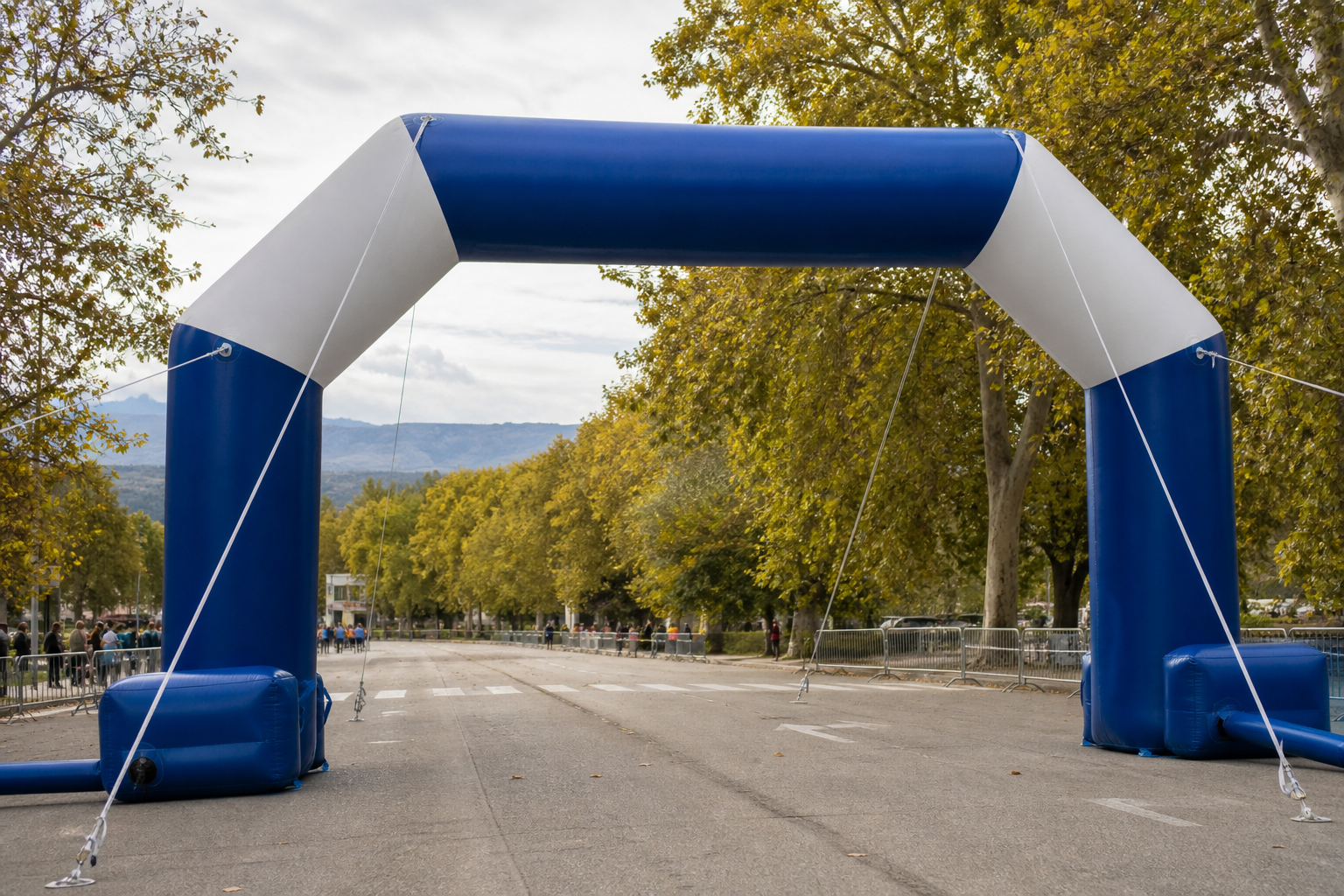
An inflatable arch is a three-dimensional entrance structure with a clear opening. It is specified around overall width, visible height, opening width, blower or air system, anchoring, artwork panels, route clearance, and the way people or vehicles pass through it.
A retractable banner is a portable graphic panel that rolls into a base cassette. It usually occupies less floor space, is easier to position close to a registration desk or booth, and is intended for a controlled viewing distance rather than a large approach or walk-through route.
When is an inflatable arch the better fit?
Choose an inflatable arch when the campaign needs the entrance to become a visible landmark: a race start or finish, festival gateway, trade-show arrival point, outdoor brand activation, sponsor route, or temporary event entrance. The clear opening can be designed around pedestrian or vehicle flow.
An arch is also useful when the buyer wants a repeatable branded gateway that can be seen from farther away than a close-range banner. The trade-off is the need to plan the blower, anchoring, power, venue clearance, weather exposure, packed volume, and installation area.
When is a retractable banner the better fit?
Choose a retractable banner when the priority is a compact graphic panel for an indoor registration area, trade-show booth, meeting point, hallway, retail counter, or other controlled environment. It can be practical when venue rules limit height, floor footprint, noise, power access, or anchoring.
A banner is usually easier to carry and deploy for a small team, but its readable area and viewing distance are more limited. It does not create a walk-through structure, and the message must compete with nearby signs, people, booth walls, and event fixtures.
How should buyers compare setup, venue, and transport?
For an inflatable arch, confirm clear opening, overall height, installation surface, anchor points, blower position, outlet access, cable route, weather plan, public separation, venue clearance, packed volume, and the required setup and deflation routine.
For a retractable banner, confirm finished height and width, base stability, graphic cassette, floor surface, lighting, carrying case, venue move-in rules, and whether the graphic needs to be replaced for future campaigns. Compare the full setup and storage routine, not just the product purchase price.
What does each format need on site?
This is the difference most comparisons skip, and it decides more entrance projects than appearance does. A retractable banner needs nothing: no power, no cable, no ongoing attention. An inflatable arch needs a pump running for the entire time the entrance is live, which means a power source within cable reach of the arch base, a cable route that does not cross a pedestrian path, and someone responsible for it.
That requirement is not a drawback so much as a constraint to check early. A car park entrance with no outlet within reach rules out a mains-powered arch before any discussion of size or artwork. A venue that supplies power at the gate makes the arch straightforward. Establish this at the site-survey stage rather than after the artwork is approved.
Anchoring differs in the same way. A banner is weighted at its base and moves easily. An arch is anchored through fixed points and is not intended to be repositioned once the entrance is set, so its placement has to be right the first time. Both pump classes in regular use accept 110-240 V at 50-60 Hz, so voltage is rarely what blocks an installation; the plug type and the distance to the outlet usually are.
Which format supports sponsor and entrance messaging?
An arch provides visible surfaces across the top and legs, so it can carry a short event name, sponsor marks, directional cue, or campaign color system around a route. The artwork must be mapped to the curved or segmented structure and checked for viewing direction.
A retractable banner provides a flat, close-range reading surface that can support more linear copy, schedules, registration instructions, or a single sponsor message. If the message must be read from a road, across a large approach, or while visitors move through a gateway, an arch may offer the stronger structural fit.
What should be included in a format-comparison RFQ?
State the event type, entrance or booth layout, visitor or vehicle flow, indoor or outdoor use, viewing distance, available footprint, venue restrictions, artwork, quantity, destination, setup labor, reuse plan, and required delivery date.
Ask the supplier to compare the arch and banner against visibility, footprint, power, anchoring, installation, packing, transport, storage, artwork, and replacement needs. A clear site brief allows the recommendation to reflect the event rather than defaulting to one format.
When neither format is the right answer
The comparison assumes the choice is between these two. For some entrances it is not, and it is worth saying so before a budget is committed to either.
An indoor entrance with a low ceiling rules out an arch on clearance grounds and usually makes a banner look undersized against the architecture. A fascia graphic, a printed truss cover or hanging signage does that job better and is not a compromise version of either format.
A permanent installation rules out both. These are temporary structures: an arch needs continuous power and supervision, and a retractable banner is built to be put away. Something permanent belongs in rigid signage, and specifying an inflatable for it is buying the wrong service life.
And an entrance with no power, no anchoring points and no crew is not an arch site whatever the budget says. Recognising that early is cheaper than discovering it on the morning.
What each format costs over a season, not per event
Compared per event, the banner wins almost every time. Compared over a season of repeat use, the comparison changes and the cheaper item is not automatically the cheaper decision.
An arch is a larger single purchase — published arch pricing starts around USD 280.00 per piece FOB Tianjin and runs to USD 680.00 depending on size, material and print, including the standard blower and basic fixing accessories. Against that it carries recurring costs a banner does not: power at every deployment, and a crew large enough to raise and anchor it.
A banner has almost no recurring cost and a shorter effective life in outdoor use. Print on a pull-up banner fades and the mechanism is the part that fails, so the fleet is replaced rather than repaired — which means the per-event saving is partly a deferred purchase rather than an absolute one.
The arithmetic that decides it is events per year. One or two, and the banner is genuinely cheaper. A season of them, and the arch amortises to a number the banner does not obviously beat, especially where the arch also removes the need for several banners at once.
The question to settle before either quotation
Most entrance-format arguments are really arguments about a requirement nobody wrote down, and they resolve quickly once it is stated.
The requirement is usually one of three things. Visibility from a distance, where the honest comparison is scale and the arch wins by a margin that no banner specification closes. Portability by one person, where the comparison is weight and set-up and the banner wins as decisively. Or a physical gateway that participants pass through, which a banner cannot be at all.
Write that requirement down first, then read the two quotations against it. Done in that order the decision is usually obvious and takes minutes. Done in the other order — two quotations first, requirement inferred afterwards — it becomes a price comparison between two things that were never doing the same job.
What each format needs from the crew and the calendar
Format comparisons usually stop at purchase price and visual impact. What actually separates them on the day is labour and time, and those are the costs that repeat at every event.
A retractable banner is a one-person job measured in minutes. It comes out of a case, it stands, and it goes away again the same way. It needs no power, no anchoring and no supervision, which means one person can deploy several of them around a site and then do something else.
An arch is a crew job. It needs unpacking, laying out, connecting to power, inflating, positioning and anchoring, and once it is up it needs someone aware of it for as long as it is standing, because it is a continuous-air structure that deflates when the power stops. Taking it down, drying it if the ground was wet and packing it properly is another block of time at the end of a long day.
That difference compounds across a programme. A roadshow visiting twelve sites is paying the arch's labour twelve times, and the arithmetic that looked marginal on one event does not stay marginal. The same difference is what makes the arch worth it at a single flagship event, where the impact is concentrated and the labour is paid once.
The lead time difference nobody plans for
The two formats are bought on different timescales, and buyers who treat them as interchangeable options discover this at the worst moment.
A printed retractable banner is a short-turnaround print job. Artwork to finished item is fast, and a late change to the design is an inconvenience rather than a crisis.
A custom arch is a manufactured structure. Production runs 7–15 days for standard custom work and 15–25 days for complex or large pieces, counted from final design approval rather than from the enquiry, and freight adds 4–15 working days by express or air or 20–45 days by sea, rail or truck. Approval time sits in front of all of it.
The consequence is that the decision between the formats has a deadline of its own. Past a certain point the arch stops being an option regardless of budget, and continuing to compare them wastes the time still available for the format that can actually be delivered. If the date is close, price the banner and stop.
Verified Specifications
Figures this guide is written against.
Air system specifications
| Pump | Airflow | Pressure | Suits |
|---|---|---|---|
| 650 W electric pump | 1,600–2,000 L/min | 2.0 psi | Smaller spheres, compact displays and short-duration indoor installations |
| 1600 W electric pump | 4,800–5,200 L/min | 4.5 psi | Large-format structures, arches and continuously inflated outdoor displays |
Both pumps cover 110–240 V at 50–60 Hz, so the same air system suits 110 V and 220–240 V markets. Confirm the plug type for the destination country.
Material specifications
| Specification | Typical use | Notes |
|---|---|---|
| Double-layer PVC | General construction for custom advertising inflatables | The default build for most promotional structures. |
| 0.4 mm PVC | Large-format projects | Used on delivered large-format orders. |
| 0.5 / 0.6 / 0.7 mm PVC mesh | Engineered structures | Specified where the structure carries load, spans further, or faces sustained wind exposure. |
Product Buying Guides
More on choosing and ordering custom inflatables.
Air Dancers for Car Dealerships: Buyer's Guide
A practical guide to selecting dealership air dancers by height, roadside visibility, artwork, blower, power, anchoring, operating hours, replacement sleeves, and rollout logistics.
How to Choose the Right Inflatable Arch Size
A buyer guide to choosing clear opening width, visible height, anchoring, blower placement, packing volume, and destination requirements for a custom inflatable arch.
Inflatable Arch vs Air Dancer
A format comparison based on entrance framing, movement, viewing distance, footprint, blower setup, anchoring, and buyer intent.
Event Decor vs Custom Advertising Inflatables
How decorative event elements differ from specification-led custom advertising inflatables used for brand visibility, product recognition, and repeat deployment.
Compare sizes, materials and air systems on the custom advertising inflatable product range page before sending an RFQ.
Buyer FAQ
