
Buyer Guide
Inflatable Air Dancers for Car Dealerships: A Buyer's Guide
Choose an inflatable air dancer for a car dealership by matching the height, sleeve artwork, blower base, power setup, placement, anchoring, operating hours, and storage plan to the actual frontage and campaign. Air dancers are useful when a dealership needs moving roadside visibility, but the purchase decision still depends on clearance, vehicle and pedestrian flow, outlet access, wind exposure, local rules, and whether one unit or a repeatable multi-location rollout is required. Confirm the site and operating assumptions before the production drawing is approved.
By InflatCraft Product Team • Last updated
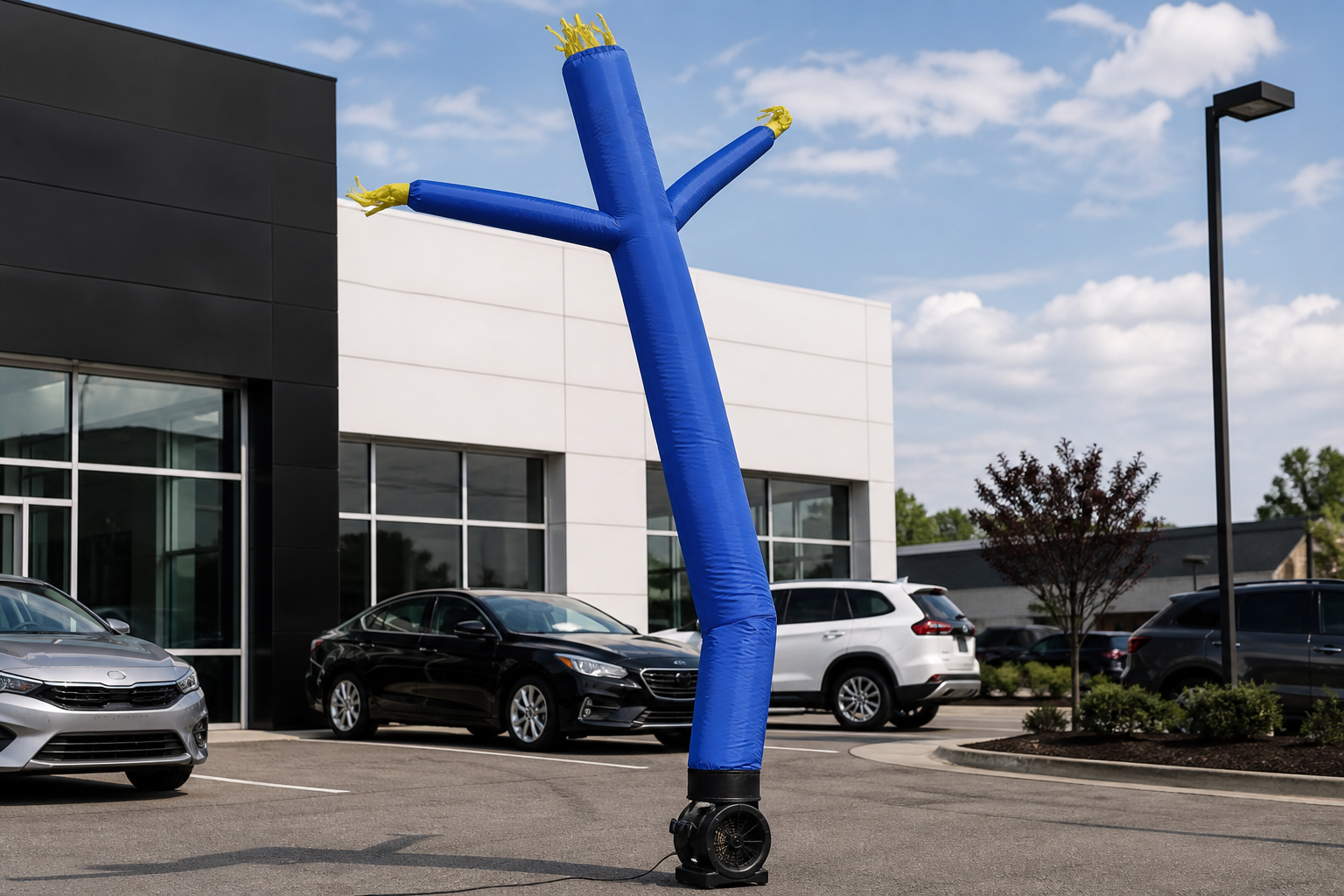
Why do car dealerships use inflatable air dancers?
Dealerships often need a tall moving marker that can be seen from a road, intersection, parking approach, or neighboring retail frontage. An air dancer can identify a promotion zone, store opening, weekend sales event, service campaign, or temporary lot activity without requiring a rigid sign structure.
The format is most useful when movement and distance visibility are more important than a detailed product image. If the campaign needs an exact vehicle replica, a fixed logo sign, or a gateway that visitors pass through, another inflatable format may be a better fit.
How should a buyer choose the size and placement?
Start with the distance from approaching drivers and pedestrians, the dealership frontage, nearby signs, overhead clearance, driveway and vehicle movement, and the position where the blower base can sit safely. The final height should be visible from the intended approach without interfering with traffic sightlines, utility lines, building access, or venue restrictions.
A placement plan should show the base, sleeve, power outlet, cable route, public separation, vehicle path, and anchoring or ballast area. Site photos and a simple marked-up plan are more useful than a height request without context.
What artwork works on a moving dealership sleeve?
Use a clear logo, short message, high-contrast color fields, and a layout that remains recognizable while the sleeve is moving. Provide vector artwork, brand colors, required message hierarchy, preferred viewing direction, and any limits on print coverage before the sleeve layout is approved.
Long copy, small details, and complex graphics can become difficult to read in motion. The production review should separate the information that must be visible at distance from supporting details that belong on a static sign or another campaign asset.
What blower, power, and outdoor-operation details matter?
The quote should match the continuous-air blower base to the sleeve height, operating duration, destination power, and placement. A US dealership should confirm 110–120V availability, plug configuration, outlet location, cable routing, weather exposure, and the daily start-and-stop routine.
Temporary outdoor use requires a site-specific operating plan for surface stability, anchoring, wind, weather, power safety, vehicle and pedestrian separation, and storage. No universal wind rating or weather guarantee should be assumed without project-specific documentation.
Which electric pump should be specified?
A dealership air dancer runs continuously through opening hours, so the pump is not an accessory decision. It sets whether the sleeve stays upright in the wind the forecourt actually gets, and how much power the location draws all day. Two pump classes are in regular use and they are not interchangeable.
The smaller class suits compact displays and shorter indoor runs. The larger class is what sustained outdoor operation on an exposed forecourt calls for: more airflow and roughly twice the pressure, which is what holds a tall sleeve steady rather than letting it sag between gusts. Specify the class against placement and operating hours, not against the unit price.
Both classes accept 110-240 V at 50-60 Hz, which matters for a group operating across markets: the same air system covers a 110 V US forecourt and a 220-240 V location abroad. What still changes by country is the plug type, so confirm it per destination before the rollout ships.
How should a dealership plan a multi-location rollout?
List each location, quantity, height, artwork version, power requirement, placement note, anchoring restriction, required delivery date, and replacement-accessory need. A consistent sleeve design can be repeated across the group, while the base position, outlet, surface, and freight arrangement may differ by site.
Case #4, “Multi-Location Air Dancer Rollout for Auto Dealership Chain,” uses this same planning logic: collect the location and power requirements, confirm artwork and compatible fan bases, group packing and freight, and document the site-specific inputs before production.
What should be included in the RFQ?
Include the campaign objective, site photos, target height, quantity, sleeve colors, logo or message artwork, operating hours, location and surface, power availability, anchoring restrictions, destination, required date, storage expectations, and whether replacement sleeves will be needed.
For a first order, also ask the manufacturer to list the sleeve, blower base, plug, attachment accessories, carry bag, export carton, repair material where applicable, and any assumptions that affect shipping or daily operation.
Verified Specifications
Figures this guide is written against.
Air system specifications
| Pump | Airflow | Pressure | Suits |
|---|---|---|---|
| 650 W electric pump | 1,600–2,000 L/min | 2.0 psi | Smaller spheres, compact displays and short-duration indoor installations |
| 1600 W electric pump | 4,800–5,200 L/min | 4.5 psi | Large-format structures, arches and continuously inflated outdoor displays |
Both pumps cover 110–240 V at 50–60 Hz, so the same air system suits 110 V and 220–240 V markets. Confirm the plug type for the destination country.
Lead time
- Typical: Bulk production typically takes 3–8 days for simple items, 7–15 days for standard custom work and 15–25 days for complex or large pieces, counted from final design approval
- Can be shorter: Repeat orders on an approved design can run shorter
- Freight and import time come on top. Lead time is confirmed per project once artwork, size, quantity and destination are fixed; treat any figure quoted before that as indicative.
Product Buying Guides
More on choosing and ordering custom inflatables.
How to Choose the Right Inflatable Arch Size
A buyer guide to choosing clear opening width, visible height, anchoring, blower placement, packing volume, and destination requirements for a custom inflatable arch.
Inflatable Arch vs Air Dancer
A format comparison based on entrance framing, movement, viewing distance, footprint, blower setup, anchoring, and buyer intent.
Event Decor vs Custom Advertising Inflatables
How decorative event elements differ from specification-led custom advertising inflatables used for brand visibility, product recognition, and repeat deployment.
Square vs Round vs Angled Inflatable Arch Styles
How square, round and angled inflatable arches differ in look, footprint and print space, and which style suits races, entrances and trade shows.
Compare sizes, materials and air systems on the custom advertising inflatable product range page before sending an RFQ.
Relevant Product Pages
Compare specifications before submitting an RFQ.
Related Project Example
Buyer FAQ
