
Buyer Guide
Branded Holiday Inflatables: Adding Logos and Campaign Artwork to Christmas Displays
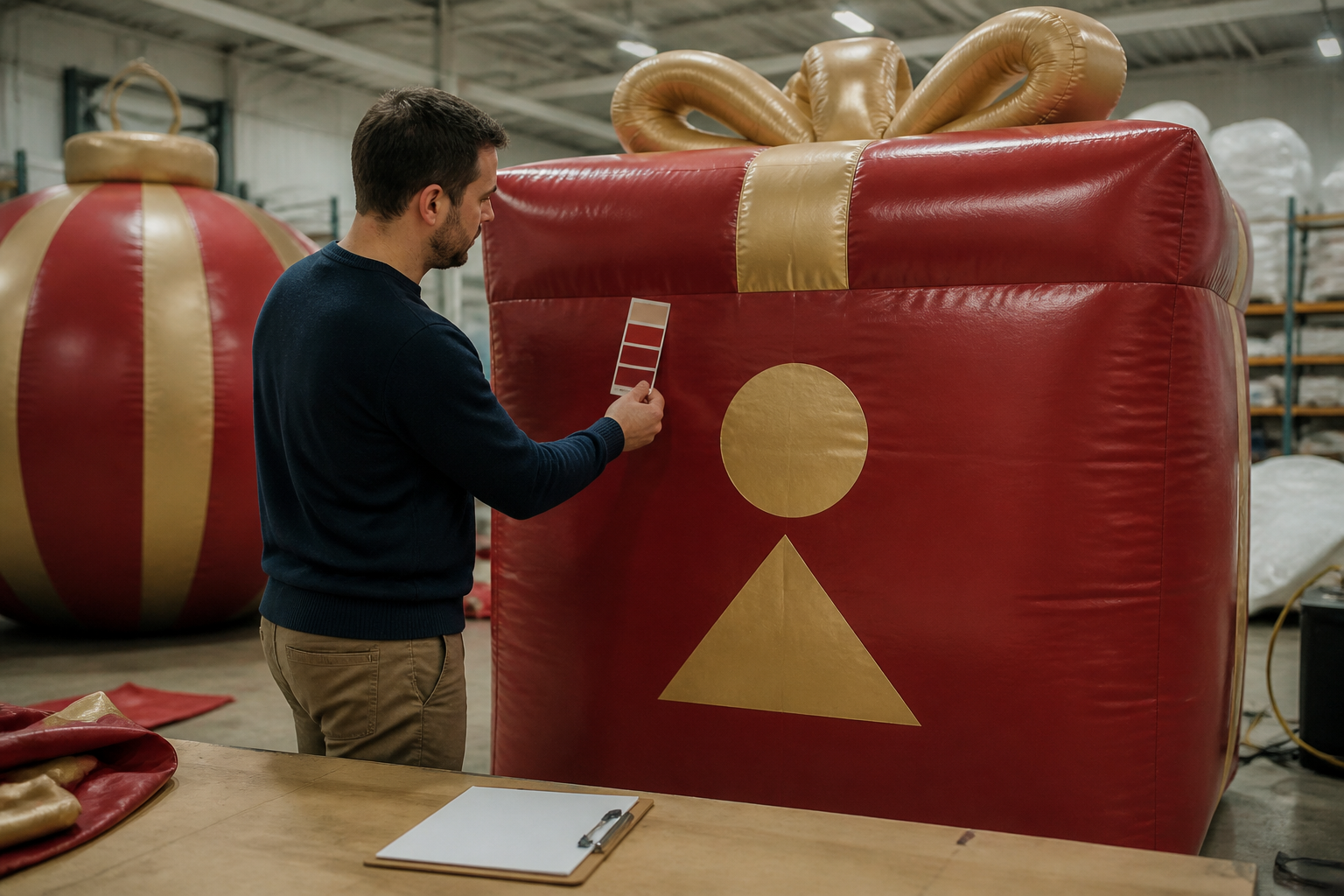
A branded holiday inflatable carries a logo, brand colours or campaign artwork as part of the Christmas design itself, for example on a gift box, Santa's sack, a snow globe base or a tree ornament, rather than on a banner tied on afterwards. To get it right, send vector artwork with Pantone references at the brief stage, decide where the brand should appear before the drawing is made, check placement on a scaled print layout, and approve colour on a printed swatch. Internal lighting can be considered for suitable designs, agreed per project rather than fitted as standard, and lighting changes how printed artwork reads after dark.
By InflatCraft Product Team • Last updated
Why brands put their name on Christmas displays
Holiday displays draw more photographs than almost anything else in a mall, a retail park or a town square. When a brand or venue pays for a centrepiece, it wants some of that attention to stay with its name. A sponsor wants to be visible on the tree it paid for; a mall wants its identity on the gift boxes that appear in thousands of family photos; a brand running a seasonal promotion wants the display to point to its product.
Branding a Christmas inflatable is a balance. Too little and nobody connects the display with the brand; too much and the display stops feeling festive and starts feeling like an advertisement people avoid in their photographs. The best branded displays make the brand part of the Christmas scene rather than a sign placed in front of it.
Where branding fits naturally
Several classic Christmas designs have a natural place for a brand. Gift boxes carry colours and a logo on their faces or ribbon. Santa Claus carries a sack, a belt buckle or a hat band that can hold a mark. Snow globes have a base that reads like a plinth for a name. Oversized ornaments carry a logo on their widest face, and Christmas trees can hold branded ornaments within the design. Nutcrackers and toy soldiers can wear brand colours in their uniforms.
Across the wider range of designs, which includes Santa Claus, reindeer, snowmen, Christmas trees, gift boxes, oversized ornaments, snow globes and nutcrackers and toy soldiers, the same principle holds: put the brand where an object in that scene would naturally carry colour or a label, and keep faces and the main silhouette clean so the display still reads as Christmas first.
Campaign artwork versus a logo
A logo is the simplest form of branding: a mark placed once or twice where the audience will see it. Campaign artwork goes further: a seasonal message, a character from the brand's advertising dressed for Christmas, or a pattern from the season's packaging wrapped around a gift box. Campaign artwork ties the display to what shoppers see elsewhere, but it also changes every year, so decide whether the display should be reusable for several seasons before choosing between a permanent logo and this year's campaign.
If the display is meant to last, keep the permanent parts (the brand colours and logo) built into the design, and ask whether seasonal messages can be carried on elements that are easier to replace.
Artwork files that print well
Send the logo and any campaign artwork as vector files (AI, EPS, SVG or a vector PDF) with Pantone references for every brand colour. A screenshot, a photo of a sign or a low-resolution web image cannot be enlarged to display scale without blurring, and colours picked from a screen will not match the brand's printed colours.
Enlargement also reveals detail that was invisible at small size. Thin outlines, fine taglines, small registration marks and gradients can look different when printed across a large, curved surface. Simplify the artwork for the display where needed, and keep the essential brand elements bold enough to read from the distance people will view the piece.
Placement, curvature and seams
Every inflatable is assembled from flat panels, and its surfaces curve. A logo placed across a seam or over a tight curve can look distorted or broken. Before production, ask for a scaled print layout that shows where the logo sits on the drawing, where the panels join, and how the artwork wraps around curved surfaces. That is the point to move a logo, not after the display arrives.
Think about where the audience will stand. A logo on the side of a gift box nobody walks past, or on the back of Santa facing a wall, does no work. Put the brand on the face that meets people first and in the angle most photographs will be taken from.
Colour accuracy
Brand teams notice colour differences immediately, and Christmas palettes make them obvious: a brand red placed next to a traditional Christmas red can clash if either is slightly off. Approve colour against a printed swatch of the actual display material, and view it in the kind of light the display will stand in, whether that is daylight in a car park or warm indoor lighting in an atrium. The verified material specifications used on InflatCraft projects are listed below this guide.
Branding and lighting
Internal lighting can be considered for suitable designs, agreed per project rather than fitted as standard. Internal lighting changes how printed artwork looks: light passing through the material brightens some colours, darkens others and can make dark logos harder to read after dark. If a branded display will be lit, ask how the artwork will read at night as well as in daylight, and consider placing the logo where it stays legible in both.
Approval and timing
Branded displays add one step to the schedule: the brand team's approval of placement and colour. Allow for it. Bulk production typically takes 3–8 days for simple items, 7–15 days for standard custom work and 15–25 days for complex or large pieces, counted from final design approval, and freight comes on top: express or air usually 4–15 working days; sea, rail or truck usually 20–45 days, after dispatch and subject to route and customs. Artwork revisions happen before production starts, so late changes to a logo move the whole schedule. Send final artwork, with the approver named on the buyer side, as early as possible, and plan backwards from the installation date.
What to send for a quote
Send the Christmas designs you want, where the brand should appear on each, the vector logo and campaign artwork with Pantone references, the target size and space limits, indoor or outdoor use, whether internal lighting is wanted, the quantity, the installation date and the delivery address. MOQ is 1 piece for most custom projects, so a single branded centrepiece can be ordered on its own.
Verified Specifications
Figures this guide is written against.
Material specifications
| Specification | Typical use | Notes |
|---|---|---|
| Double-layer PVC | General construction for custom advertising inflatables | The default build for most promotional structures. |
| 0.4 mm PVC | Large-format projects | Used on delivered large-format orders. |
| 0.5 / 0.6 / 0.7 mm PVC mesh | Engineered structures | Specified where the structure carries load, spans further, or faces sustained wind exposure. |
Lead time
- Typical: Bulk production typically takes 3–8 days for simple items, 7–15 days for standard custom work and 15–25 days for complex or large pieces, counted from final design approval
- Can be shorter: Repeat orders on an approved design can run shorter
- Freight and import time come on top. Lead time is confirmed per project once artwork, size, quantity and destination are fixed; treat any figure quoted before that as indicative.
Seasonal Display Guides
More on Christmas, Halloween and holiday inflatables.
Commercial Christmas Inflatables for Malls and Events
Which Christmas inflatables malls, retailers and events order, sizes buyers ask for, lighting and branding, and how to plan production and freight.
Custom Halloween Inflatables for Brands and Venues
How malls, retailers, attractions and bars use custom Halloween inflatables: designs that work, lighting, branding and realistic timing.
Compare sizes, materials and air systems on the custom shaped holiday inflatables page before sending an RFQ.
Relevant Product Pages
Compare specifications before submitting an RFQ.
Buyer FAQ
Additional specification questions.
Where to order
Order direct from the manufacturer.
Published by InflatCraft, operated by Tianjin Mufeng Trading Co., Ltd., a custom inflatable manufacturer founded in 2005 and based in Tianjin, China. We export to the United States, United Kingdom, Canada, Australia, Germany, France, Spain and Italy.
Request a quote
Send the brief and get a specification-based quotation.
MOQ and lead time
What sets the minimum order and where the time goes.
Sourcing from China
Brief, approval, Incoterms, freight and import, in order.
Verified specifications
Materials, air systems and lead time this site quotes against.
Export planning by country: United States, United Kingdom, Canada, Australia, Germany, France, Spain, Italy.
