
Buyer Guide
Custom Inflatable MOQ Explained: What Buyers Should Know Before Ordering
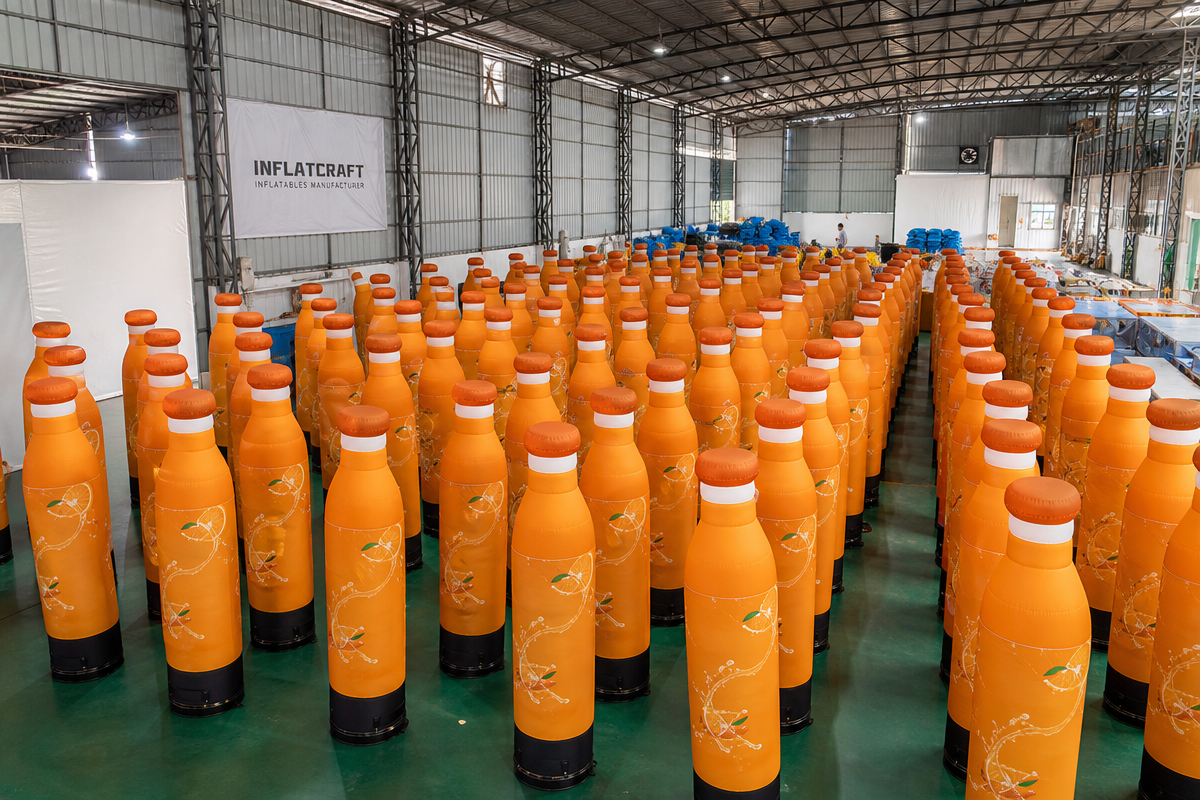
MOQ for a custom advertising inflatable is not one universal number. Many InflatCraft projects can start from 1 piece, while the final minimum is confirmed from the product type, shape, material, printing, accessories, quantity, and packing requirements. A one-off prototype and a multi-unit order may follow different commercial routes, so buyers should provide the intended quantity and specification before assuming that a catalog MOQ applies.
By InflatCraft Product Team • Last updated
What does MOQ mean for a custom inflatable?
MOQ means the minimum quantity that can be quoted or produced under the agreed specification. For made-to-order advertising inflatables, it is a project input rather than a fixed catalog promise.
Many projects can start from 1 piece. The final answer still depends on the approved shape, material, printing, accessories, and quantity.
How do product type and complexity affect MOQ?
A standard inflatable arch, a product replica, and an original custom shape can require different drawing, cutting, printing, and accessory arrangements. Complex geometry or special finishes may require a separate review before quantity is confirmed.
The buyer should distinguish a single display, a repeatable event unit, and a distributed order across locations so the quotation reflects the intended production route.
Which order details should be separated before RFQ?
State the quantity of finished inflatables, whether a sample or approval unit is needed, the required size, artwork status, destination, and required delivery date. Include whether each unit needs its own blower, carry bag, ballast, lighting, or repair material.
This avoids treating a prototype request and a bulk production request as the same commercial requirement.
How should MOQ appear in the quotation?
The quotation should state the confirmed quantity basis, specification assumptions, accessory list, packing route, and whether volume pricing applies. If the project changes shape, material, or quantity, the MOQ should be reviewed again.
This project-specific approach is more reliable than copying a fixed MOQ across all product formats.
When one piece is not the bargain it looks like
A minimum of one piece sounds unambiguously good, and for a genuine one-off it is. But the pattern and the print setup are paid once per design regardless of how many units are made, and on a single piece that fixed work is carried entirely by that piece. The unit price for one is the highest unit price the design will ever have.
That matters when the real requirement is not one. A retailer who orders one display now, likes it, and comes back for four more in the spring pays the setup once on the first order and then pays production four more times, but loses the saving that ordering five together would have produced, and risks a colour shift between the first piece and the later ones because they were printed months apart.
So the question to answer before ordering is not what the minimum is but what the realistic twelve-month quantity is. If that number is five, order five. If it is genuinely one, order one, and do not let anyone talk you into stock you will not use.
When you should not place the order yet at all
A minimum of one makes it easy to order early, and ordering early is not always right. Production is counted from final design approval, so an order placed before the artwork is settled does not start moving. It sits, and the lead time clock starts later than the order date suggests.
The same applies to size. If the venue has not confirmed the opening the piece has to clear, or whether it stands indoors or outdoors, the specification is not fixed and the drawing cannot be approved. An order placed at that point buys a position in a queue and nothing else.
The useful sequence is to settle the constraint that fixes the size, get the artwork to print-ready vector, and then order. Doing it in that order usually delivers earlier than ordering first and resolving afterwards, even though it feels slower.
Why the minimum differs by product type
A single figure across a catalogue is a sign that nobody has looked at the products. The work that has to happen before the first unit differs by format, and that work is what the minimum is really about.
A plain arch in two colours is close to the easy case. The pattern is well understood, the print is simple, and a single piece is genuinely economic. A product replica is the hard case: the shape is derived from a real object, the pattern is drawn for that object, and the panel layout has to be worked out before anything is cut. That drawing time is the same whether one unit or ten follow it.
A character mascot sits somewhere between, and depends almost entirely on how much of the character already exists on paper. A figure with a full turnaround is a manageable job. A figure that exists only as one front view needs the side and the back designed before a pattern is possible, and that design work behaves like setup cost.
The useful question to a supplier is therefore not what the minimum is, but what has to be done once before the first piece, and how much of the quotation is that. The answer tells you how much a second unit would save and whether ordering together is worth waiting for.
What changes on a repeat order
The second order of an approved design is a different commercial proposition from the first, and buyers who plan for that get a better price than buyers who treat every order as new.
The pattern exists and has been proven by a piece that shipped. The print file has been through the process and the colour is known on the actual material. What remains is production and freight. Repeat orders on an approved design can therefore run shorter as well as cheaper.
Two conditions protect that. Keep the approved production drawing and the print file reference on your side, not only on the supplier side, so a repeat is a reference rather than a reconstruction. And raise the repeat before the artwork changes, because a change to the design moves it back towards a new job rather than a rerun.
Reading a high stated minimum
When a supplier quotes a minimum well above one, the figure itself is less informative than the reason behind it, and there are three common reasons that call for three different responses.
Sometimes it reflects genuine setup on a format with heavy pattern work. In that case the minimum is real and the right move is to check whether your twelve-month requirement reaches it.
Sometimes it reflects a production schedule that does not want small jobs. That is a commercial preference rather than a technical limit, and it is worth asking whether a small order is possible at a higher unit price, because often it is.
And sometimes it reflects an intermediary consolidating orders to reach a factory minimum they do not control. That is worth knowing, because it changes who you are actually dealing with and how quickly a specification question can be answered.
The real minimum is time, not units
A one-piece minimum makes the unit count look like the flexible part of the order. In practice the constraint that bites is the calendar, because the setup work that a minimum is meant to spread does not compress no matter how few pieces are ordered.
A single custom piece still needs its pattern developed, its artwork laid out against the panels and its drawing approved before anything is cut. That is why the same lead time bands apply to one piece as to ten: 3–8 days for simple items, 7–15 days for standard custom work and 15–25 days for complex or large pieces, counted from final approval rather than from the enquiry.
Buyers who plan around a unit minimum and ignore the approval clock are the ones who end up paying for air freight. The order of operations that works is to fix the date first, subtract the freight window — 4–15 working days by express or air, 20–45 days by sea, rail or truck — subtract the production band, and then see how much approval time is actually left.
Splitting an order across two runs
Where a minimum genuinely binds, the alternative worth considering is not a smaller order but a split one: a first run of the quantity actually needed now, and a second against the same approved drawing later.
What makes this work is that the setup cost is spent once. The pattern exists, the artwork is laid out, the drawing is approved, and the second run is a rerun rather than a new development. That is why the second order is usually both faster and cheaper per piece than the first, and why it is worth asking at quotation time whether the files will be kept.
What makes it fail is a design that changes between the runs. A revised logo, a different size, a new sponsor panel — any of those turns the second run back into a first one, with the development cost paid again. If a change is likely, it is better to wait and order once.
When the minimum is the wrong question entirely
There is a category of enquiry where the minimum does not matter because the project should not be a custom build at all.
If the piece is needed inside three weeks including freight, if the artwork is not settled, and if the budget is closer to the low end of the seasonal decoration range than to the custom shape range, then the constraint is not the minimum. A stock item bought locally will arrive, and a custom one may not.
The same applies when the quantity is genuinely one and the piece is generic — a plain arch with no branding, a standard tube man in a single colour. Custom manufacture earns its cost when the shape or the print carries something specific. When it does not, the minimum is irrelevant because the whole route is wrong.
What to ask instead of "what is your minimum?"
The question produces a number and very little else, because the number is rarely the constraint that will affect your project.
Ask what the price is at one piece and at the quantity you are actually considering. The gap between those two figures is the setup cost made visible, and it tells you whether ordering more is worth it far better than a stated minimum does.
Ask what happens to the pattern and the artwork files after the run. If they are kept and referenced, a later order is a rerun; if they are not, every order is a first order and the quantity decision has to be made once and for all now.
Ask whether the lead time changes with quantity. Frequently it does not within a normal range, because the approval and setup work dominates — which means the buyer who ordered one to save money and the buyer who ordered ten both waited the same 7–15 days for standard custom work.
And ask what the quotation is valid for. Fifteen days is the normal validity here, and a quantity decision deferred past that is a decision that has to be re-priced rather than simply executed later.
Where the minimum sits against the rest of the decision
Taken on its own the minimum looks like the gating question. Placed next to the other constraints it is usually the least binding of them.
The date binds harder. The production bands run from final approval, and the freight window runs from dispatch, so a project with six weeks in hand has a genuine constraint that no quantity decision relaxes.
The artwork binds harder. Nothing is cut until the layout is approved against the panel pattern, and a design still in revision stops the order regardless of how many pieces it is for.
The specification binds harder still, because it is the thing that determines whether the delivered piece is right. A buyer who negotiated the quantity and left the material, the accessories and the incoterm unstated has optimised the variable that mattered least.
The useful order is therefore: fix the date, settle the specification, approve the artwork, and treat the quantity as the last decision rather than the first. Done that way the minimum almost never turns out to be the obstacle it appeared to be at the start.
Sourcing and Ordering Guides
More on quoting, terms and shipping.
Factory-Direct vs Trading Company: How to Verify
Learn how to tell a real inflatable manufacturer from a trading company before you order — what to ask, what to look for, and why it affects price, communication, and production visibility.
Payment Terms and Deposits for Inflatable Orders
A buyer's guide to how payment terms and deposits typically work when ordering custom inflatable products — what's standard, what varies, and what to confirm before ordering.
How to Brief a Custom Inflatable Manufacturer
A step-by-step checklist for briefing a custom inflatable manufacturer — what information to prepare before you request a quote, from product type to shipping details.
Sample Lead Time vs Bulk Production
How to separate sample approval, production lead time, artwork confirmation, technical review, quantity, and delivery planning.
Compare sizes, materials and air systems on the custom advertising inflatable product range page before sending an RFQ.
Relevant Product Pages
Compare specifications before submitting an RFQ.
Buyer FAQ
