
Buyer Guide
How to Choose a Custom Inflatable Advertising Manufacturer
What this guide covers
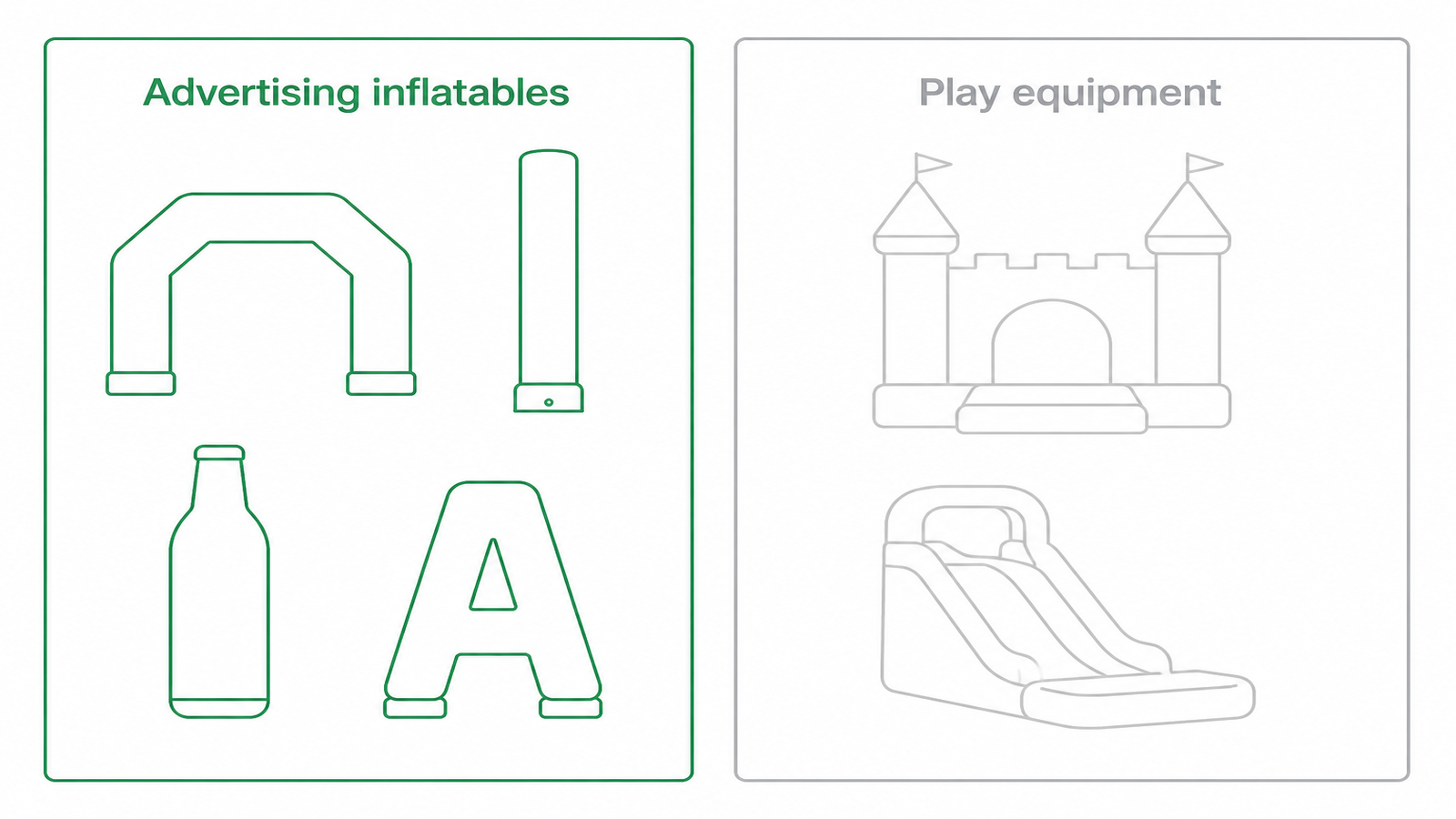
This guide is about inflatable structures built for advertising and brand activation: giant product replicas, arches and entrance tunnels, mascots and character shapes, inflatable letters and signage, tube men and air dancers, and internally lit displays.
It does not cover inflatable play equipment — bounce houses, water slides, obstacle courses. Those are governed by different safety standards, sold to different buyers, and built by a largely separate set of manufacturers.
It is written for people who are specifying and buying: marketing and event agencies, brand-side buyers, sign and display contractors, and event production companies. If you are buying a single decorative inflatable from a retail listing, most of this will not apply to you.
Evaluation criteria
Build-from-scratch capability vs re-skinning stock shapes
Some manufacturers build a new pattern for each project. Others print a customer's artwork onto a shape they already hold a pattern for. Both are legitimate; they produce different results at different price points.
Re-skinning is faster and cheaper, and it works when your shape requirement is generic — a standard arch, a cylinder, a tube man. It does not work when the shape itself carries the brand, as with a scaled replica of a bottle, can or product package.
How to verify: ask whether the shape you want already exists as a pattern in their library, or whether it will be developed for your project. Ask to see a previous build that used a newly developed pattern rather than an existing one.
Material grade and whether it is specified for repeat commercial use
Fabric specification is where the largest quality differences sit, and it is also the least visible in a photograph. Weight, coating and UV treatment determine whether a unit survives one season or several.
Material names alone are not a specification. "Oxford fabric" and "PVC tarpaulin" each cover a wide range.
How to verify: ask for the fabric weight in gsm or the tarpaulin thickness in mm, not just the material name. Ask what the same manufacturer would supply for a single-use versus a repeat-use build, and what the difference costs.
Whether artwork handling is print-ready or reference-only
There is a real difference between a supplier who accepts your logo as a reference image and one who works from print-ready vector files with defined colour targets.
The second kind will ask you for vector artwork, will ask about Pantone references, and will raise problems with your file before production rather than after.
How to verify: send your artwork early and see what comes back. A supplier who accepts a low-resolution logo without comment is telling you something about how the print will be prepared.
Blower specification and what is included with the unit
Continuous-air inflatables need a blower matched to the volume of the unit. An undersized blower produces a display that never fully forms, and the problem only appears on site.
Voltage and plug standard also need to match the destination market, which is easy to overlook when ordering across borders.
How to verify: ask what blower is supplied, at what wattage, and to which voltage standard. Ask whether the blower is included in the quoted price or billed separately.
Anchoring hardware supplied for the intended surface
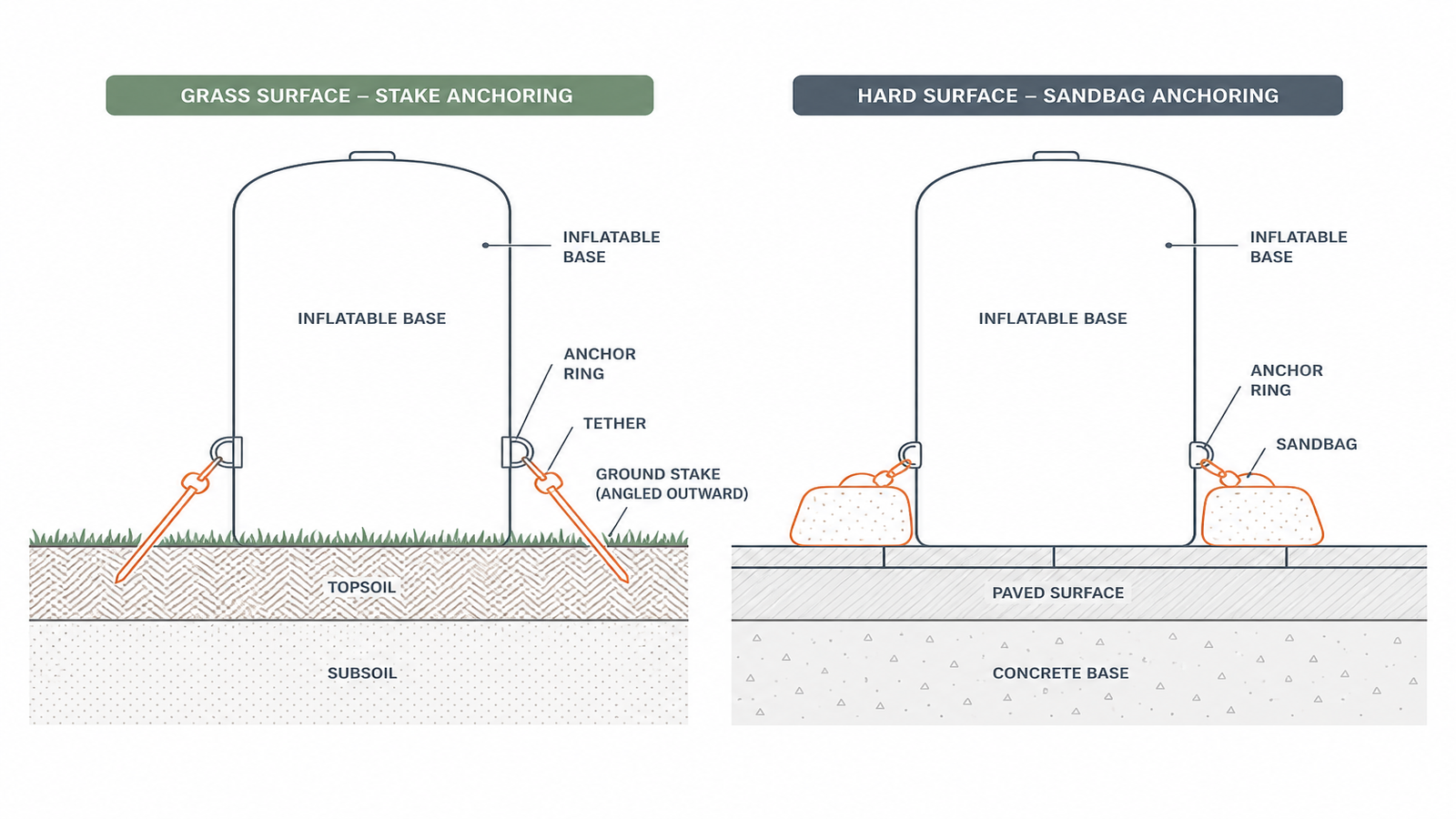
Ground stakes work on grass and soil. They do nothing on tarmac, concrete or an exhibition hall floor, where the unit needs weighted anchoring instead.
Anchoring is frequently the item that gets discovered on the day of the event.
How to verify: tell the supplier what surface the unit will stand on before you order, and confirm in writing what anchoring hardware is included for that surface.
Project scheduling against a fixed event date
Most advertising inflatables exist for a specific date. A manufacturer who works to fixed event dates will schedule backwards from the date — freight, production, artwork approval, and the decision points in between.
A manufacturer who quotes a production time without asking your event date has not begun that calculation.
How to verify: give your event date in the first enquiry and see whether the response addresses it. Ask what the latest artwork approval date is that still meets your date.
Repair and after-sales support for touring or repeat use
Units that travel get scuffed, snagged and worn at seams and contact points. If the same inflatable will be used across a season or a tour, repair provision matters more than the initial build quality.
How to verify: ask what is supplied for field repair, what the process is for a factory repair, and what the warranty covers and excludes.
What a quotation includes and what is billed separately
The most common source of dispute is not price but scope. Blower, repair kit, anchoring hardware, storage bag, freight, duties and any artwork development can each be included or excluded.
How to verify: ask for a line-item quotation rather than a single figure, and ask specifically what is not included.
Manufacturer types
These categories describe different business models, not different quality levels. Each suits a different kind of project, and each has real limitations.
Full-service custom fabricators
Design, engineering and production under one roof, usually with an in-house team that develops patterns for each project. Best suited to complex shapes, structural builds and projects where the shape itself is the brand asset.
Limitations: higher cost, longer lead times, and typically a higher minimum project value. Capacity is finite, so peak season availability can be constrained.
Standardised event structure suppliers
Companies working from a defined product system — modular tents, standard arch profiles, pneumatic structures — with customisation applied through print and accessories.
Limitations: shape flexibility is bounded by the system. Buyers wanting a fully custom form will find the range restrictive.
Overseas manufacturers selling direct
Factories selling directly to overseas buyers, typically via B2B platforms or their own sites. Lower unit cost and direct access to the production floor.
Limitations: total lead time includes international freight, which adds meaningful time to any fixed date. Time zone differences slow the approval cycle. Field repair and warranty handling are harder to arrange at distance, and returning a unit for factory repair is rarely practical. Import duties and customs handling are the buyer's concern unless a landed-cost arrangement is agreed in advance.
Brokers and resellers
Companies that take the brief and place production elsewhere. They can be useful when a project spans multiple product types or when the buyer wants a single point of contact.
Limitations: the buyer is a step removed from the production decisions, and specification questions take longer to answer. Worth establishing early whether production is in-house or placed with a third party.
Manufacturers in this category
This list is not ranked and is not exhaustive. Companies are listed alphabetically. Descriptions are drawn from each company's own published material.
| Company | Based in | Focus |
|---|---|---|
| All-Star Inflatables | United States | Spirit tunnels, mascots, advertising balloons |
| Boulder Blimp | United States | Cold-air inflatables, interactive props, large-scale marketing shapes |
| Cutting Edge Creations | United States | Custom inflatables across advertising and rental categories |
| Glow Inflatables | United Kingdom | Custom inflatables, design through installation and aftercare |
| i2k Inflatables | United States | Custom inflatables for marketing, branding and promotion |
| IDW | — | Mascots, characters, vehicles, archways, interactive inflatables |
| InflatCraft | China | Product replicas, arches, mascots, inflatable letters, LED-lit displays |
| Inflatable Design Group | United States | High-end custom replicas, sports tunnels, activations |
| Inflatable Images | United States | Cold-air inflatables, large mascots, promotional displays |
| Landmark Creations | United States | Custom advertising inflatables, balloons, costumes |
| LookOurWay | United States | Air dancers, product replicas, arches, flags, tents |
| Promotional Design Group | United States | Commercial-grade fire-retardant promotional inflatables |
| Publiair | Netherlands | Inflatable structures for advertising and events |
| Studio Soufflé | International | Artistic custom inflatables, structural domes, product props |
| TMP Inflatables | United States | Custom commercial inflatables for agencies and brand teams |
The following companies are included as examples buyers may encounter during supplier research. Capabilities, warranties, locations and operating status should be verified directly with each company. Inclusion does not imply endorsement or a like-for-like comparison.
Questions to ask before you commit
Each of these can be sent as written.
- Will the shape be built from a new pattern, or printed onto an existing pattern you already hold?
- What is the fabric weight in gsm, or the tarpaulin thickness in mm?
- Is the material UV-treated, and what does that mean for expected outdoor service life?
- Do you require vector artwork, and what happens if my file is raster only?
- Can you work to a Pantone reference, and can I see a physical print swatch before full production?
- What blower is supplied, at what wattage, and to which voltage and plug standard?
- What anchoring hardware is included, and is it appropriate for the surface I have described?
- What is the latest artwork approval date that still meets my event date?
- What is included in the quoted price, and what is billed separately?
- Is production in-house, or placed with a third party?
- What is supplied for field repair, and what is the process for a factory repair?
- What does the warranty cover, and what does it exclude?
- What documentation can you provide for venue approval in my market?
- Can you show me a previous project of comparable size and complexity?
Common failure modes
Fabric lighter than expected. The unit looks correct on arrival but shows wear or translucency after a season. Usually traced to a specification that named a material without naming a weight.
Print fading faster than the fabric. Ink and coating are separate from base material quality. Outdoor units in high-UV markets are the usual case.
Blower undersized for the volume. The display never reaches full form. Discovered on site, and not fixable on site.
Anchoring supplied for the wrong surface. Ground stakes delivered for a concrete forecourt or an exhibition hall. The single most common day-of problem.
Lead time calculated without freight. Production time and total delivery time are different numbers. On cross-border orders the gap can be weeks.
Quotation scope narrower than assumed. Blower, repair kit, storage bag, anchoring and freight each billed separately when the buyer expected an all-in figure.
Artwork approved late. Production cannot begin before approval, so every day spent on artwork revision comes out of the production window, not out of the buffer.
This guide is maintained as a reference for buyers specifying advertising inflatables. Company information is drawn from published sources and may change.