Buyer Guide
Council Approvals and Venue Rules for Inflatables in Australia
Councils, venues and insurers set the rules, and footpaths, streets and public reserves usually need council approval. Where the blower falls under the EESS scheme an Australian responsible supplier registers it and applies the RCM, and venues may specify a fire test such as AS 1530.2 or AS 1530.3. The manufacturer's contribution is product information: a scaled drawing with inflated dimensions and footprint, the material specification, the blower's electrical details, and the anchoring or ballasting arrangement. Ask the council, venue and insurer for their document list before production starts.
By InflatCraft Product Team • Last updated
Three parties, not one code
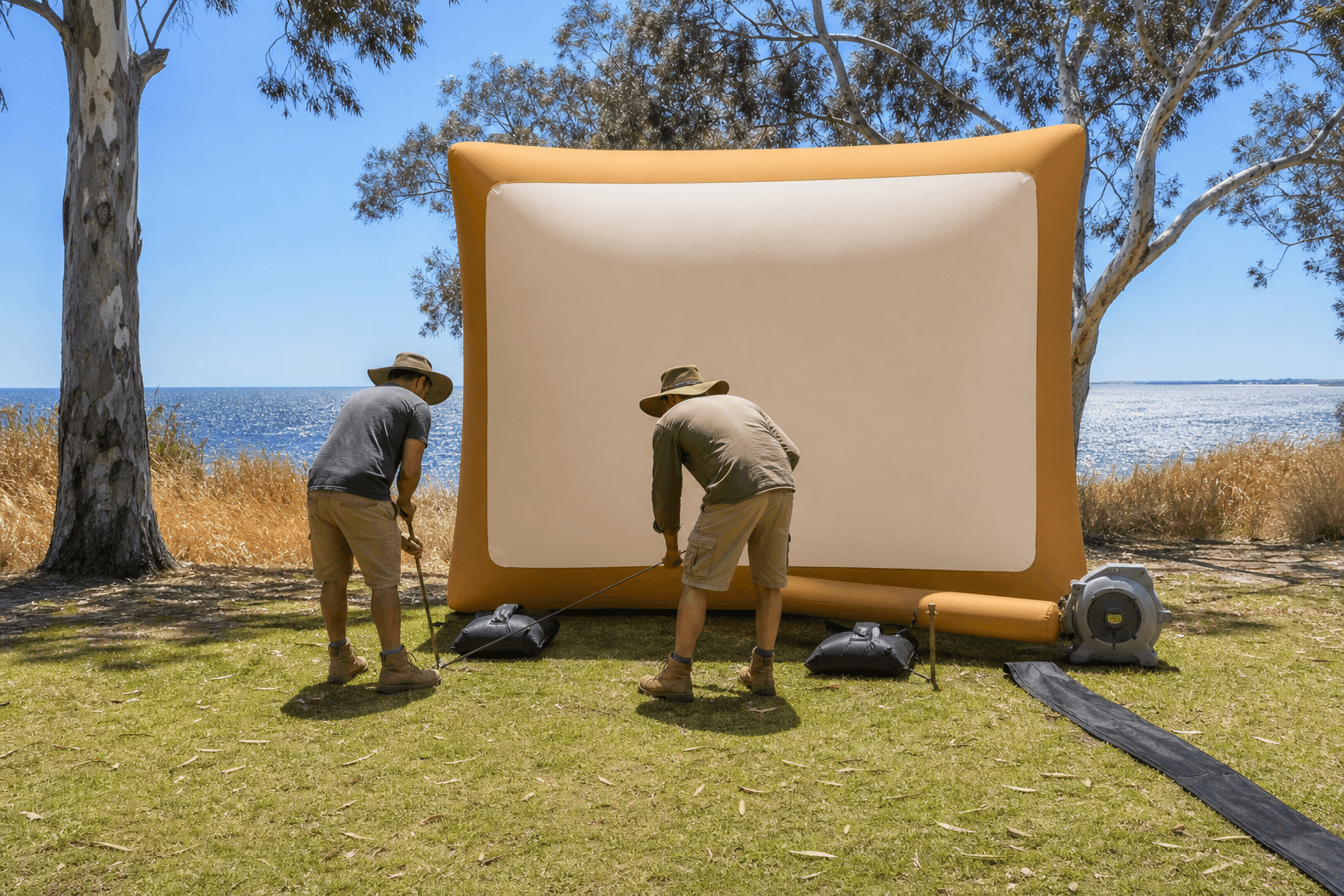
Councils, venues and insurers set the rules, and footpaths, streets and public reserves usually need council approval. Where the blower falls under the EESS scheme an Australian responsible supplier registers it and applies the RCM, and venues may specify a fire test such as AS 1530.2 or AS 1530.3.
The three can ask for different things, so a file that satisfies the venue but not the insurer does not get the piece up. Ask the organiser early which body they are submitting to and what they need from the supplier.
The blower, EESS and the RCM
This is the item that most often needs resolving before the order. Where the blower falls under the EESS scheme, it is an Australian responsible supplier who registers it and applies the RCM — a role on the Australian side, not something a factory applies from abroad.
Raise it at the quotation stage. Both the 650 W electric pump and the 1600 W electric pump run on 110–240 V, 50–60 Hz, and the plug type for the destination is confirmed on the order, but the compliance route for the unit is a separate question with a separate answer.
Fire testing on the fabric
Venues may specify a test such as AS 1530.2 or AS 1530.3. Fire behaviour is a property of the material, so the requirement has to be settled before the material is cut; a standard that arrives mid-production is a rebuild.
Send the venue's wording verbatim rather than paraphrasing it. The test the venue names is the specification.
Sun and UV are a specification input
Coastal and exposed sites can behave very differently from a city square, and summer sun and UV exposure are severe. That is not only a comfort question: sustained UV exposure is a material consideration, and 0.5 / 0.6 / 0.7 mm PVC mesh is used where a structure faces sustained exposure.
Say how long the piece will stand and whether it is shaded. A one-day activation and a season-long installation are different specifications.
What the supplier provides
A scaled drawing with inflated dimensions and footprint, the material specification, the blower's electrical details, and the anchoring arrangement. The permit application, risk assessment and insurance are the organiser's documents.
No fixed wind speed is published for these products, because no tested, model-specific limit exists. The anchoring and shutdown plan is site-specific and agreed with the organiser or the site engineer.
Verified Specifications
Figures this guide is written against.
Material specifications
| Specification | Typical use | Notes |
|---|---|---|
| Double-layer PVC | General construction for custom advertising inflatables | The default build for most promotional structures. |
| 0.4 mm PVC | Large-format projects | Used on delivered large-format orders. |
| 0.5 / 0.6 / 0.7 mm PVC mesh | Engineered structures | Specified where the structure carries load, spans further, or faces sustained wind exposure. |
Air system specifications
| Pump | Airflow | Pressure | Suits |
|---|---|---|---|
| 650 W electric pump | 1,600–2,000 L/min | 2.0 psi | Smaller spheres, compact displays and short-duration indoor installations |
| 1600 W electric pump | 4,800–5,200 L/min | 4.5 psi | Large-format structures, arches and continuously inflated outdoor displays |
Both pumps cover 110–240 V at 50–60 Hz, so the same air system suits 110 V and 220–240 V markets. Confirm the plug type for the destination country.
Sourcing and Ordering Guides
More on quoting, terms and shipping.
Australian Event Calendar and Timeline
Australia Day, the southern summer and Melbourne Cup Day, converted into artwork approval dates — with the reversed seasons built in.
What Affects the Cost of a Custom Inflatable?
A practical guide to the main factors that shape a custom inflatable quote, including material, size, complexity, accessories, artwork, quantity, and shipping.
Custom Inflatable MOQ Explained
How minimum order quantity is reviewed for custom advertising inflatables, including one-off production, material, accessories, packing, and quantity planning.
Factory-Direct vs Trading Company: How to Verify
Learn how to tell a real inflatable manufacturer from a trading company before you order — what to ask, what to look for, and why it affects price, communication, and production visibility.
Compare sizes, materials and air systems on the custom advertising inflatable product range page before sending an RFQ.
Relevant Product Pages
Compare specifications before submitting an RFQ.
Buyer FAQ
Additional specification questions.
Where to order
Order direct from the manufacturer.
Published by InflatCraft, operated by Tianjin Mufeng Trading Co., Ltd., a custom inflatable manufacturer founded in 2005 and based in Tianjin, China. We export to the United States, United Kingdom, Canada, Australia, Germany, France, Spain and Italy.
Request a quote
Send the brief and get a specification-based quotation.
MOQ and lead time
What sets the minimum order and where the time goes.
Sourcing from China
Brief, approval, Incoterms, freight and import, in order.
Verified specifications
Materials, air systems and lead time this site quotes against.
Export planning by country: United States, United Kingdom, Canada, Australia, Germany, France, Spain, Italy.
