Buyer Guide
US Venue and Permit Rules: Who Signs Off an Inflatable Installation
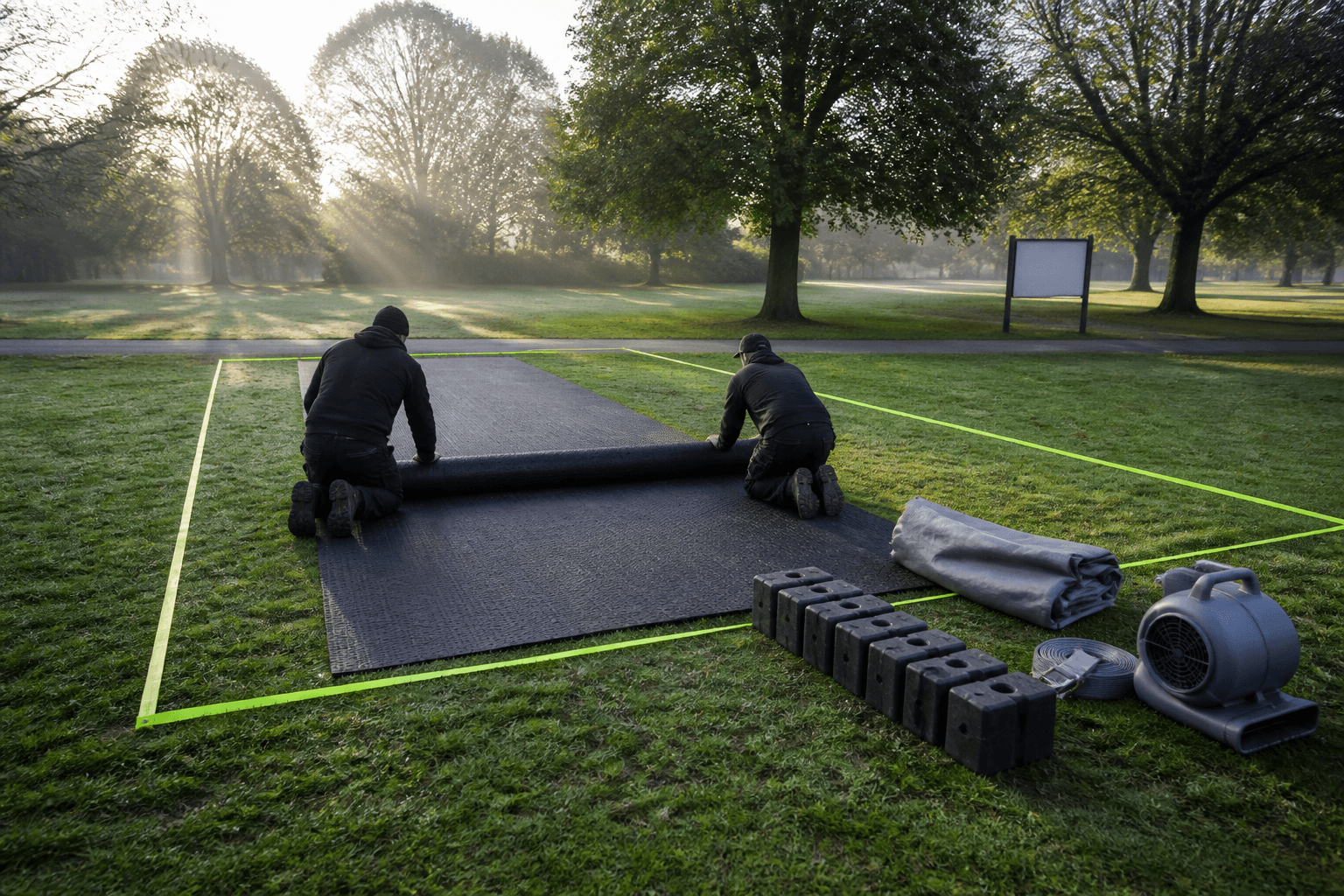
Rules come from the site rather than one national code: venue terms, a local permit for public land, and conditions set by the event insurer. Venues and insurers often ask for a blower listed by a recognised testing laboratory, such as UL or ETL, and for fire documentation on the fabric, commonly NFPA 701. The supplier's part of that file is product information: a scaled drawing with inflated dimensions and footprint, the material specification, the blower's electrical details and how the piece is anchored or ballasted. Ask the venue and the insurer for their document list before production starts, not after.
By InflatCraft Product Team • Last updated
Three parties, not one authority
Rules come from the site rather than one national code: venue terms, a local permit for public land, and conditions set by the event insurer. Venues and insurers often ask for a blower listed by a recognised testing laboratory, such as UL or ETL, and for fire documentation on the fabric, commonly NFPA 701.
That matters because the three can ask for different things. A venue may be satisfied with its own terms, the permit office may care about the public right of way, and the insurer may be the one that asks for a test certificate. A file that satisfies two of the three is not a file that gets the piece up.
The reliable question is always the same: which authority is the organiser submitting to, and what do they need from the supplier? Ask it at the briefing stage, in those words.
The blower is electrical equipment
Venues and insurers often ask for a blower listed by a recognised testing laboratory, such as UL or ETL. That is a question about the unit you are actually shipping, so raise it before the order rather than assuming the answer.
The site's socket decides the lead. Both the 650 W electric pump and the 1600 W electric pump run on 110–240 V, 50–60 Hz, and the plug type for the destination is confirmed on the order.
Fire documentation on the fabric
Fire behaviour is a property of the material, which means it has to be settled before the material is cut, not after the piece exists. A requirement that arrives after production has started is a rebuild, not an amendment.
Send the venue's wording to the supplier verbatim. "Flame retardant" in an email is not a specification; the standard the venue names is.
What the supplier puts in the file
A scaled drawing showing the inflated dimensions and the footprint, the material specification, the blower's electrical details, and the anchoring or ballasting arrangement. Double-layer PVC is the general construction, and 0.5 / 0.6 / 0.7 mm PVC mesh is used where the structure carries load or faces sustained exposure.
What the supplier does not issue is the permit, the risk assessment or the insurance. Those are the organiser's documents, and the product information is what feeds them.
Weather is part of the plan, not an exception
Conditions differ enormously between regions, and the Atlantic hurricane season runs from 1 June to 30 November on the Atlantic and Gulf coasts. An outdoor piece on the Atlantic or Gulf coast in that window is planned with a shutdown and removal procedure agreed in advance, not improvised on the day.
No fixed wind speed is published for these products: no tested, model-specific limit exists. The anchoring plan is site-specific and is approved by the organiser or the site engineer.
Verified Specifications
Figures this guide is written against.
Material specifications
| Specification | Typical use | Notes |
|---|---|---|
| Double-layer PVC | General construction for custom advertising inflatables | The default build for most promotional structures. |
| 0.4 mm PVC | Large-format projects | Used on delivered large-format orders. |
| 0.5 / 0.6 / 0.7 mm PVC mesh | Engineered structures | Specified where the structure carries load, spans further, or faces sustained wind exposure. |
Air system specifications
| Pump | Airflow | Pressure | Suits |
|---|---|---|---|
| 650 W electric pump | 1,600–2,000 L/min | 2.0 psi | Smaller spheres, compact displays and short-duration indoor installations |
| 1600 W electric pump | 4,800–5,200 L/min | 4.5 psi | Large-format structures, arches and continuously inflated outdoor displays |
Both pumps cover 110–240 V at 50–60 Hz, so the same air system suits 110 V and 220–240 V markets. Confirm the plug type for the destination country.
Sourcing and Ordering Guides
More on quoting, terms and shipping.
US Event Calendar and Ordering Timeline
Independence Day, the autumn retail run and the trade show season, turned into artwork approval dates you can put in a project plan.
Importing Custom Inflatables into the UK
What a UK import of a custom inflatable involves: the GB EORI number, the commodity code, 20% import VAT on the landed value, and where the schedule slips.
UK Council Permits and Venue Rules
Who signs off an inflatable in the UK: the council for public land, the venue and the insurer, plus the UKCA or CE question and the fire documentation asked for.
UK Event Calendar and Ordering Timeline
The bank holiday season and the Christmas retail run, converted into artwork approval dates for a UK campaign.
Compare sizes, materials and air systems on the custom advertising inflatable product range page before sending an RFQ.
Relevant Product Pages
Compare specifications before submitting an RFQ.
Buyer FAQ
Additional specification questions.
Where to order
Order direct from the manufacturer.
Published by InflatCraft, operated by Tianjin Mufeng Trading Co., Ltd., a custom inflatable manufacturer founded in 2005 and based in Tianjin, China. We export to the United States, United Kingdom, Canada, Australia, Germany, France, Spain and Italy.
Request a quote
Send the brief and get a specification-based quotation.
MOQ and lead time
What sets the minimum order and where the time goes.
Sourcing from China
Brief, approval, Incoterms, freight and import, in order.
Verified specifications
Materials, air systems and lead time this site quotes against.
Export planning by country: United States, United Kingdom, Canada, Australia, Germany, France, Spain, Italy.
