Buyer Guide
The German Event Calendar and What It Means for Your Order Date
The trade fair calendar and the outdoor season drive demand: the Oktoberfest in Munich runs from the Saturday after 15 September to the first Sunday in October, German Unity Day falls on 3 October, and Christmas markets open from late November. Exhibitor manuals set their own deadlines for technical and material documentation, often well before move-in. Bulk production typically takes 3–8 days for simple items, 7–15 days for standard custom work and 15–25 days for complex or large pieces, counted from final design approval, with freight and customs on top. Working back from German Unity Day on 3 October, that means approving artwork by mid-July for a complex piece shipped by sea, or by mid-August for air freight.
By InflatCraft Product Team • Last updated
The autumn cluster
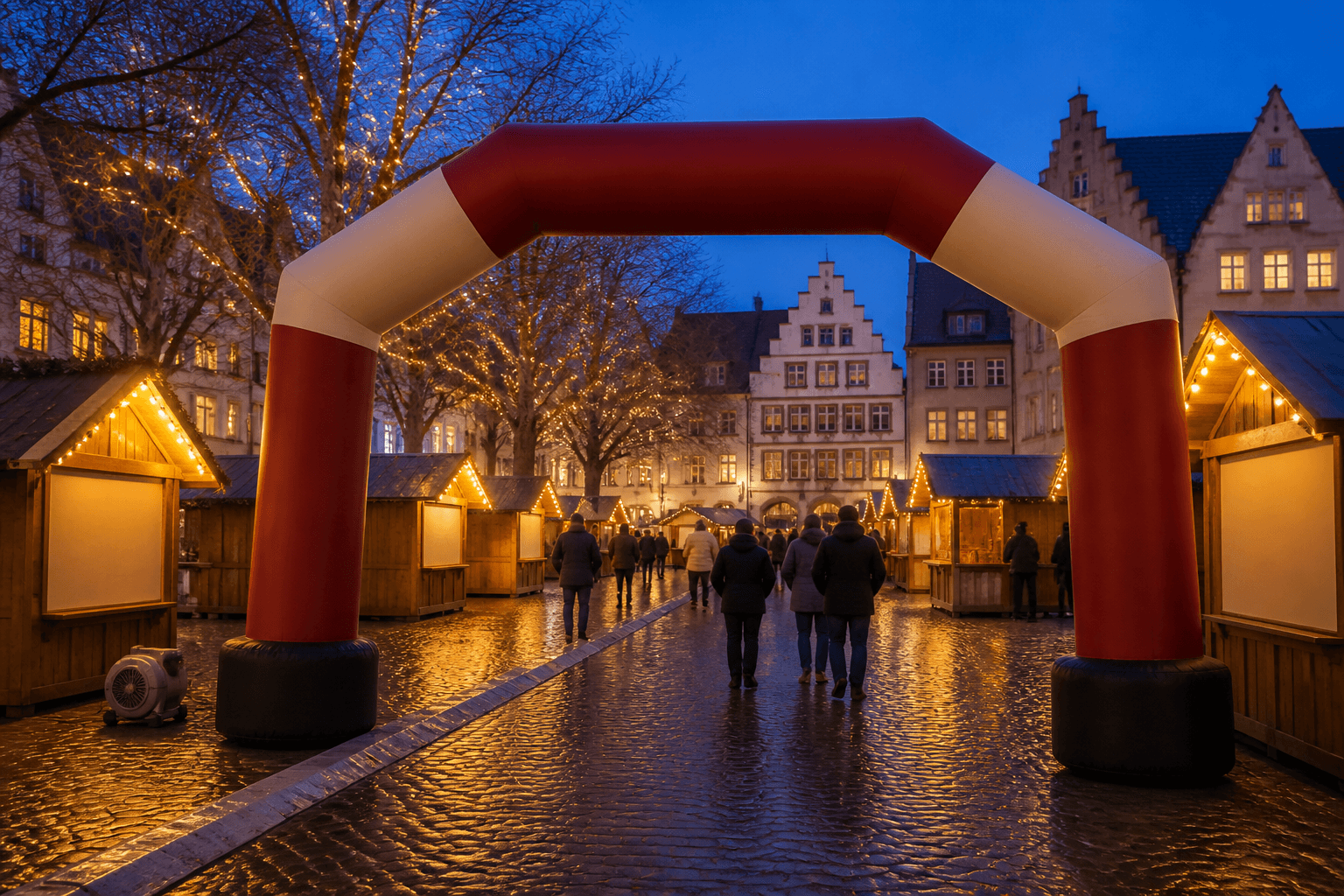
The trade fair calendar and the outdoor season drive demand: the Oktoberfest in Munich runs from the Saturday after 15 September to the first Sunday in October, German Unity Day falls on 3 October, and Christmas markets open from late November. Exhibitor manuals set their own deadlines for technical and material documentation, often well before move-in.
Three peaks land inside a short run: the Munich season, Unity Day, then the Christmas markets. For a retailer that reads as one continuous campaign season; for a supplier it is a capacity crunch, and the brands that get the schedule they want approve early.
The trade fair calendar is the harder deadline
A stand-build project is not governed by the show dates. The exhibitor manual sets the documentation deadline, and it is normally well before move-in — often before the piece would otherwise have been ordered at all.
Read it first. It usually names the fire documentation and the rigging rules, and both can change the build rather than just the paperwork.
Working the dates backwards
Bulk production typically takes 3–8 days for simple items, 7–15 days for standard custom work and 15–25 days for complex or large pieces, counted from final design approval. Freight comes on top: express or air usually 4–15 working days, and sea, rail or truck usually 20–45 days, after dispatch and subject to route and customs Customs clearance is a separate step.
Working back from German Unity Day on 3 October, that means approving artwork by mid-July for a complex piece shipped by sea, or by mid-August for air freight. For a Christmas market opening in late November, the same arithmetic puts approval at the start of September.
Cold and wet is the normal condition
Winter markets and outdoor campaigns run in cold, wet conditions, and an exposed square behaves differently from a sheltered courtyard. An exposed square in December is a different fixing problem from a sheltered courtyard, and the ground surface decides the hardware that ships with the piece.
Say which it is at the briefing stage, because the fixing hardware travels with the order rather than being sourced on site.
What to send so the date is real
The product type, the target size or the constraint that fixes it, the quantity, print-ready artwork with colour references, the destination, indoor or temporary outdoor use, and the on-site date. MOQ is 1 piece for most custom projects, so a first piece can be reviewed before a repeat order.
If the project is for a trade fair, send the exhibitor manual with the brief. It answers questions the supplier would otherwise have to ask twice.
Verified Specifications
Figures this guide is written against.
Lead time
- Typical: Bulk production typically takes 3–8 days for simple items, 7–15 days for standard custom work and 15–25 days for complex or large pieces, counted from final design approval
- Can be shorter: Repeat orders on an approved design can run shorter
- Freight and import time come on top. Lead time is confirmed per project once artwork, size, quantity and destination are fixed; treat any figure quoted before that as indicative.
Sourcing and Ordering Guides
More on quoting, terms and shipping.
Importing Custom Inflatables into France
What a French import involves: an EU-established importer with an EORI number, classification under the EU tariff, and 20% import VAT on top of any duty.
French ERP and Venue Requirements
Who signs off an inflatable installation in France, how the ERP classification changes the question, and the M1 or M2 fire classification venues ask for.
French Event Calendar and Ordering Timeline
The Fête de la Musique, Bastille Day and the August holiday period, converted into artwork approval dates for a French campaign.
Importing Custom Inflatables into Australia
Who lodges the import declaration, how the 10% GST base is worked out, and what a ChAFTA preference needs before it can be claimed.
Compare sizes, materials and air systems on the custom advertising inflatable product range page before sending an RFQ.
Relevant Product Pages
Compare specifications before submitting an RFQ.
Buyer FAQ
Additional specification questions.
Where to order
Order direct from the manufacturer.
Published by InflatCraft, operated by Tianjin Mufeng Trading Co., Ltd., a custom inflatable manufacturer founded in 2005 and based in Tianjin, China. We export to the United States, United Kingdom, Canada, Australia, Germany, France, Spain and Italy.
Request a quote
Send the brief and get a specification-based quotation.
MOQ and lead time
What sets the minimum order and where the time goes.
Sourcing from China
Brief, approval, Incoterms, freight and import, in order.
Verified specifications
Materials, air systems and lead time this site quotes against.
Export planning by country: United States, United Kingdom, Canada, Australia, Germany, France, Spain, Italy.
